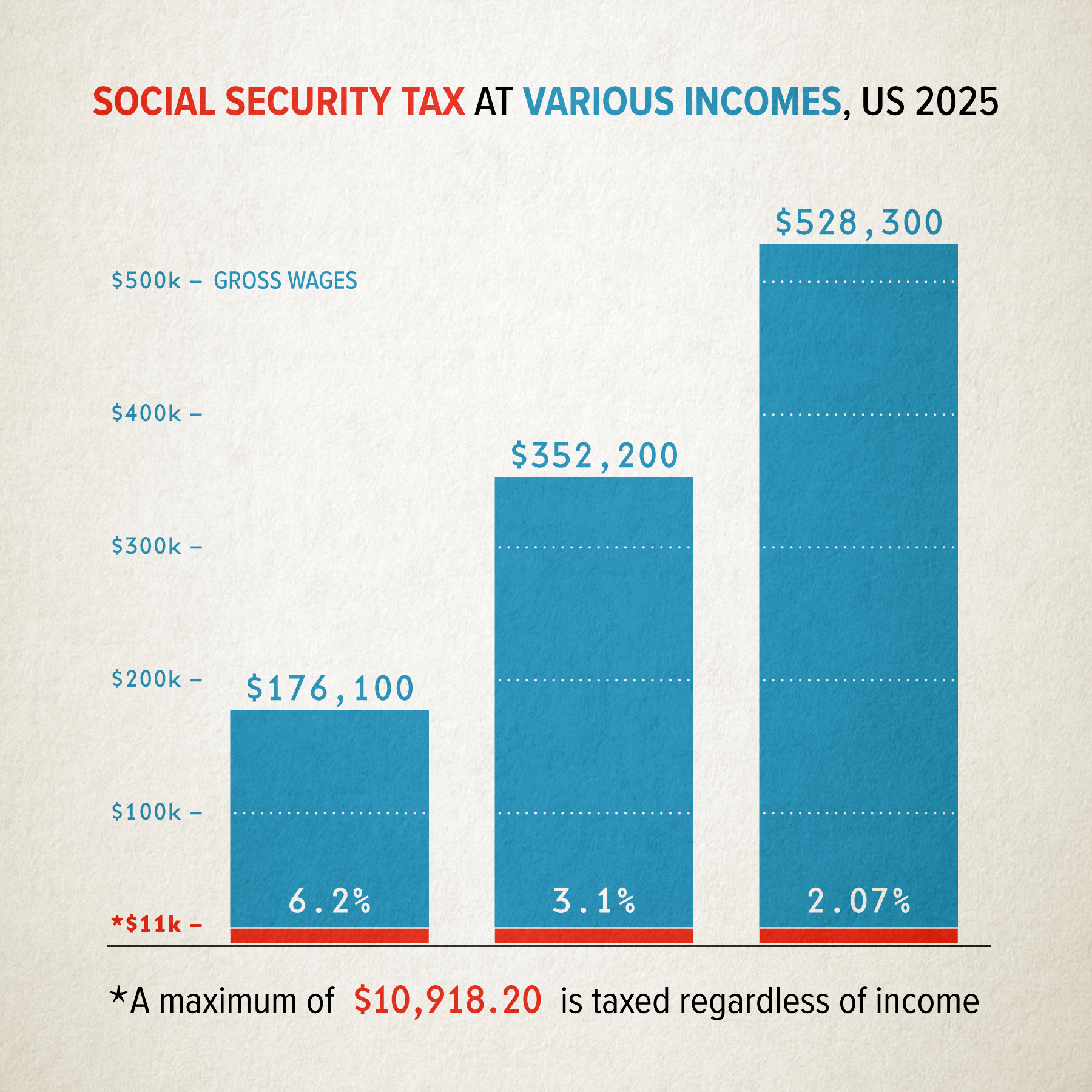
In 2025, the maximum earnings subject to Social Security tax, known as the contribution and benefit base, is $176,100. Both employees and employers are required to contribute 6.2% of wages toward Social Security, resulting in a maximum tax of $10,918.20 each for the year. Self-employed individuals pay a combined rate of 12.4%, leading to a maximum contribution of $21,836.40.
Plotted via SVG device from R, annotated in Adobe Illustrator
So the highest tax is $10,918. The Maximum Benefit at Full Retirement Age (2025): $4,018 per month
Getting rid of the cap on social security taxable income and making it a flat or even a progressive tax would sharply improve the fiscal health of the program while only impacting high income individuals
If you increase the amount taken you sure as fuck better make a corresponding increase to the maximum benefit at retirement.
And this is why my generation is screwed. Either lift the cap or give it all back so I can manage it on my own.
Ok but add income tax.
I feel like things like this a pretty misleading because yes there is a maximum cap on taxing social security
but there’s also a cap on maximum benefit from social security and the gap only widens more and more as you go up the income scale.
This is complete misdirection. The demographic that pays the most taxes (in absolute and relative terms) is high earning W2 income earners. People who have wealth don’t have current income and the focus on W2 income is intentional misdirection to stop people talking about a wealth tax and or means testing SS.
A proportional increase on input should yield a proportional increase on output. That is literally worse… a proportional input won’t get redistributed to an equal output
![[OC] Social Security Tax at Various Incomes](https://www.europesays.com/wp-content/uploads/2025/04/n3c6p92jf3se1-1800x1024.png)
9 comments
In 2025, the maximum earnings subject to Social Security tax, known as the contribution and benefit base, is $176,100. Both employees and employers are required to contribute 6.2% of wages toward Social Security, resulting in a maximum tax of $10,918.20 each for the year. Self-employed individuals pay a combined rate of 12.4%, leading to a maximum contribution of $21,836.40.
Data source: [https://www.ssa.gov/oact/cola/cbb.html](https://www.ssa.gov/oact/cola/cbb.html)
Plotted via SVG device from R, annotated in Adobe Illustrator
So the highest tax is $10,918. The Maximum Benefit at Full Retirement Age (2025): $4,018 per month
Getting rid of the cap on social security taxable income and making it a flat or even a progressive tax would sharply improve the fiscal health of the program while only impacting high income individuals
If you increase the amount taken you sure as fuck better make a corresponding increase to the maximum benefit at retirement.
And this is why my generation is screwed. Either lift the cap or give it all back so I can manage it on my own.
Ok but add income tax.
I feel like things like this a pretty misleading because yes there is a maximum cap on taxing social security
but there’s also a cap on maximum benefit from social security and the gap only widens more and more as you go up the income scale.
This is complete misdirection. The demographic that pays the most taxes (in absolute and relative terms) is high earning W2 income earners. People who have wealth don’t have current income and the focus on W2 income is intentional misdirection to stop people talking about a wealth tax and or means testing SS.
A proportional increase on input should yield a proportional increase on output. That is literally worse… a proportional input won’t get redistributed to an equal output
Comments are closed.