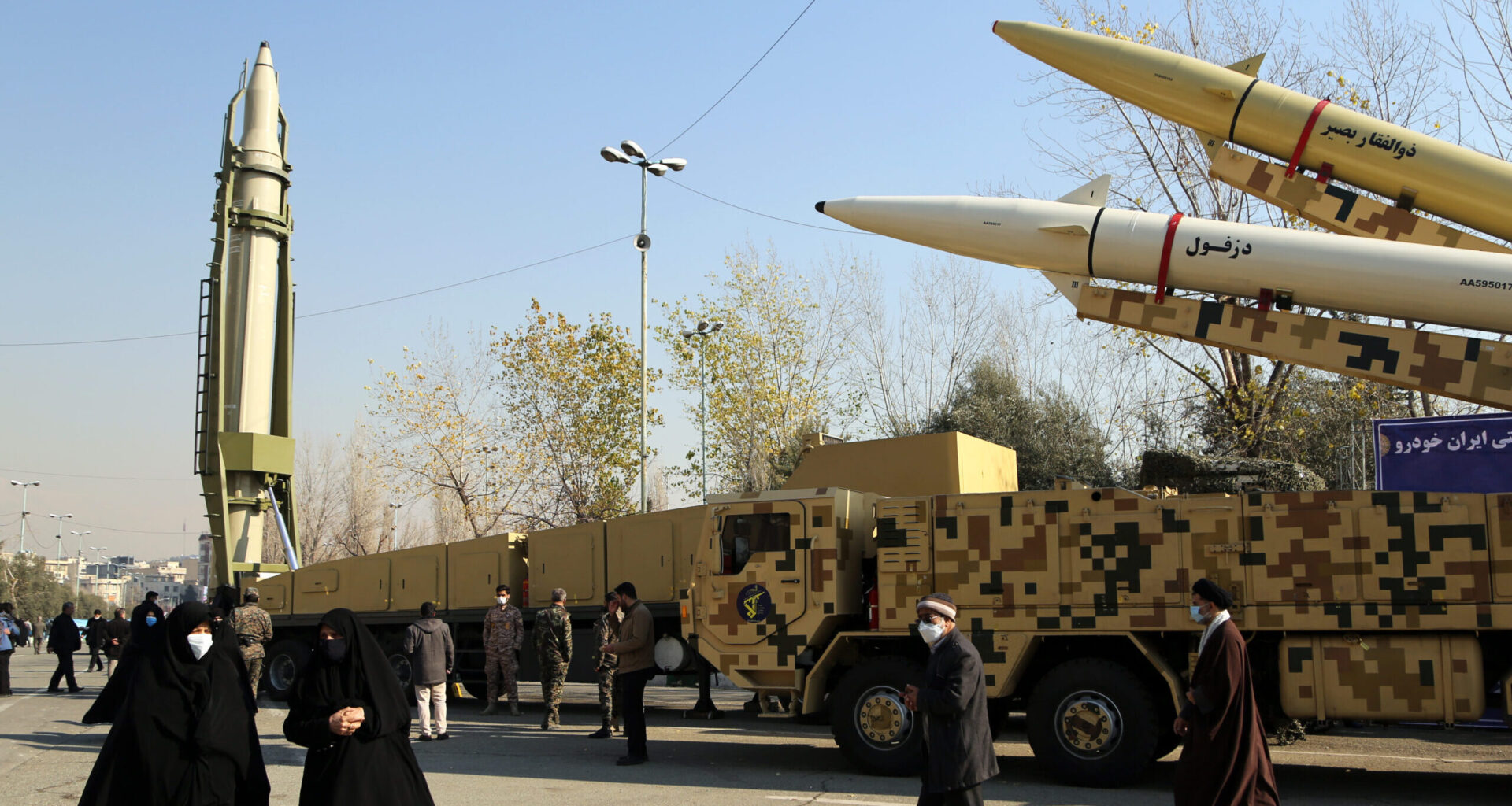
The intelligence community is the eyes and ears of the White House. Presidents only know what it tells them. The most up-to-date intelligence tells President Donald Trump that Iran is not pursuing a nuclear weapon. Yet Trump continues to threaten war unless Iran agrees to give up the nuclear weapons program that Washington knows Tehran does not have.
In March, the new Trump administration received its first Annual Threat Assessment, which compiles insights from the intelligence community. Looking at Iran’s domestic politics, the report says that, “in the past year, there has been an erosion of a decades-long taboo on discussing nuclear weapons in public that has emboldened nuclear weapons advocates within Iran’s decisionmaking apparatus.” If true, this development is hardly surprising, given Iran’s increasing vulnerability. The report notes “the degradation to [Iran’s] proxies and air defenses during the Gaza conflict” and the ouster of Syrian leader Bashar al-Assad, who had been an Iranian ally.
Nonetheless, the report says that the intelligence community “continue[s] to assess Iran is not building a nuclear weapon and that [Ayatollah] Khamenei has not reauthorized the nuclear weapons program he suspended in 2003.”
The findings of the Annual Threat Assessment haven’t had a moderating influence on Trump’s rhetoric, which if anything has become only more bellicose. “If they don’t make a deal, there will be bombing,” he told NBC News Saturday evening. On March 7, a couple weeks before the Assessment was published, the president had told FOX Business, “There are two ways Iran can be handled: militarily, or you make a deal. I would prefer to make a deal, because I’m not looking to hurt Iran.” That same day, Trump told reporters, “We’re down to final strokes with Iran…. Final moments. Can’t let them have a nuclear weapon…. Hopefully we can have a peace deal…. I’m just saying I’d rather see a peace deal than the other, but the other will solve the problem.”
In the FOX Business interview, Trump revealed that he had sent a letter to Khamenei warning that the alternative to diplomacy was war. Barak Ravid of Axios reported that the letter included a two-month deadline for striking a nuclear deal. “[I]f Iran rejects Trump’s outreach and doesn’t negotiate, the chances of U.S. or Israeli military action against Iran’s nuclear facilities would dramatically increase,” Ravid wrote.
Trump’s threats are disproportionate to, and inconsistent with, the latest U.S. intelligence. And the Annual Threat Assessment is not the first report that has informed Washington that Iran likely isn’t pursuing a nuclear weapon.
A series of reports by the International Atomic Energy Agency verified that Iran was completely and consistently in compliance with its commitments under the 2015 Joint Comprehensive Plan of Action (JCPOA)—the Iran nuclear deal—up until the time that Trump pulled out of it in May 2018.
The 2022 U.S. Department of Defense Nuclear Posture Review concluded that “Iran does not today possess a nuclear weapon and we currently believe it is not pursuing one.” In 2023, then-CIA Director William Burns said that “[t]o the best of our knowledge, we don’t believe that the supreme leader in Iran has yet made a decision to resume the weaponization program.” A year later, Burns said, “No, we do not see evidence today that the supreme leader has reversed the decision that he took at the end of 2003 to suspend the weaponization program… We don’t see evidence today that such a decision [to build a bomb] has been made. We watch it very carefully.” As recently as this February, even Trump said that, “There are many people at the top ranks of Iran that do not want to have a nuclear weapon.”
Iran has resisted U.S. coercion to negotiate. In February, Khamenei pointed to America’s not honoring the JCPOA and said, “One must not negotiate with a government like the US government. Negotiations with it is not wise, it is not intelligent, and is not honorable.” The next month, Khamenei explained further, in a post on X, why Iran isn’t willing to negotiate. “This same US president tore up the signed JCPOA agreement. How could we hold negotiations with US when we know they don’t fulfill their commitments?”
Prior to Trump’s threats, Iranian President Masoud Pezeshkian had advocated for direct negotiations with the United States, and Khamenei had supported him. Now Pezeshkian insists that Iran “will not yield to foreign pressure.” Earlier this month, Pezeshkian responded to U.S. threats by saying, “the language of threats and coercion is absolutely unacceptable… It is unacceptable for someone to come along and say, ‘Don’t do this, don’t do that, or else.’ I won’t come to negotiate with you. Go do whatever the hell you want.”
Still, Iran has said that, though direct negotiations with the U.S. are impossible until “there is a change in the other side’s approach towards” Tehran, the “way is open for indirect negotiations.” Last week on Thursday, after Tehran sent its response to Trump’s letter, Iran’s foreign minister reiterated that, “Our policy is still to not engage in direct negotiations while under maximum pressure and military threats, however, as it was the case in the past, indirect negotiations can continue.”
Trump, rather than lowering the rhetorical pressure, responded on Friday with one of his most ominous threats yet. While reiterating that his “big preference is that we work it out with Iran,” he told reporters in the Oval Office that “if we don’t work it out, bad, bad things are going to happen to Iran.” The next day, in the NBC News interview, he elaborated on what the “very bad things” would be, threatening Iran with “bombing the likes of which they have never seen before.”
The open way to indirect negotiations may have recently become much rockier, and not just because of the president’s harsh rhetoric. On CBS’s Face the Nation, National Security Advisor Mike Waltz seemed to say that Iran would have to give up not only the nuclear weapons program that they don’t have but the civilian nuclear program that they do. Waltz said that the U.S. is demanding “full dismantlement.” Iran, Waltz said, “has to give up its program” and stop “enrichment,” seemingly meaning that Tehran must cease enriching uranium even for civilian purposes. “The full program,” he said, “give it up or there will be consequences.” Waltz added that Iran would also have to give up its “strategic missile program.”
Iran is unlikely to negotiate the elimination of its missile program. Especially now, with the degradation of its front-line proxy defense, the missile program is a crucial part of Iran’s defense strategy.
Subscribe Today
Get daily emails in your inbox
They are also unlikely to negotiate the elimination of their civilian nuclear program. Iran is a signatory to the Nuclear Non-Proliferation Treaty (NPT), which declares that “Nothing in this Treaty shall be interpreted as affecting the inalienable right of all the Parties to the Treaty to develop research, production and use of nuclear energy for peaceful purposes.”
It is not clear how threatening Iran with war benefits the U.S. or the world. Iran was in compliance with the Iran nuclear deal that Trump tore up and even today signals some openness to reviving diplomacy. Tehran maintains that it has “never abandoned the negotiating table” and is willing to discuss alleged military aspects of its civilian nuclear energy program. That should be enough, since, according to U.S. intelligence, Iran is not pursuing a nuclear weapons program, and according to the NPT, it has the right to civilian nuclear energy.
Trump campaigned against Forever Wars. In his inaugural address, he said his legacy would “be that of a peacemaker” and that his success would be measured “by the wars that we end – and perhaps more importantly, the wars we never get into.” According to the Annual Threat Assessment, Iran presents no pressing need to break that promise mere months into Trump’s second administration. The president says he wants to sign a deal with Iran, but so far, his extreme threats seem to be making that diplomatic goal more difficult to achieve.