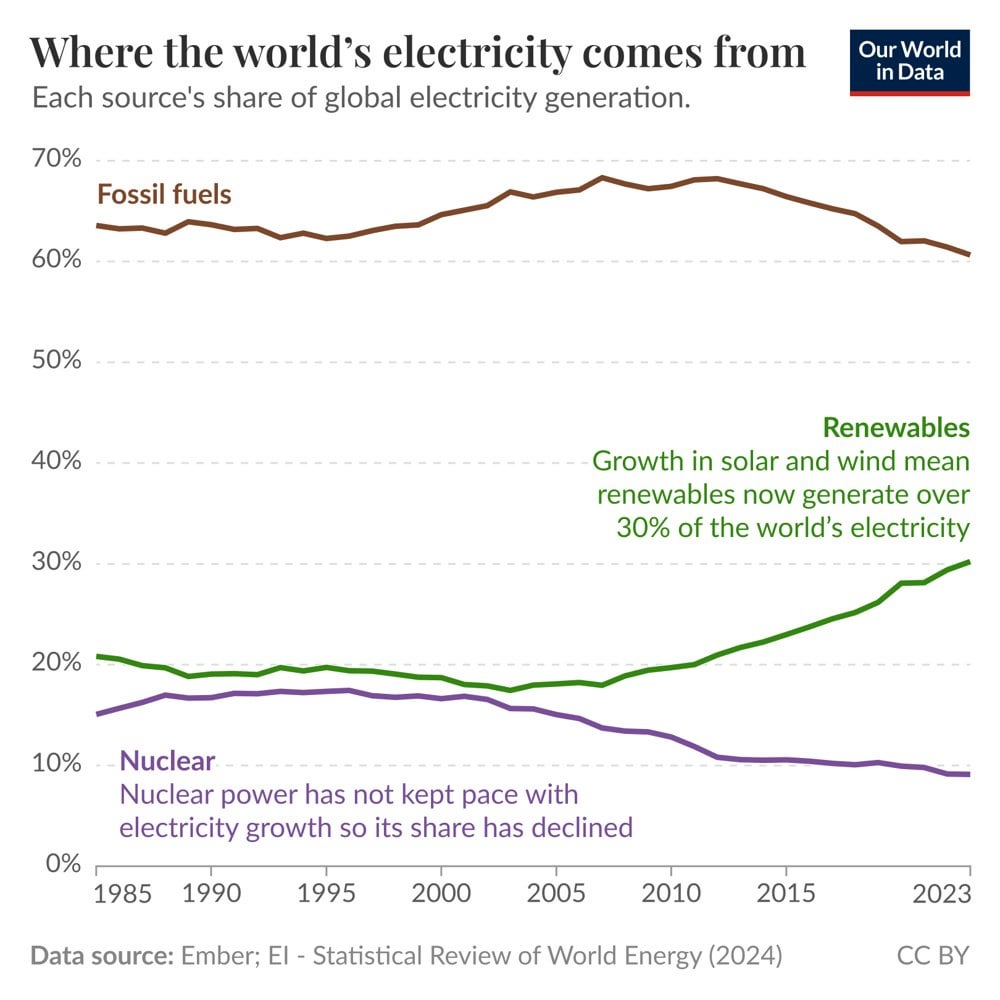
>In the chart, you can see the share of global electricity coming from fossil fuels, renewables, and nuclear since 1985. Since 2000, nuclear and renewables have followed very different trajectories. Back then, both categories made up a similar share of global electricity, but today, renewables make up more than three times as much: 30% compared to 9%.
So we know a lot of the transition to solar and wind has to do with the transition away from nuclear. Fossil fuels still remain heavily in use in a lot of industries and for a lot of developing countries the cost involved in transitioning over to cleaner energy sources is often not there.
If I remember correctly the African Union had a discussion where they announced to the whole world that their efforts in working towards more sustainable solutions was failing as funding for these programs was often inadequate or more often predatory in nature. There have been these large claims of funding that’s available but majority of those are for private non-subsidized loans which most countries cannot afford to take out.
A part of me wonders if that line for fossil fuels will see some slight decreases before stagnating entirely. It’s somewhat disappointing to think about the lack of equity especially as many countries still struggle to keep the lights on.
3 comments
Interesting trend! Do you have a visual representation of the data showing this shift?
quoting the text from the author:
>The world needs to move away from fossil fuels to low-carbon power if we’re to reduce our carbon emissions and tackle climate change.
>There are two key sources of low-carbon power: renewables (which include solar, wind, hydropower and others) and nuclear.
>While rapid growth [in solar and wind](https://ourworldindata.org/explorers/energy?tab=chart&Total+or+Breakdown=Select+a+source&Energy+or+Electricity=Electricity+only&Metric=Share+of+total&Select+a+source=Solar+and+wind&country=~OWID_WRL) has increased the amount of power coming from renewables, a lack of enthusiasm for nuclear means it’s playing a shrinking role in the global electricity mix.
>In the chart, you can see the share of global electricity coming from fossil fuels, renewables, and nuclear since 1985. Since 2000, nuclear and renewables have followed very different trajectories. Back then, both categories made up a similar share of global electricity, but today, renewables make up more than three times as much: 30% compared to 9%.
>The total amount of electricity produced by nuclear plants is [almost exactly the same](https://ourworldindata.org/explorers/energy?tab=chart&Total+or+Breakdown=Select+a+source&Energy+or+Electricity=Electricity+only&Metric=Annual+generation&Select+a+source=Nuclear&country=~OWID_WRL) as it was two decades ago. But because the world produces much more electricity overall, its share of the electricity mix has declined.
>Explore the electricity mix of different countries in our [Energy Data Explorer](https://ourworldindata.org/explorers/energy) →
So we know a lot of the transition to solar and wind has to do with the transition away from nuclear. Fossil fuels still remain heavily in use in a lot of industries and for a lot of developing countries the cost involved in transitioning over to cleaner energy sources is often not there.
If I remember correctly the African Union had a discussion where they announced to the whole world that their efforts in working towards more sustainable solutions was failing as funding for these programs was often inadequate or more often predatory in nature. There have been these large claims of funding that’s available but majority of those are for private non-subsidized loans which most countries cannot afford to take out.
A part of me wonders if that line for fossil fuels will see some slight decreases before stagnating entirely. It’s somewhat disappointing to think about the lack of equity especially as many countries still struggle to keep the lights on.
Comments are closed.