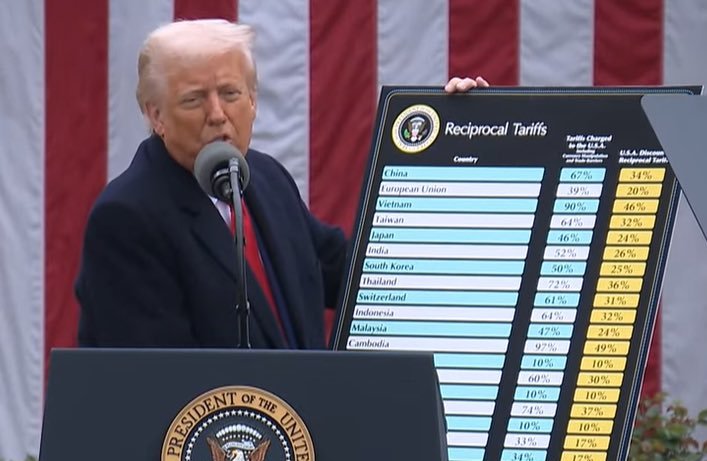
 Donald Trump announced the tariffs outside the White House
In a dramatic shift from decades of US trade policy, president Donald Trump announced sweeping new tariffs on imported goods, sparking fears of a global trade war and sending ripples across economies worldwide, including Malta.
The measures, which include a 10% universal baseline tariff on all foreign imports and targeted “reciprocal tariffs” on specific trading partners, mark one of the most aggressive trade policies in modern American history.
The move has drawn sharp criticism from allies, prompted retaliatory threats from the European Union, and raised questions about its impact on smaller economies like Malta, which relies heavily on niche exports to the US.
In 2023, Malta experienced a trade deficit with the US, importing approximately $329 million worth of goods and services from the US while exporting around $201 million to the US This resulted in a trade deficit of about $128 million for Malta.
While the Maltese government is yet to react, Opposition leader Bernard Grech warned that the newly announced US tariffs “are step back for everyone, hurting consumers and businesses.
In a post on X, formerly Twitter, Grech wrote: “I expect a strong stand by government to defend our consumers and industry. We stand with our EU partners in a united response, seeking negotiated solutions first but ready for a rapid response in kind.”
A new era of protectionism
Trump unveiled the tariffs in a fiery speech on the White House lawn, flanked by towering US flags and a crowd of union workers.
Framing the policy as a long-overdue correction to America’s “looted, pillaged, and raped” economy, he declared 5 April a day of “liberation” from unfair trade practices.
The 10% universal tariff, effective immediately, will apply to all imports, while reciprocal tariffs- ranging from 10% to 34% – will target countries Trump accuses of exploiting the US, including China (34%), the EU (20%), and the UK (10%). Canada and Mexico were granted exemptions due to existing trade agreements.
The policy fulfills a campaign promise but risks destabilizing global markets. Trump argued that the tariffs would revive US manufacturing, counter currency manipulation, and pressure trading partners to crack down on migration and drug trafficking.
Yet economists warn of unintended consequences: higher consumer prices, supply chain disruptions, and potential recessionary pressures. Goldman Sachs and J.P. Morgan have already revised growth forecasts downward, citing heightened uncertainty.
Malta – US trade
For Malta, the tariffs introduce new challenges in a trade relationship that has seen gradual shifts. In 2023, Malta exported $201 million worth of goods to the US, led by integrated circuits ($79.2 million), low-voltage protection equipment ($12.3 million), and refined petroleum ($10.6 million).
However, these exports have declined at an annualised rate of 1.06% since 2018, reflecting broader trends of Malta’s niche but shrinking footprint in the US market.
On the other hand, US exports to Malta have grown steadily, reaching $329 million in 2023—a 1.99% annual increase since 2018.
These exports are dominated by aircraft parts ($128 million), iron pipes ($55.4 million), and petroleum gas ($28.4 million). The US also dominates services trade, exporting $205 million in financial and tech services to Malta in 2017, compared to Malta’s $6.85 million in travel services to the US.
Trump’s tariffs could exacerbate this imbalance. While Malta’s integrated circuits – a critical export – may face the 20% tariff imposed on the EU, the broader impact hinges on EU-wide retaliation. As an EU member, Malta adheres to the bloc’s Common External Tariff, meaning its response will be coordinated with Brussels.
The European Union has condemned Trump’s tariffs as “unjustified” and vowed swift retaliation. European Commission President Ursula von der Leyen warned of a “strong plan” to counter US measures, likely targeting politically sensitive American exports like bourbon, motorcycles, and agricultural goods. This escalation mirrors past trade spats, such as the EU’s 2018 retaliatory tariffs on $3.3 billion of US goods following Trump’s steel and aluminium levies.
Von der Leyen said it was a major blow to the world economy and the consequences “will be dire for millions of people.” Groceries, transport and medicines will cost more, she said, “and this is hurting, in particular, the most vulnerable citizens.”
However, Von der Leyen acknowledged that the world trading system has “serious deficiencies” and said the EU was ready to negotiate with the US but was also prepared to respond with countermeasures.
For Malta, the EU’s collective response offers some insulation but no immunity. The island’s exporters could face indirect fallout if US tariffs dampen demand or disrupt supply chains. Moreover, Malta’s declining exports to the US suggest vulnerability to further erosion. Industry analysts urge Maltese businesses to diversify markets and lobby for EU safeguards, particularly for high-value sectors like electronics and pharmaceuticals.
The tariffs have already strained US relations with key allies. Canadian Prime Minister Mark Carney lambasted the measures as “economic aggression,” while China accused the US of “bullying.” Even domestically, the policy faces skepticism: only 28% of Americans in a recent Marquette Law School poll believed tariffs benefit the economy.