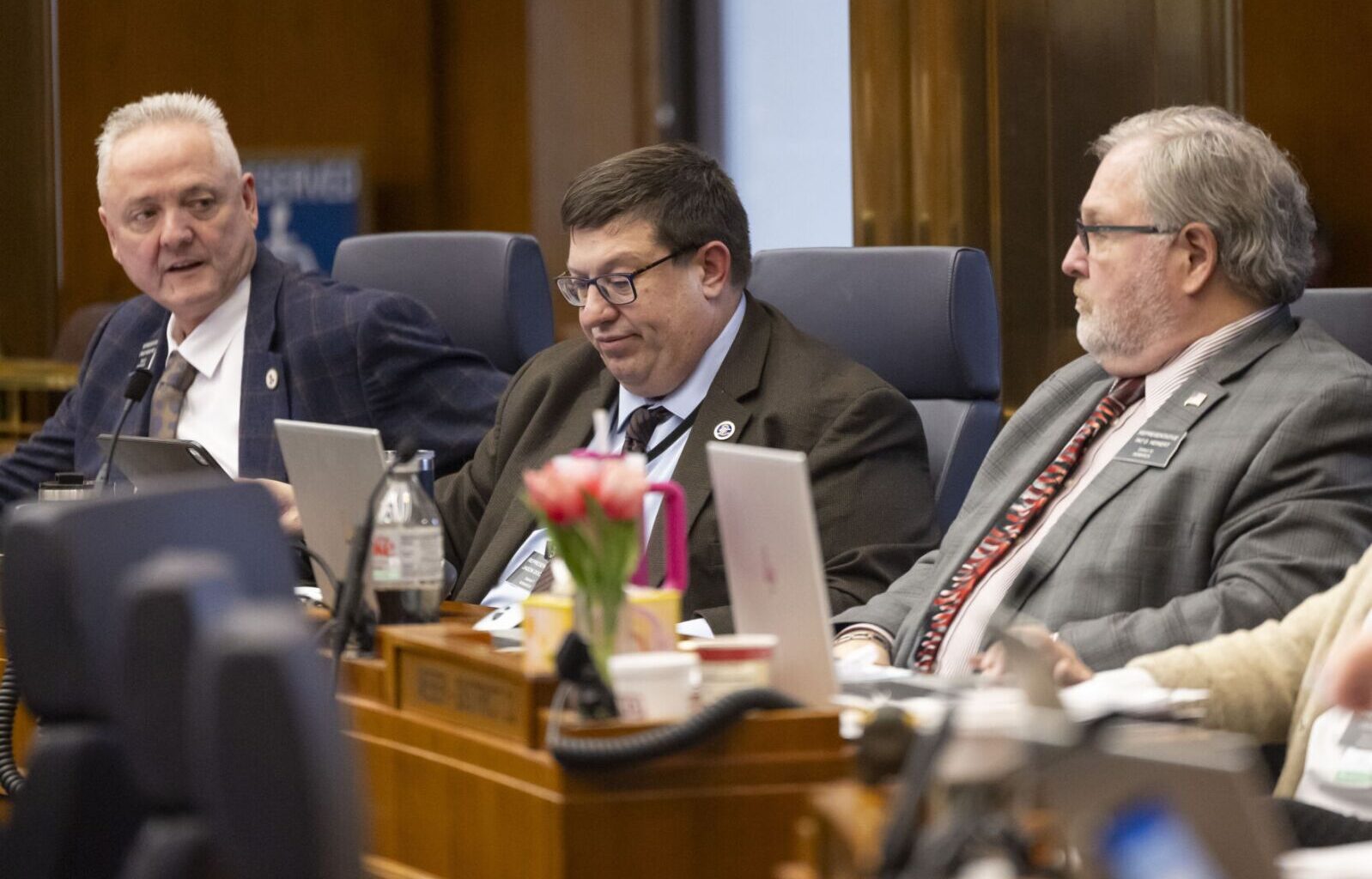
BISMARCK — A bill that would allow North Dakota’s State Energy Research Center to work on projects that could result in nuclear waste disposal has passed the state House, with amendments that aim to limit the potential disposal to above-ground facilities and require state approval before the research is done.
But some House members who voted against the bill expressed concern that the law, which alters a state statute completely preventing this kind of research, opens the door for unintended consequences that could also ultimately lead to a backlash against nuclear power in the state.
was introduced in conjunction with
which funds a study on “advanced nuclear power’s” potential in North Dakota. “Advanced nuclear” refers to myriad, less-used nuclear power technologies that backers say could make the fuel cheaper and less wasteful.
SB 2159 got a vote of 57-32-5 in the House on Wednesday.
The University of North Dakota’s Energy and Environmental Research Center, or EERC, is the designated State Energy Research Center, or SERC.
SB 2159 originally struck a line from the law governing SERC that prevents it from doing research that could lead to the storage of nuclear waste — practically all nuclear power creates toxic waste, and some new technologies could recycle that waste, but the deployment of that technology is far off. A lobbyist for the EERC said the prohibition in the law would prevent it from participating in the study prompted by HB 1025.
SB 2159 passed through the North Dakota Senate 45-2, but opposition picked up in the House from three northern North Dakota farmers and an environmental group.
Two of those farmers were from a community that fought to get the law and other regulations around radioactive waste in place about a decade ago after a drilling project was proposed for rural Pierce County, home to Rugby. The federal Energy Department had planned to drill boreholes that would have assessed the stability of the subsurface, including as a potential location for spent nuclear fuel. Pushback prevented it and led to the language on the books.
Among their worries was that these types of studies could eventually lead to Pierce County becoming a destination for permanent nuclear waste storage. A prohibition on high-level radioactive waste disposal exists in state law, but the federal government can override that.
There is no permanent storage option for nuclear waste in the United States. For decades, federal officials tried to permit Yucca Mountain in Nevada for permanent storage, but that effort is effectively dead in the water.
For now, spent fuel is stored in temporary pools or casks near power plants. Nuclear power makes up about 20% of U.S. electricity. Development has stalled in recent decades because it is so expensive, but a broad effort is underway to get more nuclear power on the grid because it is carbon-free and can be called on around the clock.
After the farmers testified, the House Energy and Natural Resources Committee amended the bill. Instead of removing the clause that prevents the State Energy Research Center from engaging in projects that could result in nuclear waste disposal, the bill changes the language to require researchers get approval from the Industrial Commission — a regulatory body made up of the governor, attorney general and agricultural commissioner — and consult with the High-level Radioactive Waste Council that was formed after the Pierce County incident.
The amendment also specifies the waste storage that could occur as a result of an Industrial Commission-approved study or project would only be above-ground storage.
House Energy and Natural Resources Committee Chair Todd Porter, R-Mandan, who supported the bill, said if a nuclear power plant came to North Dakota, federal regulations would require it to have facilities for waste storage, so any state plant would have to consider what it would do with waste.
Mirek Petrovic, the agriculture community representative on the High-level Radioactive Waste Council and one of the farmers who testified against the bill last month, told The Bismarck Tribune before the vote that the amendment was an improvement from what was originally proposed, but he still preferred to see the bill fail.
When the bill came up for a vote on the House floor, Rep. Jared Hendrix, R-West Fargo, expressed concern that though the amendments included safeguards, the bill would still remove the broader prohibition on research projects that could lead to underground storage, potentially opening up the possibility of the SERC researching it since it would not be explicitly banned.
Hendrix said he supports nuclear power, but the SERC language should be revisited after the study required by HB 1025 is complete.
“If we fail to do this right, we could turn public opinion against nuclear power,” he said.
State Rep. Jon Nelson, R-Rugby, who represents the area where the borehole controversy took place, spoke in favor of the bill, saying it would allow a study of nuclear power while protecting residents from living near a permanent storage location.
“Not only did I support the original prohibition, I wrote it. It was my bill that we passed in 2017. … I don’t disagree with many of the concerns from the other section in this chamber, but this is a different matter,” he said.