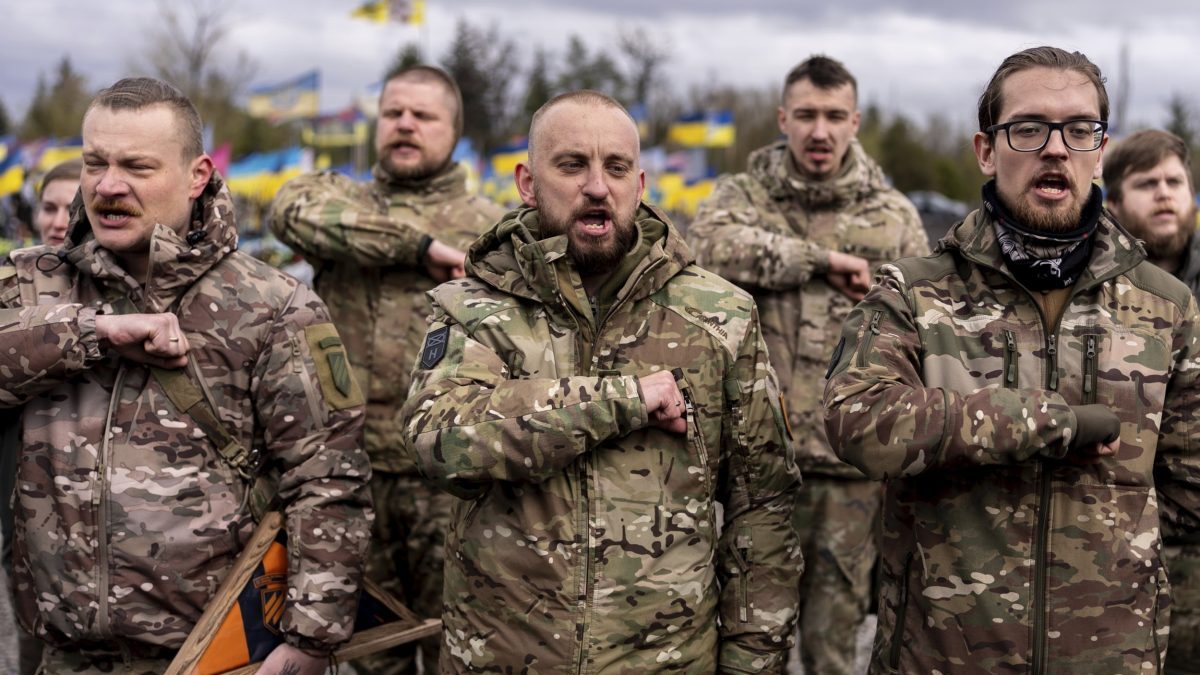
Ukraine accused Russia of stonewalling truce negotiations by presenting a list of delaying conditions and demands
Negotiations are still ongoing to reach a full truce agreement with Ukraine and Russia, after both Brussels and the White House admitted Kremlin leaders are dragging their feet on proposals to end the three-year war.
As the US sought to hash out the terms of a peace deal between Kyiv and Moscow, Ukraine accused Russia of stonewalling negotiations by presenting a list of delaying conditions and demands.
Russia has already rejected an American-backed proposal for a 30-day unconditional ceasefire and appears to be reneging on a more limited truce in the Black Sea, which had been agreed last month.
Russian forces hold the advantage in Ukraine, and Kyiv has warned Moscow is planning a fresh spring offensive to ramp up pressure on its foe and improve its negotiating position.
Ukraine has endorsed a broader US ceasefire proposal, but Russia has effectively blocked it by imposing far-reaching conditions.
Specifics of any peace deal have not been published in full, but admissions from key officials and leaked reports have suggested any agreement would have major implications for Ukraine, its territory, and its natural resources.
Ukraine could be partitioned ‘like Berlin post-Second World War’
Trump’s envoy to Kyiv, General Keith Kellogg, suggested Ukraine could be partitioned like Berlin after the Second World War. This would split Ukraine into zones of control, with British and French troops as part of a “reassurance force” in the west and Moscow’s forces in the east.
Between them would be Ukrainian forces and a demilitarised zone. The US would not provide any ground forces, Kellogg claimed.
“You could almost make it look like what happened with Berlin after World War Two, when you had a Russian zone, a French zone and a British zone,” the White House official said in an interview with The Times.
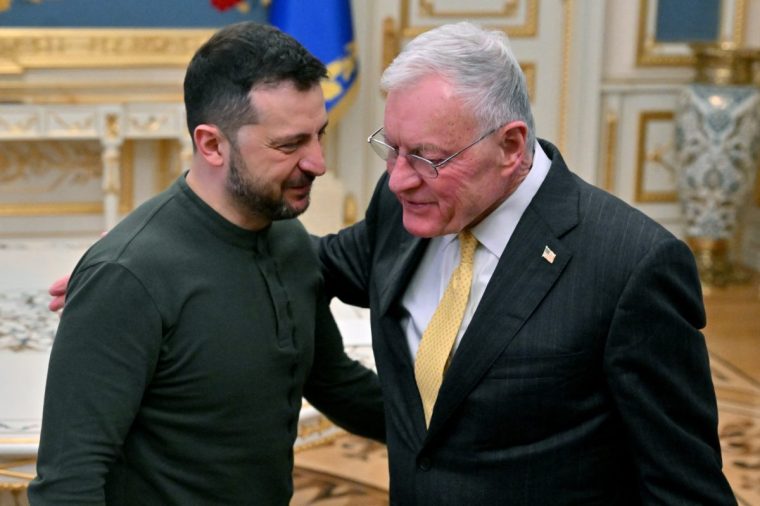 Volodymyr Zelensky greets US envoy Keith Kellogg at his offices in Kyiv in February (Photo: Sergei Supinsky/AFP)
The remarks may cause consternation in Kyiv, which unlike Nazi Germany has a functioning government.
Sergey Lavrov, the Russian foreign secretary, stressed last month that the Kremlin would not accept peacekeeping troops from any Nato country “under any conditions”.
But Kellogg said the British and French-led peacekeeping forces to the west of the Dnipro river, which bisects Ukraine from north to south and runs through Kyiv, would “not be provocative at all” to Moscow.
The general insisted that Ukraine was a big enough country to accommodate several armies seeking to enforce a ceasefire.
Kellogg also proposed that a demilitarised zone of 18 miles could be implemented along the existing lines of control in the east.
US demands pipeline control
The US and Ukraine are also still locked in discussions over a minerals deal, which Trump is insisting upon for Kyiv to “payback” Washington for weapons delivered by the previous Biden administration.
The US has demanded control of a crucial pipeline that would be used to send Russian gas to Europe, according to reports.
A source told Reuters that the US government’s International Development Finance Corporation would take control of a natural gas pipeline from Russian energy giant Gazprom, according to the proposals.
The pipeline runs from Sudzha in western Russia to the Ukrainian city of Uzhhorod. It stretches around 750 miles (1,200km) and flows to the border with the EU and Slovakia.
Ukraine cut off the supply of gas on 1 January after its five-year contract with the Russian state-owned energy company Gazprom expired.
Allies continue to back Ukraine
Ukraine’s allies pledged a record 21 billion euros (£18.2 billion) of military aid for the country on Friday, with the Defence Secretary warning that 2025 was “the critical year” for the war.
The funding includes a £450 million package from Britain and Norway to fund radar systems, anti-tank mines, vehicle repairs and hundreds of thousands of drones for Kyiv.
German defence minister Boris Pistorius, who on Friday chaired a meeting of the Ukraine Defence Contact Group (UDCG) alongside Defence Secretary John Healey, said “ongoing aggression” from Russia meant “we must concede peace in Ukraine appears to be out of reach in the immediate future”.
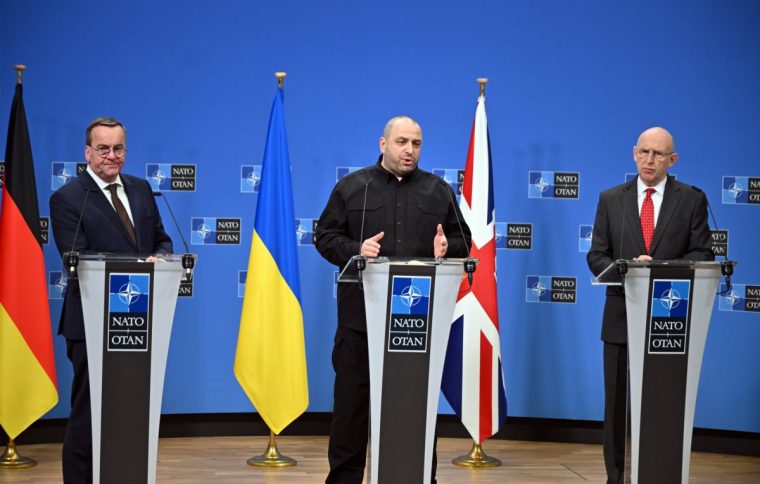 Ukrainian Defence Minister Rustem Umerov (centre), German Defence Minister Boris Pistorius (left) and British Defence Minister John Healey (Photo: Dursun Aydemir/Anadolu via Getty)
Healey, meanwhile, said: “This UDCG could not meet at a more important time, because 2025 is the critical year for this war in Ukraine, and now is the critical moment in that war.”
Opening the meeting, he urged allies to “step up our support for Ukraine in the fight”, adding: “Our job as defence ministers is to get urgent military aid into the hands of Ukrainian warfighters.”
European peacekeeping force plans ‘still unclear’
The EU’s top foreign affairs diplomat appeared to suggest this week that plans for a European peacekeeping force to help Kyiv were still unclear.
Kaja Kallas told BBC Radio 4’s Today programme: “If we have such boots on the ground, so what is the goal? Are they monitoring, are they deterring, are they keeping the peace, are they fighting? I mean, what could be the goal? And that’s not really clear.”
Healey on Friday hit back at Kallas’ suggestion. “Our planning is indeed, for the ‘coalition of the willing’, real, substantial, well advanced – the European Union is not part of that planning,” the Defence Secretary told reporters.
Healey also chaired a separate gathering of defence ministers from the “coalition of the willing” this week to discuss plans for a peacekeeping force to be deployed to Ukraine in the event of a ceasefire.
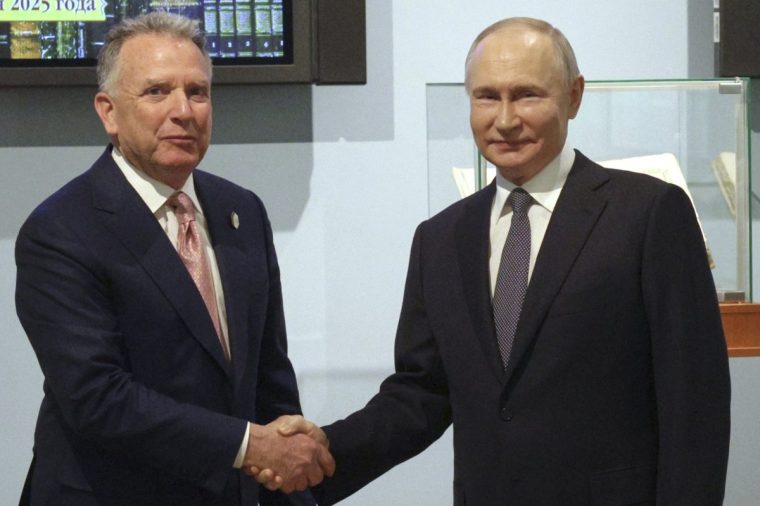 Russian President Vladimir Putin meets Donald Trump’s special envoy Steve Witkoff in St Petersburg, Russia (Photo: Gavriil Grigorov/AP)
Previous meetings of the UDCG have been chaired by the US defence secretary but in a sign of America’s disengagement from European security Healey has taken over the duty since Trump became president in January.
However, US defence secretary Pete Hegseth attended Friday’s meeting virtually, as did Ukrainian president Volodymyr Zelensky.
Pistorius insisted that Hegseth’s decision to attend the meeting virtually was “not a matter of priorities” but of “schedules”, adding the “most important fact was that he took part”.
‘Russia has to get moving’
US envoy Steve Witkoff travelled to Russia again on Friday to press the Kremlin to accept a truce, as Moscow continued to drag its feet.
Trump expressed frustration with Moscow over the state of the talks, writing on social media on Friday: “Russia has to get moving. Too many people ere (sic) DYING, thousands a week, in a terrible and senseless war – A war that should have never happened, and wouldn’t have happened, if I were President!!!”
Lavrov on Saturday reiterated that a prospective US-backed agreement to ensure safe navigation for commercial vessels in the Black Sea could not be implemented until restrictions are lifted on Russian access to shipping insurance, docking ports and international payment systems.
Details of the prospective deal were not released, but it appeared to mark another attempt to ensure safe Black Sea shipping after a 2022 agreement that was brokered by the UN and Turkey but halted by Russia the following year.