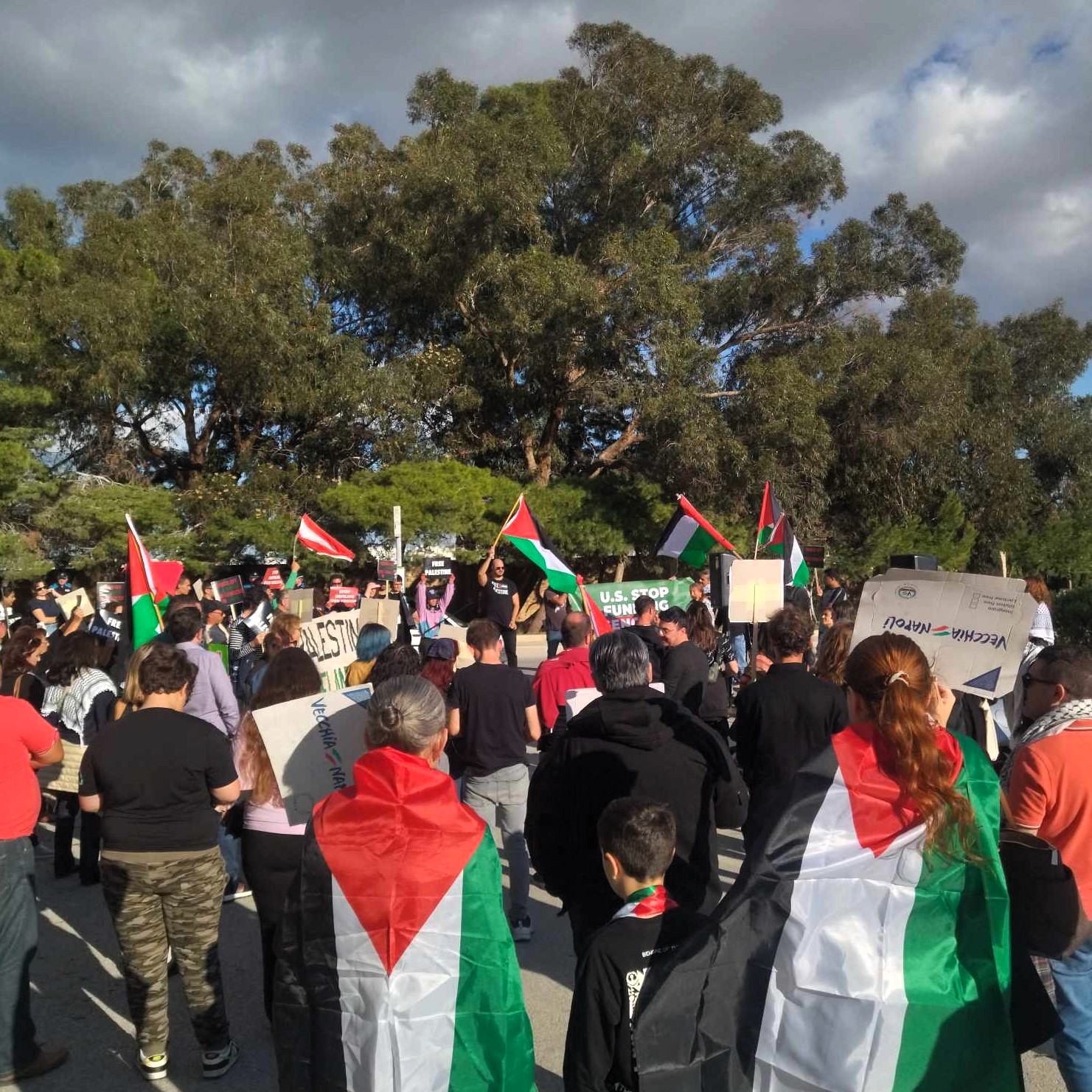
 Photo taken during a recent pro-Palestine protest organised by Moviment Graffitti
France is planning to recognise a Palestinian state and could do so as early as June. “We must move towards recognition, and we will do so in the coming months”, said the French President Emmanuel Macron recently.
“I want to believe in peace; today, the conflict has intensified and it’s terrible … Since the 2nd of March, there’s nothing going in (the Gaza strip) — no water, no food, no medication, and none of the injured are coming out,” Macron said.
The ongoing war has recently reached a grim milestone; over 50,000 Palestinians have been killed, 15,613 being children, and any real prospect of peace feels like throwing a wish and a penny into a dry fountain.
As of April 2025, the state of Palestine is recognised as a sovereign state by 147 of the 193 member states of the United Nations, or just over 75% of all UN members. Ireland, Norway, Spain and Slovenia have officially recognised the state of Palestine last year.
Amid Israel’s expanding war on the Gaza strip, the recognition of a Palestinian state carries crucial geopolitical value for the Palestinians. It strengthens their voice, enhances their capacity to hold Israeli authorities accountable for illegal occupation and potential war crimes, and encourages other Western countries to act on the long promised, but never fulfilled, two-state solution.
In view of these recent international developments, Israeli Foreign Affairs Minister, Gideon Sa’ar said that “these kind of actions (France’s recognition of Palestine), will not bring peace, security and stability in our region closer – but the opposite, they only push them further away”.
This type of political stance by the Israeli Authority has remained vastly unchanged for decades. Back in 2015, when the Vatican recognised the state of Palestine in its drive for a two-state solution, Israel had at the time expressed its disappointment, saying (again) that this “will not advance the peace process”. Indeed, every initiative towards a two-state solution was pushed to the back of the cupboard to gather dust by Israel.
On the 22nd of March 2024, Malta issued a joint statement together with Spain, Ireland and Slovenia, stating that they were ready to recognise the State of Palestine as a sovereign state “when it can make a positive contribution and the circumstances are right.” Fast forward a year; Spain, Ireland and Slovenia have recognised the state of Palestine whilst Malta has remained on the fence, still waiting “for the right circumstances”.
Since the attainment of its independence on the 21st of September 1964, Malta has traditionally held a close and friendly relations with the Palestinian people.
Being a constant supporter of the two-state solution, the Maltese foreign policy consistently advocated for a peaceful and negotiated resolution to the Israeli-Palestinian conflict. Whilst Malta recognised the State of Israel back in 1965, this did not happen yet for Palestine.
In fact, Malta treats its 1988 declaration as a recognition of Palestinian “aspirations” of statehood, rather that a full recognition of statehood itself. This declaration has never been rectified in the last 37 years.
The United Nations’ Special Rapporteur on the Occupied Palestinian Territories, Francesca Albanese, recently reiterated the gravity and urgency of the situation. She said that with the war’s unspeakable toll on civilians, growing concerns of accelerated forced displacements of Palestinians from the Gaza strip and the West Bank, and the systematic violation by the Israeli Administration of decades of UN resolutions, all countries are being called upon to examine their diplomatic relations with both Israel and Palestine.