Average earnings are worthless in a society with massive and growing inequality, the median is what matters. Nicely made graphic though.
Edit: apparently the median is very similar to the average, so that’s good. Consumer purchasing power is still something that can’t be measured here, which means wage growth may be “fake”. But like I said, very nice graph and USAFacts is a good organization.
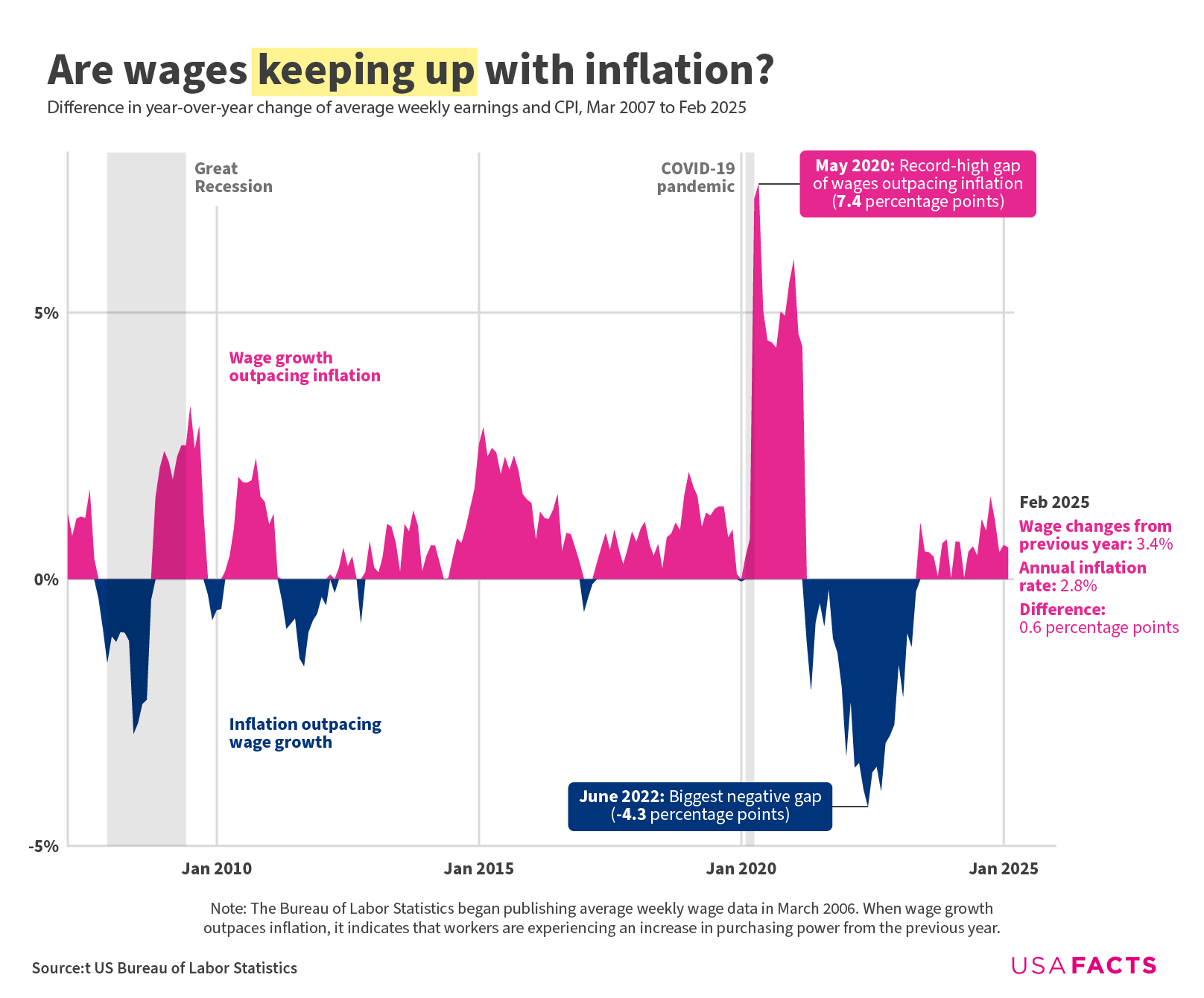
The Bureau of Labor Statistics has published average weekly wage data since 2006. Since then, average wages outpaced inflation 71.3% of the time (the top half of this chart). Most recently, wage growth has been faster than inflation in every month since February 2024.
But let’s talk about the outliers in 2020 and 2022:
* In May 2020, wages increased 7.6% over the previous year while inflation was at 0.2%, a record-high gap of 7.4 percentage points. This spike was attributed to pandemic labor market disruptions that disproportionately affected lower-wage jobs.
* The biggest negative gap (-4.3 percentage points) was in June 2022, when nominal wages grew by 4.8% year over year while inflation hit 9.1%.
We can measure the effect of inflation on wage growth by comparing the nominal average weekly wage to its inflation-adjusted (or “real” wage) equivalent. Since March 2006, the nominal average wage rose from $686 to $1,225, a 78.7% increase. Once adjusted to February 2025 dollars, it went from $1,095 to $1,225, a 11.9% increase. So the nominal wage growth was $540, but the real wage growth was $130.
But more recently, between February 2024 and February 2025, the nominal average wage grew from $1,185 to $1,225 — $40 more a week, a growth rate of 3.4%. Accounting for inflation, the real wage growth was 0.58% or an additional $7 a week.
It’s going to take a long time to recover from 20% inflation.
It would be nice to see this with median wage rather than average wage.
I would expect the simplest presentation would just be median wages in constant dollars per year. For relative rate I’d suggest percent change per year or versus an index year.
Inflation adjusted wages have been at or near all time highs since covid, but so many people deny this for some reason
The issue with this will always be tied to occupational prerequisites.
For example, in 2018, 60% of jobs in the US required a bachelor’s degree. The cost of that education increased over 181% since the late 90s. Employers now get the benefits of specialized labor, yet wages did not go up to pay enough for that prerequisite, so wages did not keep up with inflation.
Currently around 40% of jobs in the US require a bachelor’s.
This is usually not ever tied correctly to wages keeping pace.
So the return to work in May 2020 just after the pandemic started took us from near even (after a declining second half 2019) all the way up to a 7.4% differential? How does that make sense?
Research (limited pre-2020) suggests pandemics cause a drop in unemployment and a rise in wages. Sure enough, exactly what happened. The average workers pay went up a lot- and they could not stop spending it. Wasn’t gonna last forever as inflation rose though and eventually we reached equilibrium.
Still insane that a process that was directly caused by the pandemic, was predicted to happen, and was experienced worldwide, was somehow blamed all on joe biden. We could stand to increase the economic literacy in this country.
Use median wages, and cost of living, not inflation/CPI which doesn’t track all living expenses.
I used to be able to afford eggs.
Doesn’t this include the cost of benefits too? So if healthcare cost go up YoY it counts as a raise since your company is spending more on benefits? But in reality it’s just that healthcare got more expensive but your purchasing power is still declining
My salary has effectively decreased over the last 5 years because of inflation. I’ve only gotten the routine 2% per year increase the last 5 years. Same for the whole company, supposedly.
It should be noted that the giant spike in wages in 2020 was due to mass layoffs of food service workers who generally don’t get paid that much. Similarly during the Great Recession the people who lost jobs were often on the lower end of the pay scale. Labor jobs were particularly hard hit. So wages went up but the overall health of the economy was bad.
I LOVE how many people are mad at this chart because it isn’t confirming their biases.
this sub always has a few grumblings, but omg, LOOK at this comment section!!
i’m not smart enough for this graph, anyone care to dumb it down for me?
Funfact: If America stuck to the gold standard and y’all were still paid in the 50’s worth of 25 cents per hour in gold, the current minimum wage would be about $19/hr.
Productivity has outpaced wages by an incredible margin. Though technology has increased our efficiency, the benefits are almost entirely sucked up by the powerful. It’s wage theft that the median quality of life has not improved in this regard. Meanwhile, benefits of advancements in medicine do not help the base of our society because of corrupt healthcare practice.
A microcosm of this is seen in our sports: our lead in the Olympics has shrunk, our dominance in the NBA has vastly diminished, and this is entirely the fault of the parasitic youth sports industry. Obviously, since we were the most advanced by a long shot for years, this is expected to some degree, but it has also been pissed away by allowing billionaires to increase margin artificially by decreasing value of their services and buying out competition.
We continue to be the reserve currency, and still have the most powerful companies, so it’s not all bad. But using material extracted from your foundation is never a story that ends well.
![[OC] Wages vs. Inflation in the US](https://www.europesays.com/wp-content/uploads/2025/04/qchvhw0uu0ve1-1616x1024.png)
19 comments
Source: Bureau of Labor Statistics
Tools: Datawrapper, Illustrator
More data [here](https://usafacts.org/answers/are-wages-keeping-up-with-inflation/country/united-states/)
Average earnings are worthless in a society with massive and growing inequality, the median is what matters. Nicely made graphic though.
Edit: apparently the median is very similar to the average, so that’s good. Consumer purchasing power is still something that can’t be measured here, which means wage growth may be “fake”. But like I said, very nice graph and USAFacts is a good organization.
The Bureau of Labor Statistics has published average weekly wage data since 2006. Since then, average wages outpaced inflation 71.3% of the time (the top half of this chart). Most recently, wage growth has been faster than inflation in every month since February 2024.
But let’s talk about the outliers in 2020 and 2022:
* In May 2020, wages increased 7.6% over the previous year while inflation was at 0.2%, a record-high gap of 7.4 percentage points. This spike was attributed to pandemic labor market disruptions that disproportionately affected lower-wage jobs.
* The biggest negative gap (-4.3 percentage points) was in June 2022, when nominal wages grew by 4.8% year over year while inflation hit 9.1%.
We can measure the effect of inflation on wage growth by comparing the nominal average weekly wage to its inflation-adjusted (or “real” wage) equivalent. Since March 2006, the nominal average wage rose from $686 to $1,225, a 78.7% increase. Once adjusted to February 2025 dollars, it went from $1,095 to $1,225, a 11.9% increase. So the nominal wage growth was $540, but the real wage growth was $130.
But more recently, between February 2024 and February 2025, the nominal average wage grew from $1,185 to $1,225 — $40 more a week, a growth rate of 3.4%. Accounting for inflation, the real wage growth was 0.58% or an additional $7 a week.
More data [here](https://usafacts.org/answers/are-wages-keeping-up-with-inflation/country/united-states/) if you’re curious. And these two reports from a few months back feel especially relevant too:
* [Why do prices feel high if inflation is slowing](https://usafacts.org/articles/why-might-prices-feel-high-if-inflation-is-slowing/) (Jan 2025)
* [How are Americans doing financially](https://usafacts.org/articles/how-are-americans-doing-financially/) (June 2024)
It’s going to take a long time to recover from 20% inflation.
It would be nice to see this with median wage rather than average wage.
I would expect the simplest presentation would just be median wages in constant dollars per year. For relative rate I’d suggest percent change per year or versus an index year.
Inflation adjusted wages have been at or near all time highs since covid, but so many people deny this for some reason
The issue with this will always be tied to occupational prerequisites.
For example, in 2018, 60% of jobs in the US required a bachelor’s degree. The cost of that education increased over 181% since the late 90s. Employers now get the benefits of specialized labor, yet wages did not go up to pay enough for that prerequisite, so wages did not keep up with inflation.
Currently around 40% of jobs in the US require a bachelor’s.
This is usually not ever tied correctly to wages keeping pace.
So the return to work in May 2020 just after the pandemic started took us from near even (after a declining second half 2019) all the way up to a 7.4% differential? How does that make sense?
Research (limited pre-2020) suggests pandemics cause a drop in unemployment and a rise in wages. Sure enough, exactly what happened. The average workers pay went up a lot- and they could not stop spending it. Wasn’t gonna last forever as inflation rose though and eventually we reached equilibrium.
Still insane that a process that was directly caused by the pandemic, was predicted to happen, and was experienced worldwide, was somehow blamed all on joe biden. We could stand to increase the economic literacy in this country.
Use median wages, and cost of living, not inflation/CPI which doesn’t track all living expenses.
I used to be able to afford eggs.
Doesn’t this include the cost of benefits too? So if healthcare cost go up YoY it counts as a raise since your company is spending more on benefits? But in reality it’s just that healthcare got more expensive but your purchasing power is still declining
My salary has effectively decreased over the last 5 years because of inflation. I’ve only gotten the routine 2% per year increase the last 5 years. Same for the whole company, supposedly.
It should be noted that the giant spike in wages in 2020 was due to mass layoffs of food service workers who generally don’t get paid that much. Similarly during the Great Recession the people who lost jobs were often on the lower end of the pay scale. Labor jobs were particularly hard hit. So wages went up but the overall health of the economy was bad.
I LOVE how many people are mad at this chart because it isn’t confirming their biases.
this sub always has a few grumblings, but omg, LOOK at this comment section!!
i’m not smart enough for this graph, anyone care to dumb it down for me?
Funfact: If America stuck to the gold standard and y’all were still paid in the 50’s worth of 25 cents per hour in gold, the current minimum wage would be about $19/hr.
Productivity has outpaced wages by an incredible margin. Though technology has increased our efficiency, the benefits are almost entirely sucked up by the powerful. It’s wage theft that the median quality of life has not improved in this regard. Meanwhile, benefits of advancements in medicine do not help the base of our society because of corrupt healthcare practice.
A microcosm of this is seen in our sports: our lead in the Olympics has shrunk, our dominance in the NBA has vastly diminished, and this is entirely the fault of the parasitic youth sports industry. Obviously, since we were the most advanced by a long shot for years, this is expected to some degree, but it has also been pissed away by allowing billionaires to increase margin artificially by decreasing value of their services and buying out competition.
We continue to be the reserve currency, and still have the most powerful companies, so it’s not all bad. But using material extracted from your foundation is never a story that ends well.
Comments are closed.