Sign up for the Slatest to get the most insightful analysis, criticism, and advice out there, delivered to your inbox daily.
A man tried to murder the governor of Pennsylvania by setting fire to his home, and it’s barely broken through into the news cycle. This is in part because there is so much news generated by the Trump administration, from their economically devastating trade war to their attacks on higher education to their refusal to bring back an innocent man they accidentally deported to a Salvadoran prison. But it’s also in part because political violence is losing its shock value, largely thanks to a right-wing movement that embraces violent rhetoric and then either ignores or celebrates the violence it begets. And that’s very bad news for a nation already teetering on the brink.
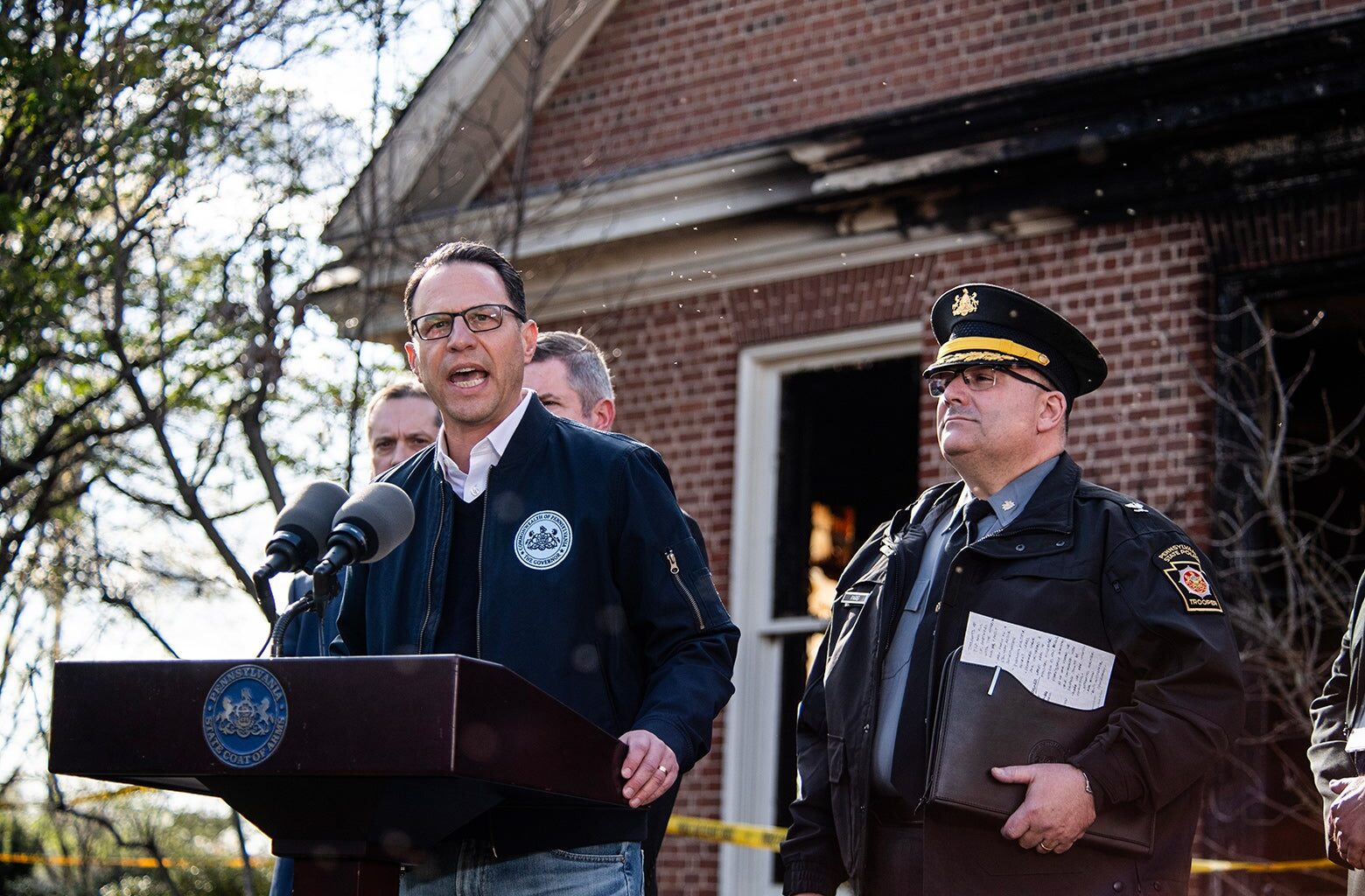
On Saturday, Pennsylvania Gov. Josh Shapiro gathered family and friends at his residence, the governor’s mansion, for a Seder meal to mark the first night of Passover. After the dinner ended and Shapiro and his family went to sleep, 38-year-old Cody Balmer allegedly climbed over the fence that surrounds the property, broke windows, and tossed Molotov cocktails inside. Luckily, first responders came quickly, and Shapiro and his family were safe. The images of the fire’s aftermath, though, are shocking. And Balmer allegedly carried a sledgehammer with him; police say Balmer told them that had he encountered Shapiro in the house, he would have “beaten him with his hammer.”
Balmer is by most accounts not a stable individual. His hammer comments, though, are particularly chilling: They are reminiscent of the 2022 hammer attack and attempted kidnapping of Paul Pelosi, the octogenarian husband of former House Majority Leader Nancy Pelosi, that fractured Pelosi’s skull and caused other serious injuries. “Where’s Nancy?” the attacker reportedly yelled.
One would imagine that all Americans—all decent people everywhere—would condemn such nightmarish violence, no matter their politics. But now-President Donald Trump and many of his MAGA fans and colleagues seemed to find the near-killing of an elderly man funny. Just days after the attack, Donald Trump Jr. posted an image of a hammer and men’s underwear to social media with the quip, “Got my Paul Pelosi Halloween costume ready.” His father wasn’t much better. “We’ll stand up to crazy Nancy Pelosi, who ruined San Francisco—how’s her husband doing, anybody know?” Trump asked the crowd at a California Republican convention in 2023. “And she’s against building a wall at our border, even though she has a wall around her house—which obviously didn’t do a very good job.”
Trump, thankfully, has yet to make light of the attack on Shapiro (although how low we have sunk when that even needs to be said). But he did manage to make it about him: “The attacker was not a fan of Trump, I understand,” he said. “Just from what I’ve read and what I’m been told. The attacker basically wasn’t a fan of anybody.” He also told reporters that the attacker was “probably just a whack job.”
When it was Trump on the receiving end of an attack by a man with amorphous political beliefs who also seemed like a whack job, he was singing a different tune. The left, he posted on social media, “has taken politics in our Country to a whole new level of Hatred, Abuse, and Distrust.” And he blamed Kamala Harris and Joe Biden. “Their rhetoric is causing me to be shot at, when I am the one who is going to save the country and they are the ones that are destroying the country—both from the inside and out,” he told Fox News.

Jill Filipovic
A Bright Spot Is Emerging Amid All This Trump Chaos
Read More
It is good that Trump at least said that the kind of violence aimed at Gov. Shapiro cannot be allowed to happen in the U.S. I’m about as much of a Trump opponent as one can be, and I also don’t believe that violence against him is justified, let alone the answer to America’s problems. But Trump’s and his administration’s tepid condemnations sound awfully hollow when they so consistently stoke violence, and routinely fail to condemn the violence that comes from their side—or worse, when they justify, celebrate, or pardon pro-Trump violent criminals.
Political violence is not a new problem in the U.S., but it is a significant one. And while political violence has recently come from the left and the right alike, it has not come from both sides equally—and perhaps more importantly, both sides do not react in the same way. Right-wing violence is much more common in the United States. And it’s useful to see how elected, appointed, and other officials and political leaders respond when political violence occurs. When Trump survived an assassination attempt, elected Democrats voiced their shock and horror, and universally condemned the attack. While random people may have joked on Twitter or lamented the shooter’s imperfect aim in their private group chats, the members and leaders of the Democratic Party did not hope for the president’s demise or see anything funny about a gunman nearly taking out a presidential candidate.
And while Luigi Mangione, who allegedly shot and killed the CEO of UnitedHealthcare, has become something of a folk hero for Americans across the political spectrum who are fed up with predatory health insurance companies, it’s impossible to imagine him being invited to meet Joe Biden, being recruited for congressional internships, or being nominated by a sitting member of Congress for a Congressional Gold Medal—all of which were accorded to Kyle Rittenhouse after he responded to a Black Lives Matter protest by packing up his gun and heading into the fray, where he ended up shooting three people, two to death. (A jury found him not guilty of homicide in 2021.)
It’s impossible to imagine elected Democrats claiming Mangione is some sort of political prisoner; it seems beyond the realm of reality to believe that a Democratic president might pardon him. And yet Trump and his MAGA movement have rewritten the history of the deadly Jan. 6 insurrection to do just that, claiming that anti-democracy rioters—people who wanted to undo the results of a free and fair election—were the true patriots, and pardoning even those convicted of serious violent crimes.
It’s not that the political left isn’t violent—it certainly can be. It’s not even that leftists, liberals, and progressives never cheer on violence—sometimes they do. But the party apparatus that represents the American left-of-center has managed, so far, to largely hang on to sanity and decency and continues to reject political violence. The party representing the American right has not.
These differences play out in rhetoric, too. It is again hard to imagine a Democrat running for office and declaring all conservatives or Christians evil enemies of the people who cannot be reasoned with and must be destroyed. It’s hard, even now, to imagine a Democrat running for office and promising “retribution” against the Trump administration and MAGA voters.
But from Trump, that’s simply the norm.
“I always say, we have two enemies,” Trump said on Fox News as he ran for office in 2024. “We have the outside enemy, and then we have the enemy from within, and the enemy from within, in my opinion, is more dangerous than China, Russia, and all these countries.” And he has often promised revenge, which he now appears to be exacting.
“In 2016, I declared, ‘I am your voice,’ ” Trump said in 2023, before a crowd of right-wing activists. “Today, I add: I am your warrior. I am your justice. And for those who have been wronged and betrayed, I am your retribution.”
This language of violence and warfare is, again, not an exclusively right-wing dynamic. But it is much more of a right-wing dynamic than a left-wing one. And when coupled with the right’s general hesitation to condemn violence when it comes from their own side, it may feed into a culture in which violence becomes an unremarkable part of political life. It certainly feeds into a culture of fear: Some Republicans have reportedly said in private that they don’t voice opposition to Trump for fear that they will wind up in a MAGA stan’s literal crosshairs.
Now that Trump is in office, his desire for retribution is not just words. He seems, at best, ambivalent about violence befalling those he believes have somehow crossed him, having pulled security protection for several men who used to work in his administration, despite credible threats against their lives—threats largely from foreign adversaries, made because of the work those men did in Trump’s service.
We’re Getting Dangerously Close to a Losing North Carolina Candidate Being Declared the Winner
This Content is Available for Slate Plus members only
The Crisis Over Trump’s Salvadoran Gulag Has Reached a Terrifying Breaking Point
The Republicans Are Considering Something Truly Shocking: Raising Taxes on the Rich
There’s a Television Show That I’m Convinced Explains Trump. You Won’t Guess What It Is.
Political violence can be alluring in its simplicity, and it has seduced many otherwise intelligent people who no doubt believe themselves to be generally kind and decent. But the only way that democracies function is by hashing out our disagreements through political means: In elections, in legislatures, in the courts. Resorting to violence doesn’t just make people scared and make life less comfortable; it undermines the whole democratic project.
We don’t know yet why, exactly, Balmer targeted Shapiro, assuming the police are right that Balmer was the attacker. We know Balmer, like so many, many violent men before him, was also accused of physically attacking his ex-wife and children. According to early reporting, Balmer allegedly called 911 after the fire and told dispatchers that the governor should know that he “will not take part in his plans for what he wants to do to the Palestinian people.” Balmer’s politics also seem all over the place, and he reportedly struggles with mental health problems. He may be the exact kind of “whack job” that Trump says he is.
But whatever and whoever Balmer is, the kind of violent act he is accused of committing is not unique. Nor, in Trump’s America, is it guaranteed to be condemned. That dark reality doesn’t just threaten the lives of politicians, or even our nation’s moral character. It threatens our very existence and ability to sustain democratic rule.

Sign up for Slate’s evening newsletter.