
The European Union could compensate for the loss in US aid to Ukraine, should Washington pull its support, by only needing to increase its contribution by approximately 0.21% of its annual GDP.
This would see it increase from €44 billion to €82 billion ($50 billion to $93.3 billion).
Follow our coverage of the war on the @Kyivpost_official.
The figures were given by Christoph Trebesch, the director of the International Finance Research Center at Germany’s Kiel Institute.
Trebesch quoted the statistics during an online discussion titled “Ukraine’s public finances in the third year of war,” organized by Ukraine’s Centre of Economic Strategy.
Replacing US aid is financially feasible for Europe, according to Trebesch. “We’re not talking about massive sums. In terms of [the total] budget, this is like a ‘side item,’ rather than essential effort,” he said.
EU institutions and the “big five” European economies – Germany, UK, France, Italy and Spain – would be crucial to such scaling up of financial support. The EU Commission could expedite its Monetary and Financial Assistance Program to double its financial aid flows.
These larger European countries could step up by simply increasing their annual aid effort from approximately 0.1% of GDP to 0.2%.
The big five economies should be encouraged to increase their share since Scandinavian and Baltic countries, such as Denmark, Estonia, Latvia and Lithuania, already provide a higher percentage of their GDP in aid compared to larger Western European economies like France and Spain

Other Topics of Interest
British Defence Intelligence Update Ukraine 18 April 2025
Latest from the British Defence Intelligence.
Denmark has provided nearly 2.5% of its GDP to Ukraine, Trebesch said. Meanwhile, the United Kingdom contributed only 0.5% of the country’s GDP, with Germany allocating 0.1%.
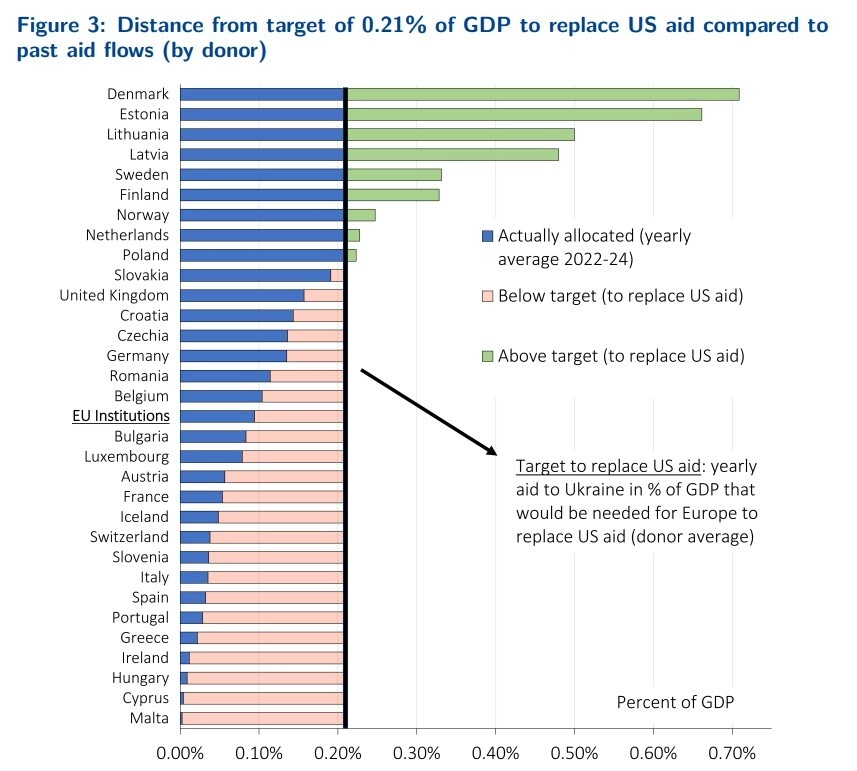 Source: Kiel Institute’s “Ukraine Aid: How Europe Can Replace US Support” report
The disparity underscores the varying levels of commitment to the provision of aid among European nations relative to their economic capacity.
In terms of military aid, the US currently leads the way, especially with specific high-tech weapon systems, such as HIMARS and Patriot missiles, which would be more difficult to replace. Europe should shift, both from European and Ukrainian manufacturers.
Firm procurement promises are vital for ensuring Ukraine’s long-term defense capabilities.
Political analysts and government officials had warned for months that Washington’s support to Ukraine was not guaranteed – particularly after US President Donald Trump took office. Even before Washington’s aid freeze, Kyiv had already put several precautionary economic measures into place in anticipation of potential disruptions from its largest backer.
As a result, Ukraine doesn’t face an immediate economic crisis despite the ongoing uncertainty over Western assistance. Kyiv Post previously reported that, on the contrary, Ukraine has already secured enough external funding sources to cover social spending and essential government services for 2025.
But the fate of financing in 2026 and beyond remains uncertain, as does the possibility of an end to Russia’s war against Ukraine being secured in the near future.