From reproductive rights to climate change to Big Tech, The Independent is on the ground when the story is developing. Whether it’s investigating the financials of Elon Musk’s pro-Trump PAC or producing our latest documentary, ‘The A Word’, which shines a light on the American women fighting for reproductive rights, we know how important it is to parse out the facts from the messaging.
At such a critical moment in US history, we need reporters on the ground. Your donation allows us to keep sending journalists to speak to both sides of the story.
The Independent is trusted by Americans across the entire political spectrum. And unlike many other quality news outlets, we choose not to lock Americans out of our reporting and analysis with paywalls. We believe quality journalism should be available to everyone, paid for by those who can afford it.
Your support makes all the difference.
Read more
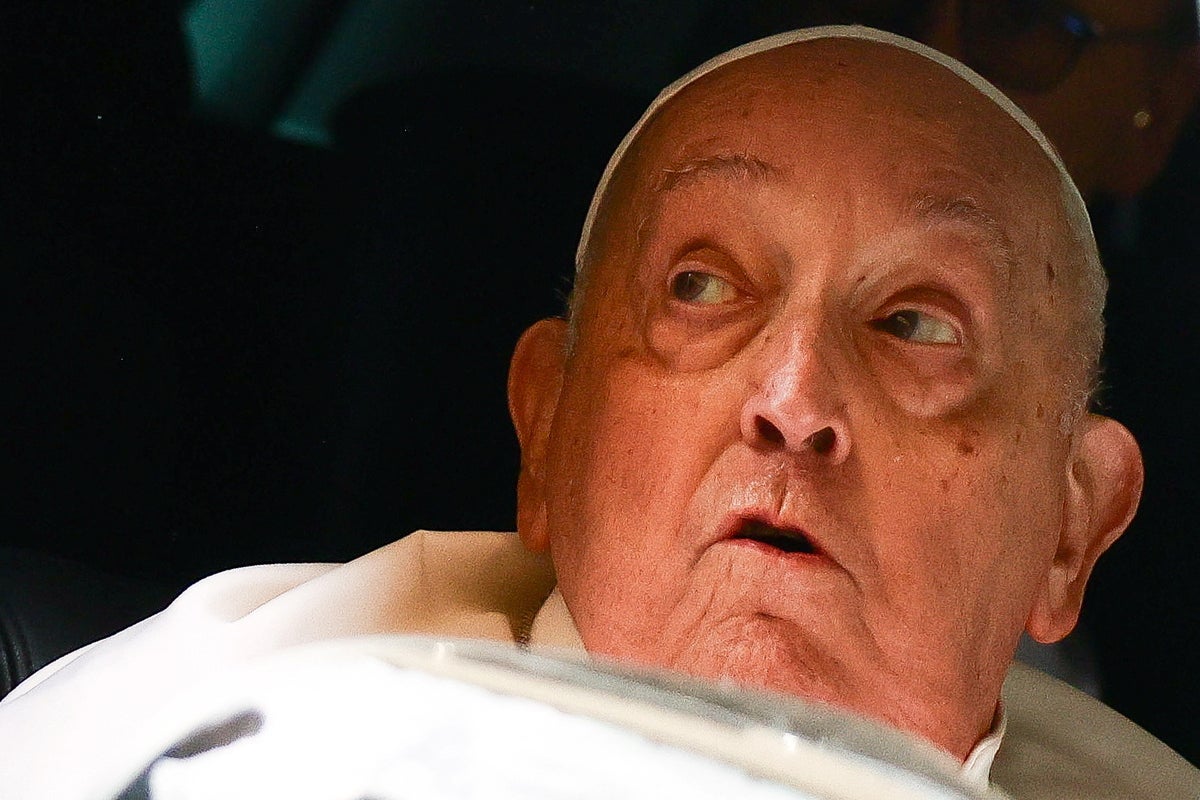
Tributes have poured in from leaders around the world after the death of Pope Francis, aged 88.
World leaders from King Charles and Italy’s prime minister to leaders from India, France and the Pope’s home country of Argentina shared their condolences and memories of the pontiff after the Vatican announced the Pope’s death.
Pope Francis had spent 12 years at the head of the Catholic Church, and recently had a lengthy battle with ill health that necessitated weeks of treatment in hospital.
Vatican camerlengo Cardinal Kevin Farrell said on Monday: “His entire life was dedicated to the service of the Lord and of his Church.
“He taught us to live the values of the Gospel with faithfulness, courage, and universal love, especially for the poorest and most marginalised.
“With immense gratitude for his example as a true disciple of the Lord Jesus, we commend the soul of Pope Francis to the infinite, merciful love of God, One and Tribune.”
The pontiff had been hospitalised for weeks battling a complex lung infection which led to early stages of kidney insufficiency.

open image in gallery
Pope Francis starts reading his speech during his weekly general audience in the Paul VI Hall, at the Vatican, Wednesday, Feb. 12, 2025 (Copyright 2025 The Associated Press. All rights reserved)
Francis, who suffered from chronic lung disease and had part of one lung removed as a young man, was admitted to Gemelli hospital on February 14 for a respiratory crisis that developed into double pneumonia.
He spent 38 days there, the longest hospital stay of his 12-year papacy.
However, he emerged on Easter Sunday – a day before his death – to bless thousands of people in St Peter’s Square and treat them to a surprise Popemobile tour of the piazza, drawing wild cheers and applause.
‘Heavy hearts’: Tributes flow for Pope
Leaders from around the world have shared their memories of the Pope following the news.
King Charles and Queen Camilla, who had visited the Pope on an official trip to Italy earlier this month, were “deeply saddened” to hear the news of the Pope’s passing.
“But our heavy hearts have been somewhat eased, however, to know that His Holiness was able to share an Easter Greeting with the Church and the world he served with such devotion throughout his life and ministry,” the King said in a tribute.
“The Queen and I remember with particular affection our meetings with His Holiness over the years and we were greatly moved to have been able to visit him earlier in the month.”

open image in gallery
The King and Queen met with the Pope earlier this month (Vatican)
Italian Prime Minister Giorgia Meloni said that Pope Francis had returned to the house of the heavenly father.
“This news saddens us deeply, because a great man and a great pastor have left us,” she said.
“I had the privilege of enjoying his friendship, his advice and his teachings, which never failed even in moments of trial and suffering.”
French President Emmanuel Macron said the Pope had wanted the Church “to bring joy and hope to the poorest” and unite the world.
“May this hope be reborn endlessly beyond him,” he said.
Argentina’s President Javier Milei said that despite differences between them, he had known “true kindness and wisdom” from the Pope.
“As President, as an Argentine, and, fundamentally, as a man of faith, I bid farewell to the Holy Father and stand with all of us who are today dealing with this sad news,” he said.
Indian Prime Minister Narendra Modi said he was “deeply pained” by the Pope’s death.
Bouncer to Pontiff: Pope Francis’ extraordinary life
The Pope, who was born in Argentine capital Buenos Aires as Jorge Mario Bergoglio, became the first person from the Americas to take the role after succeeding Benedict XVI in 2013.
He studied at the technical secondary school Escuela Técnica Industrial, graduating with a chemical technician’s diploma before he spent several years as a food technician in the Hickethier-Bachmann Laboratory.
Having also worked as a bouncer, janitor, in 1958 he joined the Society of Jesus – known as the Jesuits – in 1958. He climbed the ranks within the Argentine Church before being made a Cardinal by Pope John Paul in 2001.

open image in gallery
Nuns pray before the statue of late Pope John Paul II outside the Agostino Gemelli Hospital where Pope Francis was hospitalized in Rome (EPA)
After the resignation of Pope Benedict XVI, Pope Francis was elected in the fifth round of voting in a papal conclave – the process by which a new Pope is selected.
A respiratory infection had always been the main concern surrounding Pope Francis’ health, after he lost most of his lung due to an illness during his early adulthood. In 2023, the Pope was hospitalised for three days with a bad case of pneumonia.
Modernising Pope: Francis’ greatest achievements
Pope Francis was credited for adopting a less formal approach to the papacy. After his election, he took a bus back to his hotel rather than being driven in the papal car, before he visited a Cardinal in hospital the next day – where he chatted with patients and staff.
He was willing to engage more women in senior roles within the Catholic Church and has long argued that the Church should be sympathetic to the LGBTQ+ community – while calling for the decriminalisation of homosexuality around the world.
The pontiff has also been a critic of unshackled capitalism and put climate change action front-and-centre of much of his papacy.

open image in gallery
Pope Francis presides the vespers at Saint Paul Outside the Walls, in Rome on January 25, 2025 (AFP via Getty Images)
On the international stage, he played a crucial diplomatic role in a tumultuous decade, weighing in on the Israeli-Palestinian conflict, Russia-Ukraine war, the plight of refugees worldwide, and notably playing a crucial role in the restoration of US-Cuban relations in 2014.
He also called on countries in the West to significantly increase the number of refugees they took in. Responding to Donald Trump’s plan to build a wall with Mexica in 2016, the Pope said: “A person who only thinks about building walls, wherever they may be, and not building bridges, is not Christian.”
Key Facts:
– Jorge Mario Bergoglio was born on December 17, 1936, in Buenos Aires, Argentina, of Italian immigrant stock. He was ordained a priest in the Jesuit order in 1969. From 1973-79 he was the order’s top leader in Argentina. He became an auxiliary bishop of Buenos Aires in 1992 and the city’s archbishop in 1998. He was made a cardinal in 2001 by Pope John Paul II.
– Surprising many observers of the Roman Catholic Church, Bergoglio was elected pope at a conclave in March 2013 following the resignation of Pope Benedict. He chose to be called Francis in honour of Saint Francis of Assisi, emphasising a commitment to poverty, peace, and care for the environment.
– He was the first non-European pope in 1,300 years, the first from Latin America and the first Jesuit to hold the post. Jesuits are known for their commitment to education and social justice, including working with the poor and marginalised.
– He shunned many of the traditional trappings of the papacy, preferring to live in a modern Vatican guest house rather than the grand papal apartments in the Apostolic Palace. He pared back the papal wardrobe, wore a plastic watch and chose to be driven around in a simple family car.
– He soon clashed with conservatives, who were unhappy with his informal style from the start. They balked at his calls for the Church to be more welcoming to LGBT people and divorced Catholics and at his clampdowns on the use of the traditional Latin Mass.
– Francis made 47 trips outside of Italy, visiting more than 65 states and territories, clocking up more than 465,000 km (289,000 miles). However, he never returned to Argentina.
– He initiated changes within the Vatican, emphasizing transparency, accountability and financial reform, and appointed more women to senior posts in its hierarchy. However, he was also viewed as a haphazard leader, often blindsiding Vatican officials with his off-the-cuff comments and unpredictability. Despite many efforts, he struggled to get a grip on the Church’s crisis over sexual abuse by clerics. (Reporting by Crispian Balmer and Joshua McElwee Editing by Frances Kerry)
What happens now?
A secretive election, known as the papal conclave, will now be held in the Vatican’s Sistine Chapel, from which white smoke will rise once a group of cardinals under the age of 80 agree with a two-thirds majority on a new candidate. The interregnum period, the stage between a Pope’s death and the selection of a new one, has now begun.
The Pope’s death is verified by the camerlengo – the Vatican’s overseer of property and revenues. They call out the Pope’s name three times, and when no response is received, the Pope is pronounced dead and the public are informed before a new pontiff is selected.
Officially, the only requirement for the next Pope is to be male and Catholic. In reality, Pontiffs have only ever been chosen from the ranks of Cardinals for centuries.

open image in gallery
Faithful wait under the closed window of the Apostolic Palace at The Vatican, where the Pope blesses the faithful gathered in St. Peter’s Square after the Angelus every Sunday (Copyright 2025 The Associated Press. All rights reserved)
After a special morning mass, the 120 Cardinals of voting age will gather inside the Sistine Chapel to begin rounds of voting.
Through speeches, prayer, and political jostling, Cardinals whittle down candidates through successive rounds of voting.
A Pope is only elected when there is a two thirds majority. The longest papal conclave lasted three years in the thirteenth century due to political infighting.