
The world is watching two nuclear powers inch closer to conflict – not only with grave concern for human life but also with a keen awareness of the cascading effects this war could unleash across global systems.
In a multipolar world already under strain from climate change, inflation, and war in Ukraine, a conflict between India and Pakistan might be the last domino we can afford to see fall.
Follow our coverage of the war on the @Kyivpost_official.
What Happened?
Tensions between India and Pakistan sharply escalated following a deadly attack in Pahalgam, a popular tourist resort in Indian-administered Kashmir – a disputed territory that has long been a flashpoint between the two nuclear-armed neighbors.
India quickly blamed Pakistan for supporting the militant group behind the attack and responded by suspending its participation in the Indus Waters Treaty – a key water-sharing agreement brokered by the World Bank in 1960. In practice, this meant cutting off access to the Indus River system, which supplies fresh water to 80% of Pakistan’s population.
The treaty, once a rare example of cooperation between two bitter rivals, had survived wars and hostilities for over six decades. But now, it has been brought to a halt.
In response, Pakistan announced its withdrawal from the Simla Agreement – the 1972 accord that obligated both countries to resolve disputes over contested territories, such as Kashmir, through peaceful means and bilateral dialogue.

Other Topics of Interest
Elon Musk, Trump, and Silicon Valley leaders are reviving a 1930s technocracy vision, pushing for tech-led governance, global annexations, and space colonization.
The Roots of the Conflict
The roots of the India-Pakistan conflict go back to the 1947 partition of British India, which led to the creation of the two separate nations. Kashmir, a Muslim-majority region ruled at the time by a Hindu maharaja, became the centerpiece of dispute when both countries laid claim to it.
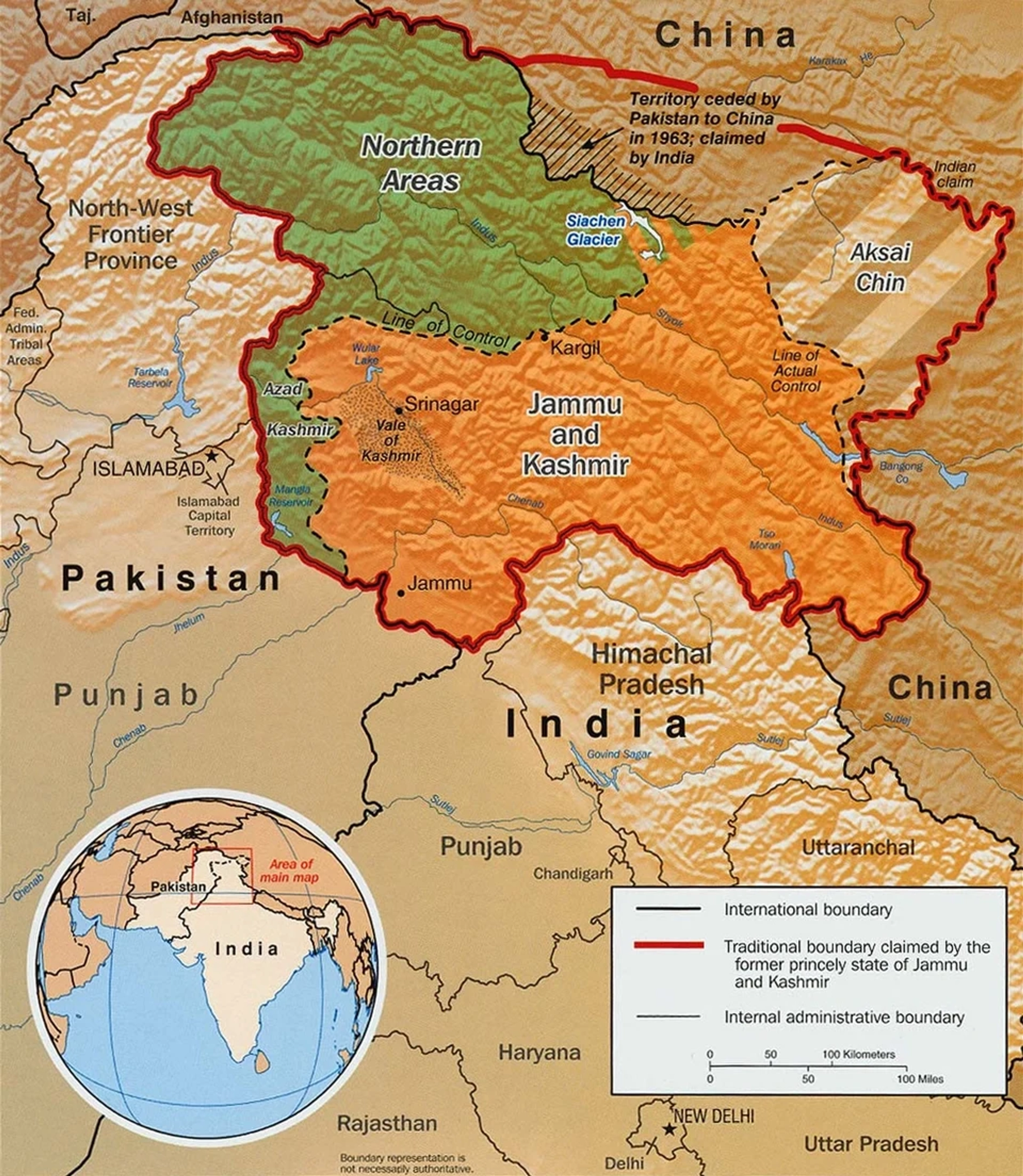
source: https://wikipedia.org
Three wars have been fought over the region (1947, 1965, 1999), and despite numerous ceasefires and treaties, tensions have never been fully resolved. The situation is made even more volatile by both nations being nuclear powers – with significant nationalist sentiment tied to Kashmir on both sides.
Adding to the instability is the impending expiration of the Shimla Agreement, a 1972 accord that, while not a peace treaty, has helped regulate diplomatic engagement and conflict resolution mechanisms between the two countries.
The prospect of this agreement lapsing raises fears of fewer constraints on military escalations.
The Breaking Point
The rhetoric on both sides has intensified.
India, buoyed by its growing global influence and military strength, has reportedly threatened to dismantle Pakistan.
“It is our national resolve to deal a crushing blow to terrorism,” Prime Minister Narendra Modi declared.
At the same time, Pakistani military leaders have declared their readiness for a full-scale war.
On the ground, satellite images and field reports confirm the buildup of troops and artillery on both sides of the Line of Control (LoC). Clashes involving tanks and heavy mortars have already occurred.
Geopolitical alliances further complicate the situation.
China – Pakistan’s long-time strategic partner – is reportedly supplying missile systems. Turkey has also ramped up military cooperation with Pakistan, including the delivery of six transport aircraft loaded with weapons and ammunition.
Meanwhile, India maintains robust ties with the US, France, and Israel – which continue to provide advanced technology and strategic intelligence.
If War Breaks Out: Global Impact
An India-Pakistan war would not be a regional affair – it would shake the global economy.
India is one of the world’s largest producers of pharmaceuticals, IT services, cars, smartphones (including iPhones), and consumer electronics. Any disruption would drive up prices and destabilize global supply chains.
Food markets would also suffer. Both countries are major exporters of rice, spices, fruits, and vegetables. War would jeopardize exports, especially via key routes like the port of Karachi and the Arabian Sea, increasing logistical risks and insurance costs.
Even oil prices could spike due to increased maritime instability in the Indian Ocean – a vital corridor for energy transit.
Finally, global tech markets would be affected. India is a crucial hub for data services, call centers, chip design, and backend IT development. Disruption there would ripple across Silicon Valley, the EU, and Asia.
The views expressed in this opinion article are the author’s and not necessarily those of Kyiv Post.