![Which 20th Century decade had the best music? (Infographic) [OC]](https://www.europesays.com/wp-content/uploads/2025/05/hqt9v1onzzye1-1000x1024.png)
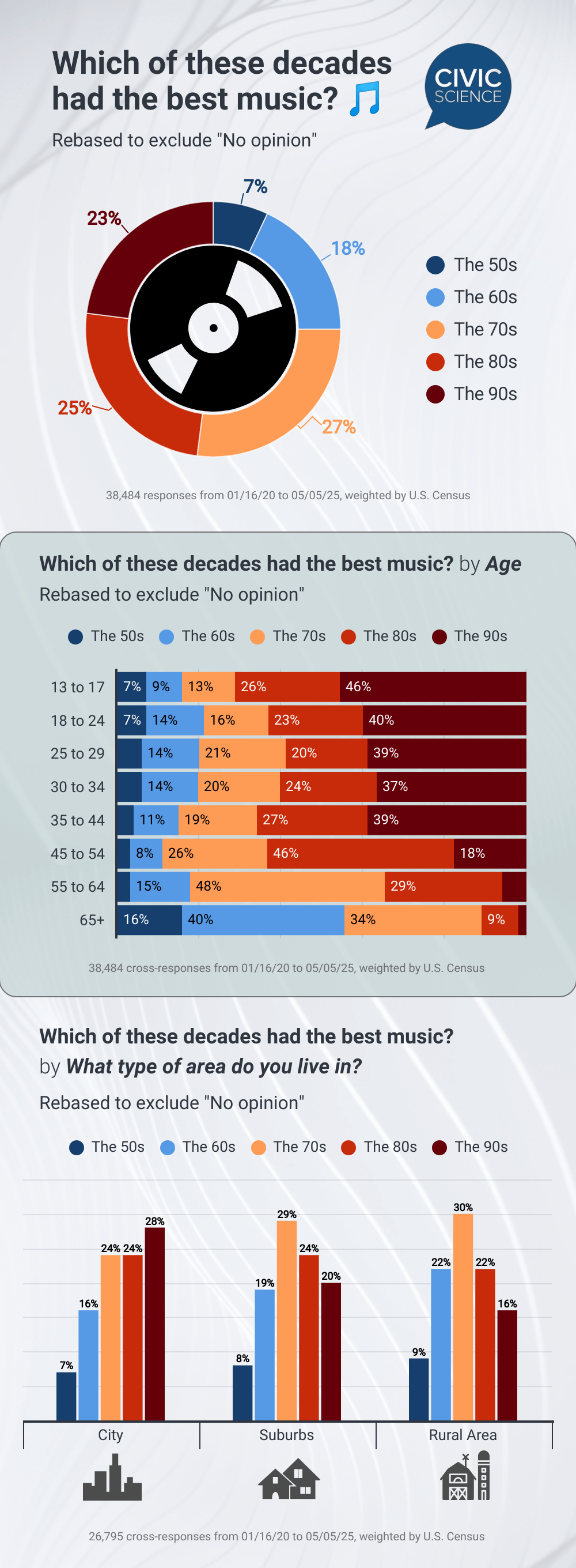
Which decade of the late 20th Century had the best music? It's a hotly debatable question — the 70s, 80s, and 90s are all within four percentage points of each other at the top of the charts.
Want to weigh in? You can answer this ongoing CivicScience survey yourself here.
Data Source: CivicScience InsightStore
Visualization Tool: Infogram
Posted by CivicScienceInsights
33 comments
The 90s are going to get stacked if you don’t include 00’s and 10’s when discriminating by age no?
In the 90’s, nobody thought that the 90’s had the best music.
Didn’t know we stopped making music 25 years ago
I wonder if the younger folk know which decade some old music was made.
Very weird. It seems like the cohort 65+ is totally different from all the other ones. I would have expected more interest in the music of the 50s and 60s in the cohort 55-64, which is not so distant from the other one.
Easily 60s and 70s. That was the real rock.
The current decade always has the best music because it has its own music plus every decade before it.
90s won in most age groups. Yet altogether 90s is only third
These couldn’t have been equally sized groups to get the result of your pie chart based on your bar graph by age. That doesn’t give any indication of what is “best” when the 55 and up groups outnumber the other 6
You need equal-size age groups. Hell, make it year by year if you have enough data.
It’s hard to root against the 90s for one simple fact: music was the most developed.
By 1990, we had a full-fledge scene for all types of rock, hip-hop, several types of dance music, classical, reggae, ska, jazz, pop on steroids… and the list goes on.
Like, I totally get the 60s and 70s. They had some absolutely great music. The 80s also had a lot of the genres I mentioned above emerge, but not quite fully developed.
By the 90s, you had greats being released of every genre. Even if jazz was a far way from leading the music world, you still had Dizzy Gillespie dropping heat, while you have Tupac topping charts. You simply don’t have that in 1968.
Extremely shocking to me how much the 90s wins out here…
the 70s are objectively correct.
What you see is that people largely think that the music when they were growing up is the best. That bottoms out at 35, where they can’t pick that as an option any more.
Your age ranges are inconsistent. You’ve got a few 5 year intervals, a 7 year interval, and a few 10 year intervals. Just stick to either 5 year intervals for everyone, or 10 years intervals for everyone.
I’d love to talk to the 7% of teenagers that said the 50s.
So people remember their favorite songs by decades of origin? I’m constantly saying, “damn, that was from the 80’s? I guess that time I first heard it was from a cover”
A whole lot of nostalgia bias.
Why are the 00s and 10s not included? Either you should have included them or excluded the younger age groups
The answer is the decade during which you were a teenager, unless you are a counter culture weirdo like me.
Also you need more consistent age splits.
This would be so much better if one of the visualizations analyzed responses by aggregating the decade where the respondent spent the most time in the age range of 13-20. Label it as as “My Decade”. And then report the rest of the responses directly. That way we could see if one decade stands out for cross-generational appreciation.
I think this is very dependent on when the person was born? I’d hypothesize that people generally like the music that was popular when they were teens. I’d be interested in seeing a calculation showing if people like music the decade following their birth decade, before?
“You see, I think drugs have done some good things for us. I really do. And if you don’t believe drugs have done good things for us, do me a favor. Go home tonight. Take all your albums, all your tapes and all your CDs and burn them. ‘Cause you know what, the musicians that made all that great music that’s enhanced your lives throughout the years? Real fucking high on drugs.”
Bill Hicks
What’s up with7% of 13-17 year olds preferring 50s music? This seems fishy.
Depends on the genre really.
I think going by genre would’ve been more useful. There are usually multiple different genres in different decades, but people who are younger might only know of a few songs from a specific decade and only of one or two genres.
Disco was popular in the 1970s, but so was Soul. Both evolved from R&B, but they don’t sound the same. Soul seems to have more orchestrated sounds and more emotional lyrics and the way they sing sometimes sounds religious even if the lyrics aren’t religious at all.
In the 1980s, synth-pop and some forms of rock and rap started to become more popular.
I thought everyone believed the music from when they were in high school was the best. But teens from the 90s like the 70s.
1969 alone makes the 60s the best decade.
No one is pointing out that the 50s grows in popularity as the group gets younger. Hipsters much? Sorry guys, the 50s weren’t that good.
I think this data from older respondents shows the power of nostalgia, and that would be more obvious had more time periods been added.
I have no doubt that, if ’00 and ’10’s were included, younger people would signal that music as the best, since that is the music they grew up hearing. As it is, they are not given that option, and default to the music most like today. For older demographics, you see the period roughly corresponding to their own youth take up more of the chart. These are the songs they grew up with and have a deep attraction to, and it makes sense that this is when music was, to them, the ‘best’, hence the larger affinity for older music in those groups.
Additionally, while this does indicate the total number of respondents, it only indicates that they are weighted by US census data. The number of respondents who reported from each group is also material, and nowhere stated. While the overall sample seems of appropriate size, it is worth asking if each weighted subcategory shares the same opinion. This is doubly true depending on ‘no response’- respondents were removed from demographic data sure, but are they still counted in the size of your sample?
I think this chart is a good example of is the way data can be manipulated to reach a conclusion. It’s easy to create a survey saying ‘respondents agree the best star wars movie is (you pick)’ if the only alternative is the star wars Christmas special. But that is not an honest accounting of public opinion.
People always value songs they listened towhen they were young
I’ll take unsurprising survey results for $500, Alex.
I like the idea of this but I have so many questions.
Why are the cohorts all different sizes, why are there no ‘00, ‘10s, etc., why does it stop at 65+. If showing decades shouldn’t it have the ages all be decades too?
Comments are closed.