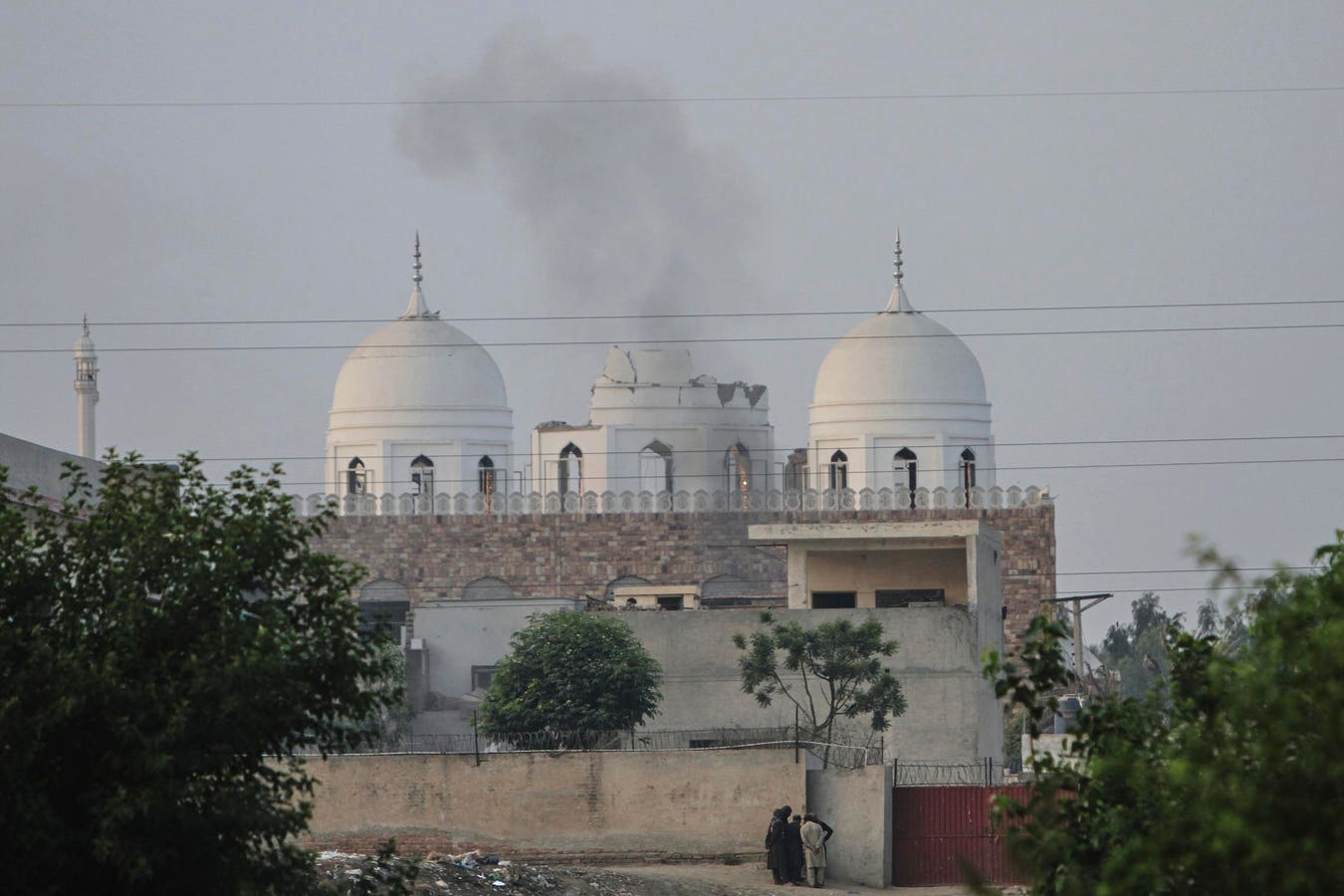
India launched missile strikes in Pakistan early on Wednesday, two weeks after it accused Pakistan of being involved in a terrorist attack on the tourist town of Pahalgam that killed over two dozen people.
A private security guard walks through rubble of a damaged building after a suspected Indian missile … More attack, in Muridke, a town in Pakistan’s Punjab province.
Copyright 2025 The Associated Press. All rights reserved.
Key Facts
The Indian Ministry of Defense said in a statement said the strikes targeted “nine terrorist infrastructure sites in Pakistan and Pakistan-occupied Jammu and Kashmir,” and added that they were “focused, measured and non-escalatory in nature.”
India claimed no Pakistani military facilities were hit by the strike and said the military operation, which it has dubbed “Operation Sindoor,” underscores India’s “resolve to hold perpetrators accountable while avoiding unnecessary provocation.”
Pakistani officials denounced the strikes, calling them “an unprovoked and blatant act of war” that had “violated Pakistan’s sovereignty.”
In a Wednesday morning press conference, India’s Foreign Secretary Vikram Misri claimed the government’s intelligence assessment indicated further attacks were being planned against India and with the strikes New Delhi “exercised its right to respond and pre-empt as well as deter such more cross-border attacks.”
Lieutenant Gen. Ahmed Sharif Chaudhry, the head of the Pakistani military’s public relations arm, told reporters that the Indian strikes had killed 26 civilians and left 46 others injured as of Wednesday morning.
Sharif also restated an earlier claim by the Pakistan military that neither countries jets trespassed each other’s territories and the Indian airstrikes were conducted from their own airspace and struck multiple cities including Bahawalpur, Kotli and Muzaffarabad.
The Pakistan military also claimed without sharing evidence that it had shot down five Indian fighter jets—a claim Indian authorities have not commented on but Associated Press reported that two planes fell onto villages in India-controlled Kashmir.
Get Forbes Breaking News Text Alerts: We’re launching text message alerts so you’ll always know the biggest stories shaping the day’s headlines. Text “Alerts” to (201) 335-0739 or sign up here.
How Have World Leaders Reacted To The India Strikes?
Shortly after India announced the strikes, President Donald Trump told reporters at the Oval Office that he had just been informed about it and said: “It’s a shame…I guess people knew something was going to happen based on a little bit of the past. They’ve been fighting for a long time…I hope it ends very quickly.” Secretary of State Marco Rubio tweeted that he was monitoring the situation closely and said: “I echo @POTUS’s comments earlier today that this hopefully ends quickly and will continue to engage both Indian and Pakistani leadership towards a peaceful resolution.” China’s foreign ministry said India’s military operation was “regrettable” and added: “We urge both sides to act in the larger interest of peace and stability, remain calm, exercise restraint and refrain from taking actions that may further complicate the situation.” Israel’s ambassador to India, Reuven Azar, tweeted: “Israel supports India’s right for self defense. Terrorists should know there’s no place to hide from their heinous crimes against the innocent.” A spokesperson for United Nations Secretary-General Antonio Guterres said he is very concerned about the Indian military operation and is calling for “maximum military restraint” from both sides. He then added: “The world cannot afford a military confrontation between India and Pakistan.”
News Peg
Tensions between India and Pakistan, nuclear-armed nations, have risen in recent weeks following the attack on Pahalgam in April that killed 26 people, all of one of whom were Indian nationals. The attack on the city, which is located in an Indian-controlled part of Kashmir, was carried out after the neighboring countries had been exchanging gunfire along their border the week prior. India accused Pakistan of involvement in the Pahalgam attack, with Pakistan calling the allegations “baseless and concocted.” India later vowed to retaliate and Tarar said military action from India would be “responded to assuredly and decisively.” The U.S. has aligned itself with India in the growing conflict, with Trump saying India has “our full support and deepest sympathies.”
What To Watch For
In an interview with Bloomberg TV, Pakistan’s defense minister said “We have been saying all along the last fortnight that we will never initiate anything hostile toward India,” he added. “But if India attacks, we’ll respond. If India backs down, we’ll definitely wrap up.” During a media briefing about the strikes, Indian Air Force Wing Commander Vyomika Singh, said: “India has demonstrated considerable restraint in its response. However, it must be said that the Indian armed forces are fully prepared respond to Pakistani misadventures if any that will escalate the situation.”
Key Background
India and Pakistan have been at odds for several decades, with the contested border region of Kashmir becoming a flashpoint in several conflicts between the two countries. Three wars have been fought over the area, with the most recent violent outburst between India and Pakistan happening in 2019, when India launched airstrikes against Pakistan after blaming the country for a suicide bombing that killed 40 Indian paramilitary personnel in Kashmir.
Further Reading
A Timeline of Tensions Between India and Pakistan Over Kashmir (New York Times)