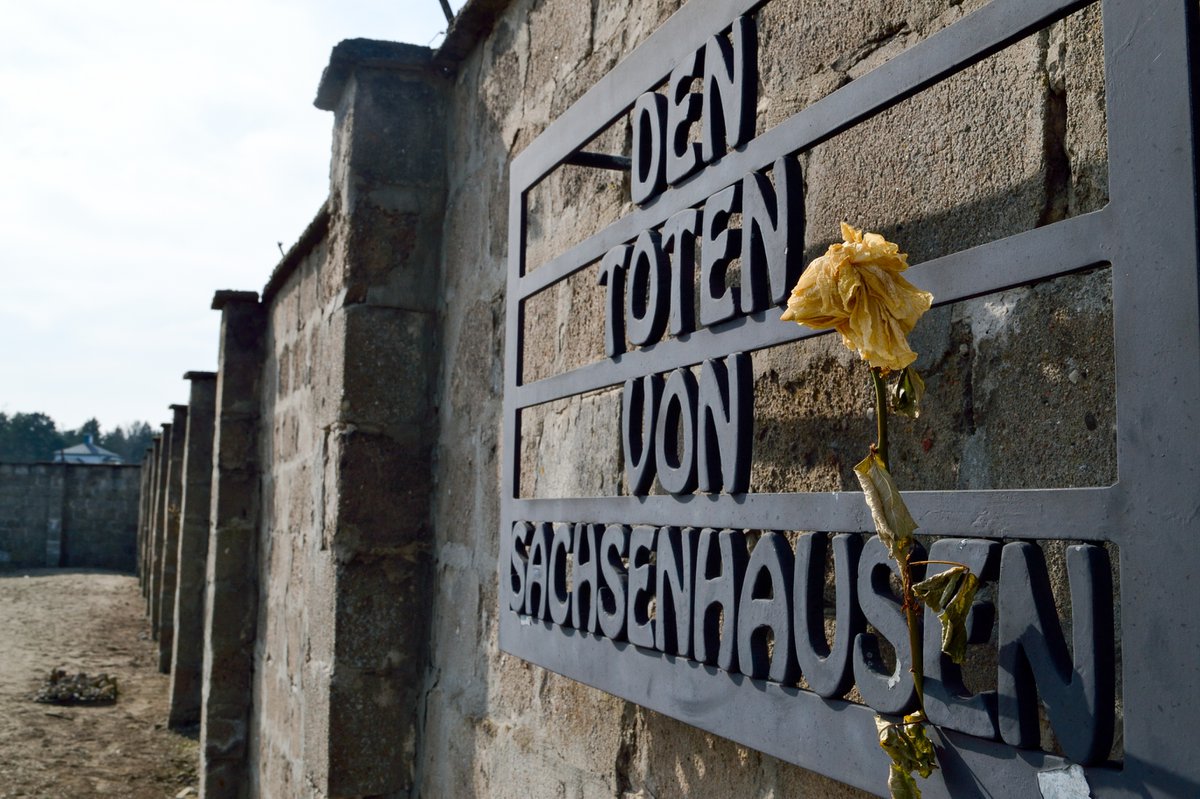
It was a cool evening this spring in Berlin, nearly eighty years after the end of the Second World War, and I was wandering near Tempelhofer Feld with a friend. We slowed down as we approached what he had told me was the former site of a small camp for Eastern European forced laborers during the Third Reich.
On the main road in the distance, cars sped over Leinestraße metro station, which had been used as an air raid shelter as the Allies closed in on the capital city in the spring of 1945. We stopped to look at the monument which now stands on the site of the labor camp. It is sparse, modern, and sterile, so unlike the type of hell people must have suffered there. We were quiet until my friend asked me if I knew anyone who was in the war. The answer to that question, we agreed, has become something of a generational divide, one that is deeply reflected in each generation’s political attitudes.
Most older Millennials, Gen X, and Baby Boomers are the children and grandchildren of the generation that watched fascism’s first major moment on the global stage. But they didn’t just live through the war. That same generation witnessed so many of the events that forged our modern world—from the Nakba in Palestine and the establishment of the state of Israel, to the end of colonialism in Syria and Vietnam, to early rumblings of independence across Africa, or, in the case of the family of my friend in Berlin, the British partition of India. To have a tangible connection to that era is, for many people, especially in the so-called West, their only connection to the struggles against fascism and colonialism, to a notion of solidarity and unity in the face of a great evil. But for many younger people, that period is, as columnist James Marriott wrote in The Times in late 2023, “more like history than current affairs.”
In September 2020, a study by the Conference on Jewish Material Claims Against Germany found that 23 percent of young adults in the United States believed the Holocaust was “a myth, or had been exaggerated, or they weren’t sure.” About half of respondents reported seeing Nazi symbols and statements denying the Holocaust on social media. A July 2024 survey found evidence that younger generations may be less concerned about anti-Jewish hatred when compared to older people, although there is no way to determine how their views may have been affected by Israel’s genocide in Gaza and its media campaign to justify the current war using antisemitism to delegitimize pro-Palestine activists.
That reality aligns with a slight but important shift towards conservatism in Gen Z. A Gallup poll last year found that “Gen Z teens are twice as likely to identify as more conservative than their parents than millennials were twenty years ago,” with the biggest spikes among men and self-identified Republicans. Put differently, the more conservative members of Gen Z are trending further right.
A generational ignorance about the Holocaust—arguably the most discussed aspect of World War II—raises the question of what else young people aren’t being taught in school.
Aaron Retish is a history professor at Wayne State University, as well as the chairperson of the board of the Abraham Lincoln Brigade Archives (ALBA), a nonprofit that offers lesson plans and other resources for educators to teach about the Spanish Civil War. Retish tells The Progressive that while many younger people feel connected to the antifascist struggles of the 1930s and 1940s and “see clear parallels to growing authoritarianism, racism, antisemitism, and xenophobia today to the fascist takeovers in Spain, Germany, Italy, and elsewhere,” it is of course not the case for everyone.
“Many Americans do not have a clear understanding of why the United States joined the Allies to fight fascism in Europe,” Retish explains. “As more people who fought fascism, either on the front lines in Europe or who supported the war on the home front, have died, their personal stories of why they fought have faded.” And as schools devote less time to teaching the history of the World War II years, important context is being lost. “Most students are not taught about the Spanish Civil War or that volunteers from across the world, including nearly 3,000 Americans, went to Spain to fight fascism.”
I was born in the United States in 1988. Like many of my peers, I learned about the war from a patriotic perspective, with some lessons about the Holocaust and the bombing of Pearl Harbor. But we never really learned the rest of the picture.
And in answer to my dear friend’s question, I did know someone who fought in the war. My paternal grandparents took care of my brother and me most days after school. My grandfather had been in the Polish army and spent the length of the conflict as a Nazi prisoner of war, working as a forced laborer. My grandmother witnessed World War II as a civilian in Ukraine and, later, in Poland and Germany. Our afternoons were steeped in wartime stories of whizzing bullets, lost siblings, and small acts of defiance. My grandparents’ stories were a living part of my childhood. And they helped shed light on the true breadth of Nazi crimes in pursuit of a fascistic, white supremacist world—crimes in addition to the horrors of the Holocaust and the mass murder of six million Jewish people.
Among the earliest victims of Nazi terror were communists, socialists, and other antifascists. Concentration camps were established to detain the political opponents of the Nazis, as well as “alleged ‘anti-socials’ and ‘criminals,’ ” which, under Nazi laws, included gay men. Even their efforts to get ordinary Germans to accept the persecution of their Jewish neighbors hinged on portraying Jewish people as criminals who required removal from society in the name of public safety.
It’s part of what makes World War II unique, according to Derborshi Chakraborty, a doctoral candidate in history who studies fascism and nationalism at the Free University of Berlin.
“The Second World War was unparalleled in human history,” Chakraborty explains. “It was a battle of different ideologies, and these different ideologies had different interpretations of history and visions for the future,” which in the case of fascism, meant that it “categorized and subcategorized human beings in different strata,” with white Germans at the top. He cites British historian Roger Griffin’s definition of fascism as any nationalist ideology that leans on the idea of a “glorified, golden past,” as well as the creation of a “generic enemy” that must be eliminated so “that glory of the past can be restored.” And that generic enemy shifts depending on the movement: Antisemitism, for example, does not play the same role in contemporary European far-right movements as it did in the 1930s, and many international fascist movements are rooted in other forms of hate.
“If we look at the fascists in South Asia, their generic enemy is very different from the Nazis; their generic enemy are the Muslims, and they believe that they have hindered the Indian or the Hindu nationalist past from regaining its glory in the present,” Chakraborty explains. In order to truly understand and address fascism today, he continues, “We have to liberate the history of fascism from the history of the Second World War.”
The Nazis saw Jews, Poles, other Slavs, Roma and Sinti, the disabled, the mentally ill, Black people, so-called Aryans of mixed heritage, homosexuals, and dissidents all as part of the Untermenschen, or the subhuman classes. Just as the Nazis did not begin their regime with the “final solution” against the Jewish peoples of Europe—their earliest policies included encouraging “voluntary” self-deportation to Palestine and elsewhere—they were not able to realize the full extent of their ethnic cleansing campaigns against other Untermenschen, although millions of them were murdered between 1933 and 1945. Many of us in the United States today would have found ourselves, or at least a loved one, on the long list of “undesirables.”
I loved my grandfather immensely. With his blue eyes and blonde hair, most U.S. Americans would have been pressed to distinguish him from a German. Fewer still would have placed him or any other Polish person outside the bounds of whiteness. Yet even the typically “Aryan” phenotypes of Poles like him were not enough to protect them from Nazi persecution. Take, for example, a 1939 pamphlet, “POLEN ODER POLLACKEN? (Poles or Polacks?)” that accused Polish people of trying to erase German culture and values, while the cover of an anti-race-mixing propaganda book read: “Polish blood terror. An eternal warning.” The Nazis carried out their first attempts to use gas as a tool of mass murder in Poznań, Poland, on patients from nearby psychiatric hospitals. The camp in Poznań was also used early in the war to imprison and torture members of the region’s anti-Nazi resistance, from clergy to middle school teachers.
The defining factor of fascism, though, is its anti-democratic character. “Everyday democracy, and democratic and fundamental rights, for example, freedom of expression, press freedom . . . all of these things are very much violated in all fascist regimes,” Chakraborty tells The Progressive. “If you look at Nazi Germany or Mussolini’s Italy, one of the casualties was the free press and the journalists and intellectuals who were trying to crop up some kind of resistance through their writings, through publishing. They were imprisoned and executed by these regimes.”
The Second World War, Chakraborty says, “was actually an anti-fascist war. And that is why a spectrum of very different ideologies,” which were often at odds with one another before the war, “actually came together to fight the fascists by bringing up a united front.” That’s why it’s critical, he says, to identify the “fascists of today” and build alliances that “can actually fight these ideologies.”
A growing number of political analysts argue the United States and the world are witnessing a boom in far-right and fascist politics. Their adherents are forging global alliances in their struggle for political influence, as University of Oslo professor sociology Katrine Fangen told Deutsche Welle in February: “These networks are not only fighting for . . . cultural hegemony. Their ultimate goal is to reshape the global ideological landscape in favor of nationalism, social conservatism, and opposition to liberal democracy.”
For his part, Retish agrees on the importance of unity as the best strategy to defeat any fascist surge: “The political and economic moment is renewing popular interest in the 1930s and what it took to stop fascism. It took coalitions . . . standing up to a violent state and its supporters and fighting for what is right.”