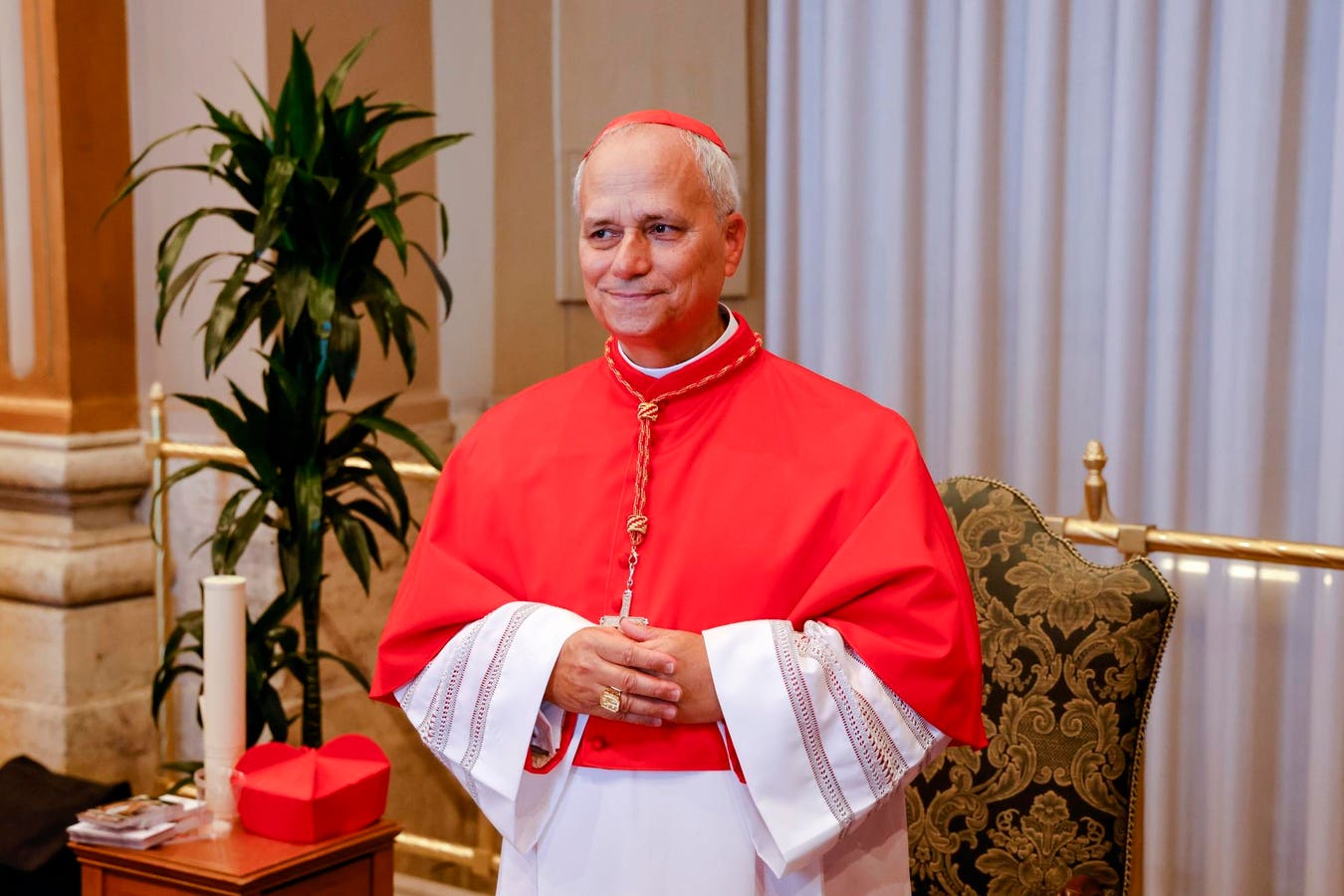
Pope Leo XIV, the first American leader of the Catholic Church, previously known as Robert Francis Prevost, returned to the Sistine Chapel the day after his election to deliver a mass for the College of Cardinals, where he described his role as both a cross to bear and a blessing and urged church leaders to make themselves “small.”
Cardinal Robert Francis Prevost, who was elected to be the new pope, poses for a photo at the end of … More the consistory where Pope Francis elevated 21 new cardinals in St. Peter’s Square at The Vatican, Sept. 30, 2023.
Copyright 2023 The Associated Press. All rights reserved
Key Facts
Leo XIV, the American-born polyglot who spent much of his career in Peru, spoke briefly in English Friday morning to an audience of cardinals before delivering the rest of his homily in Italian.
“Through the ministry of Peter, you have called me to carry that cross and to be blessed with that mission,” Leo XIV said in English, addressing the cardinals who elected him, whom he urged to “walk with me as we continue as a church, as a community of friends of Jesus.”
In Italian, Leo XIV delivered a homily that suggested some of his priorities as pontiff, in which he warned against “practical atheism,” lamenting that Jesus is sometimes “reduced to a kind of charismatic leader or superman” and that “there are many settings in which the Christian faith is considered absurd, meant for the weak and unintelligent,” according to a translation from the Vatican.
Leo XIV criticized the prioritization of “technology, money, success, power, or pleasure” over faith and said there are settings where “missionary outreach is desperately needed” to reach “ordinary people,” echoing his decades of work as a missionary abroad.
The new pope praised his predecessor, Francis, whom Leo XIV said “taught us so many times, we are called to bear witness to our joyful faith in Jesus the Saviour.”
He urged cardinals to make themselves “small” and said “all those in the Church who exercise a ministry of authority” should “move aside so that Christ may remain.”
What’s On Pope Leo Xiv’s Schedule In His First Days As Pope?
On his first weekend as pope, Leo XIV will meet with cardinals Saturday and make his first public appearance Sunday to deliver the Regina Caeli prayer from St. Peter’s Basilica, according to a schedule published by the Vatican. On Monday, Leo XIV will meet with members of the international press, and on Friday, May 16, he will meet with members of the Vatican’s diplomatic corps. Leo XIV’s inaugural mass will be held May 18 in St. Peter’s Square at 10 a.m. Vatican time, and he will hold his first general audience May 21.
What Were Leo Xiv’s First Words As Pope?
“Peace be with you! Dearest brothers and sisters, this was the first greeting of the risen Christ, the good shepherd who gave His life for the flock of God. I, too, would like this greeting of peace to enter your hearts, to reach your families and all people, wherever they are; and all the peoples, and all the earth: Peace be with you,” according to a translation of Leo XIV’s speech from the Vatican.
What We Know About Pope Leo Xiv
Leo XIV, 69, was born in Chicago and most recently served as Prefect of the Dicastery for Bishops and president of the Pontifical Commission for Latin America under his predecessor, Pope Francis. He was made a cardinal by Francis, and Vatican experts have said he similarly values Francis’ championing of the poor. He has, however, drawn criticism for his handling of priests accused of sexual abuse. (Read more about Leo XIV here.)
What Has Trump Said About Pope Leo Xiv?
President Donald Trump weighed in on the selection, posting his congratulations to Leo XIV on Truth Social, adding: “It is such an honor to realize that he is the first American Pope. What excitement, and what a Great Honor for our Country. I look forward to meeting Pope Leo XIV. It will be a very meaningful moment!” Speaking to reporters Thursday, Trump said he was “a little bit surprised, but very happy” the pope is American, and said he hopes to meet Pope Leo XIV and that the Vatican has already reached out.
How Have Other American Leaders Reacted?
Vice President JD Vance congratulated Leo XIV in a post on X, saying: “I’m sure millions of American Catholics and other Christians will pray for his successful work leading the Church. May God bless him!”
Former President Joe Biden also sent well wishes, saying on X: “May God bless Pope Leo XIV of Illinois. Jill and I congratulate him and wish him success.”
Former President Barack Obama and former first lady Michelle Obama said on X they were sending “congratulations to a fellow Chicagoan,” and added: “This is a historic day for the United States, and we will pray for him as he begins the sacred work of leading the Catholic Church and setting an example for so many, regardless of faith.”
Secretary of State Marco Rubio said in a statement on Leo XIV being named pope: “this is a moment of profound significance for the Catholic Church, offering renewed hope and continuity amid the 2025 Jubilee Year to over a billion faithful worldwide … The United States looks forward to deepening our enduring relationship with the Holy See with the first American pontiff.”
How Did They Announce When A Pope Was Been Chosen?
After voting, the ballots were burned, and chemicals were added to produce either black smoke—indicating no pope has been elected—or white smoke—meaning a pope was been chosen—from the Sistine Chapel. Vatican watchers gathered to watch what color the smoke was after every vote. Prevost received the necessary two-thirds majority vote to be elected pope Thursday afternoon, which likely occurred on the fourth ballot, following two failed ballets Thursday morning and one failed ballot Wednesday. Bells tolled as the white smoke poured out from the Sistine Chapel, where thousands gathered in St. Peter’s Square and chanted, “Long live the pope!” Cardinal Dominique Mamberti announced Prevost—who took the papal name Leo XIV—as pope on the balcony of St. Peter’s Basilica on Thursday evening, about an hour after white smoke billowed from the Sistine Chapel.
Who Were The Leading Contenders To Be Elected Pope?
There was no clear frontrunner to win the papacy, Vatican experts said, though some of the cardinals who were considered to be prime candidates included Italy’s Pietro Parolin, the Vatican secretary of state who is considered more moderate than Francis, and the Philippines’ Luis Antonio Gokim Tagle, who draws comparisons to Francis for his liberal-leaning stances and his championing of the poor. Parolin and Tagle were the two leading contenders on various betting sites, including Polymarket and Kalshi, as bettors waged millions on the papal election. Other cardinals who were considered possible candidates included several from Italy— Pierbattista Pizzaballa and Matteo Zuppi—as well as Congo’s Fridolin Ambongo, Hungary’s Peter Erdo, Ghana’s Peter Turkson and France’s Jean-Marc Aveline.
Why Was This Conclave Important?
Papal experts said the conclave could determine whether the Catholic Church continues down the path laid by Francis to become more progressive, or whether a more conservative successor could be chosen and potentially roll back some of Francis’ reforms. Francis was notable, and divisive, for his stances striking a more welcoming tone toward LGBTQ+ Catholics and women in church leadership roles, which won some global praise but angered conservative critics. Cardinal Anders Arborelius of Sweden said some cardinals wanted to elect a successor “who can follow in the footsteps of Francis. Some others said, ‘No, no. Not at all,’” The New York Times reported, while Italian conservative Cardinal Camillo Ruini said there was a “need to return the church to Catholics.” Dean of the College of Cardinals, Giovanni Battista Re, said in a homily Wednesday the new pope would face a “difficult and complex turning point in history,” stating he prayed for a pope who leads “for the good of the church and of humanity.”
How Did The Conclave Work?
While secluded from the outside world, cardinals under the age of 80 cast four votes each day until a candidate receives a two-thirds majority. The process began Wednesday afternoon with mass at St. Peter’s Basilica, after which cardinals proceeded to the Sistine Chapel to begin the conclave. On days no successor was chosen, cardinals spent the night in Vatican guesthouses to resume voting the next day. Each cardinal was assigned a desk affixed with papers that say, “Eligo in summum pontificem,” or, “I choose as supreme pontiff.”
Surprising Fact
Some cardinals watched the movie “Conclave,” the papal drama that won an Oscar just two months ago, while prepping for the real thing, Politico reported, citing a cleric involved in the conclave who said some cardinals found the film “remarkably accurate.” Viewership of “Conclave” spiked 283% within a day of Francis’s death, according to Luminate.
Why Did Day One Of The Conclave Take So Long?
Wednesday’s vote took longer than most experts had predicted, as the first release of smoke took an hour longer than the first black smoke in 2013 during the conclave that elected Pope Francis. Mathew Schmalz, editor of the Journal of Global Catholicism and College of the Holy Cross religious studies professor, told BBC News the lengthy wait for the first release of smoke may have been because of the large number of cardinals from around the world meeting one another for the first time, speculating the conclave could take one day longer than usual. Though it’s unclear why Wednesday’s vote took so long, Schmalz told the BBC he is “getting kind of nervous” about whether the conclave may have run into issues that will need to be smoothed out in the coming days. The conclave of 133 electors is the largest and most globally diverse in history, greater than the 115 electors that participated in the 2005 and 2013 conclaves, which may also cause a longer time for the vote.
Key Background
Francis died at age 88 on Easter Monday, April 21, following a bout of health issues, which led to his longest hospital stay while pope. Francis was hospitalized earlier this year for bilateral pneumonia and bronchitis, and Vatican doctors said he died of cerebral stroke and irreversible heart failure.
Further Reading
These Cardinals Are The Top Candidates To Succeed Pope Francis (Forbes)
The Church Is More Global Than Ever. What Does That Mean for the Next Pope? (New York Times)