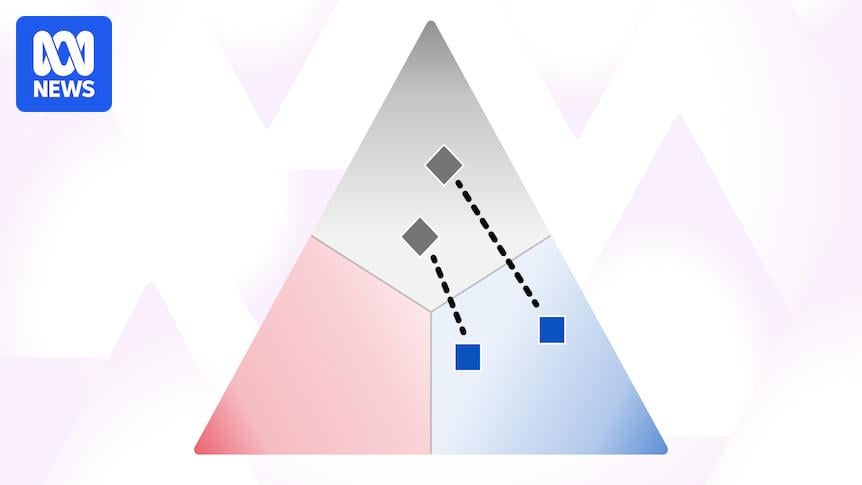
Australian government landslide victory in 2025 obscures a continuing trend away from decades of domination by the two major political parties
Posted by lipstikpig
Australian government landslide victory in 2025 obscures a continuing trend away from decades of domination by the two major political parties
Posted by lipstikpig
5 comments
This has really great visualisations of the shifts and changes in voting patterns in the recent federal election.
What we saw is a rise of independent MPs caused by a shift of voting preferences towards localised policy concerns. This is quite contrarian as we’re speaking about federal elections – not state or council, so the direct impact these independent MPs can have within their electorate is arguable.
It’s probably more about idealogical representation than direct policy intervention. For example most independents are representing higher income electorates and therefore statically skew towards civic interests such as gender pay equality and climate change in Australia.
Regardless, democracy is in a truest sense about representation, and this is what I believe it’s about – the two major Australian parties are representative of the overall nation’s interests on a declining basis.
It’s probably healthier for the nation on a democratic notion, however as long as a party wins by majority.
Minority governments are simply less effective.
Sorry isn’t this the biggest election win of a major party in decades/ever?
One key point: Australia has preferential voting (aka Instant Runoff voting), which allows third parties to be viable without incurring the spoiler effect (for the most part).
When the article talks about “primary votes” I think they are referring to first preferences, i.e. the number of voters who put X as the first choice. That’s why you can see Labor and Coalition seats in grey territory – they lost on first preferences but won on remainder preferences.
A huge caveat is that Australia uses ranked voting / preferential voting / instant runoff voting / transferable vote voting.
It’s all the same thing.
So, yes, the final results obscure the changes to first preferences, but, as described, they’re available for anyone to see.
It does, however, give individual voters the ability to rank their preference for each of the available candidates.
It stops the ‘wasted’ vote when voting for a minor party in a FPTP system.
Comments are closed.