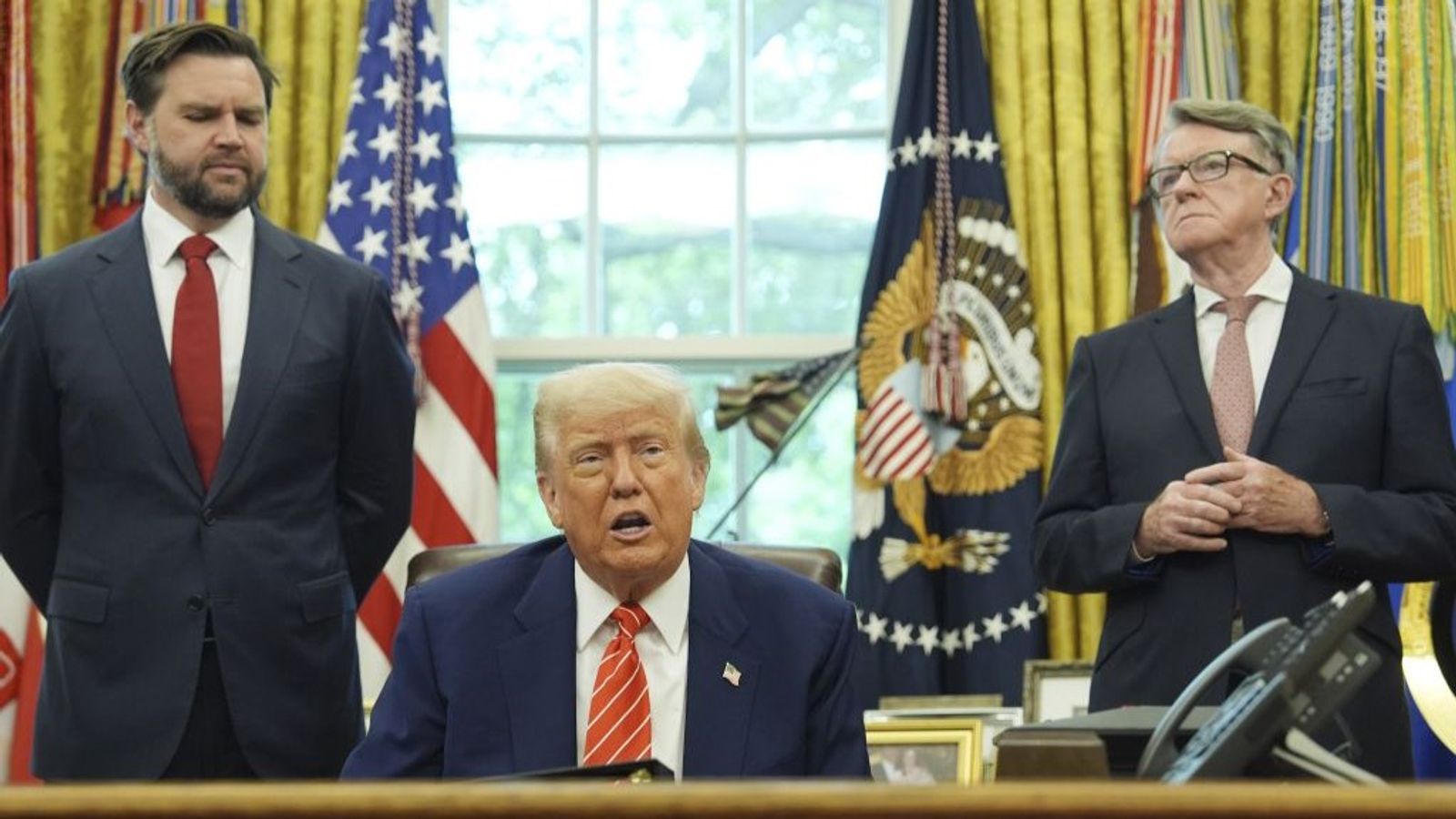
A US-UK trade deal was announced Thursday evening, after only being trailered that morning.
Tariffs of 27.5 percent on UK cars will be reduced to 10 percent for a quota of 100,000 cars—any additional sales will be charged the full rate. Tariffs on UK steel and aluminium will be removed. There will also be exemptions for UK aerospace components, in return for British Airways ordering 30 Boeing 787 Dreamliner jets. All other exports to the US will incur a blanket 10 percent tariff.
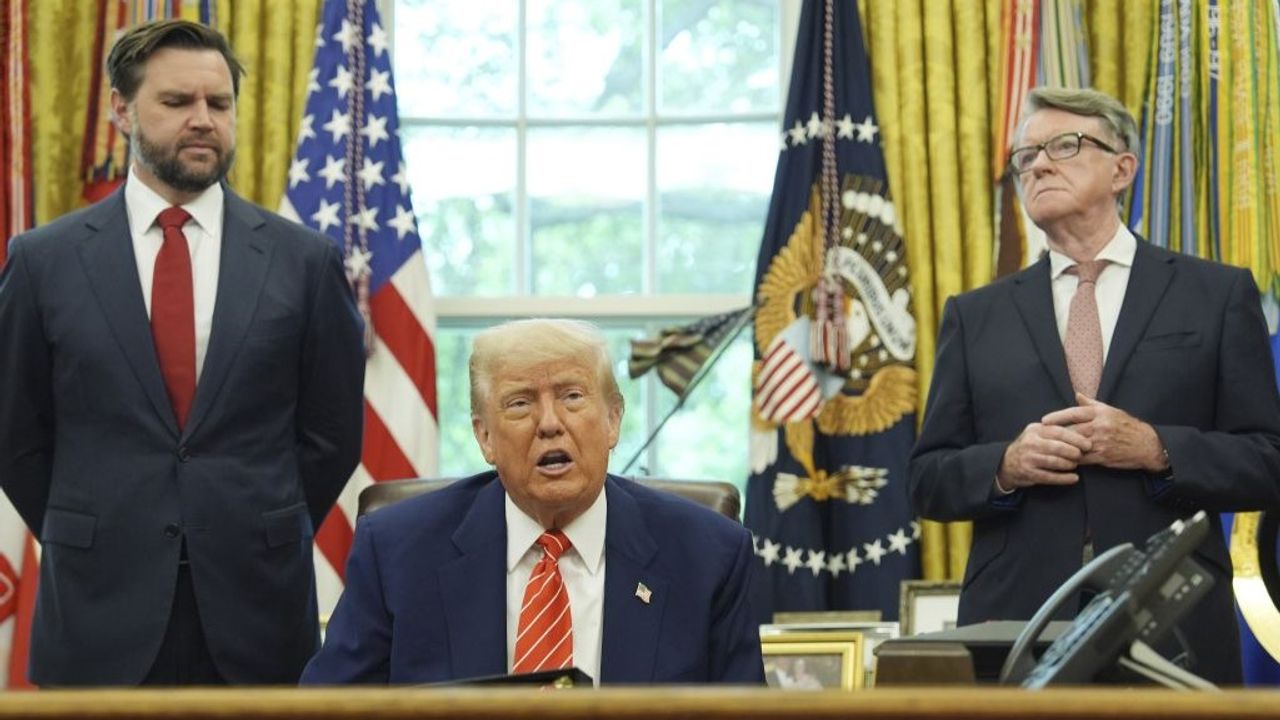
President Donald Trump, center, with Vice President JD Vance, left, and Britian’s ambassador to the United States Peter Mandelson, right, making remarks on a trade deal between U.S. and U.K. in the Oval Office of the White House, May 8, 2025, in Washington [AP Photo/Evan Vucci]
A reciprocal agreement on beef allows both countries to export 13,000 metric tonnes at a reduced tariff rate of 4-10 percent for UK exporters and tariff-free for US exporters—down from up to 125 percent in some cases. The US is also granted a tariff exemption on the first 1.4 billion litres of ethanol exported to the UK—previously a rate of 10-50 percent was charged.
There have been vague suggestions of preferential treatment when it comes to tariffs on pharmaceuticals—Britain’s second-largest goods export to the US by value after cars—which Trump is expected to announce in the coming weeks.
Although the deal brings some small relief to Britain’s car and steel industries, the overall picture shows the weak hand being played by British capitalism. Average UK tariffs on US products have fallen from 5.1 percent to 1.8 percent since Trump became president, while average US tariffs on UK goods have increased from 3.4 percent to 10 percent.
More than anything, the deal is a signal from Sir Keir Starmer’s Labour government that it is prioritising relations with America over those with Europe. And Trump’s White House is eager to use this fact to its advantage in its trade war, against the European Union (EU), but also globally.
While most British commentators have limited themselves to pointing out how “thin” the deal is, a few have been more scathing. Alan Beattie, writing in the Financial Times, headlined an article, “Britain’s trade deal with Trump may not be good news for the world”, arguing, “Starmer’s choice undermines multilateralism and poses risks to the UK”.
Beattie describes the deal, “designed purely to escape the tariffs that Donald Trump imposed on steel and cars”, as “closer to a protection payment to a mob boss than a liberalising agreement between sovereign countries,” and warns, “Given how eager the UK was to make a deal, there’s no guarantee that Trump won’t come back for more.”

His biggest concerns go beyond Britain. Beattie writes that “whatever short-term benefit it has given to the UK,” the deal “hasn’t done a whole lot for the integrity of the global trading system.” By “capitulating to US pressure and rushing for a quick deal, the UK has encouraged others to do the same,” and “By accepting that it will continue to face the 10 per cent baseline tariff, the UK has also normalised a deeply regressive move.”
The agreement with the US was announced the same day the EU published a 200-page catalogue of more than 4,800 goods imported from the US which could be hit with tariffs totalling close to €100 billion. Trump very possibly sprung the news—putting in a surprise call to Starmer Wednesday night—as a riposte.
For its part, the European press has been quick to point to Britain’s weak economic position viz the US, the European Union and China. “Compared to the two big blocs [China and the EU],” wrote Der Spiegel, “the British are small fry,” accounting for just 3 percent of US trade. It cites Justin Wolfers, professor at the University of Michigan, calling the agreement “a photo opportunity with little macroeconomic relevance”.
The paper added, “Trump can feel vindicated that it was a good idea to ‘blow up the whole system’. Other governments will now be under pressure to extract concessions for their companies and voters.”
This will irk European leaders with whom Starmer is attempting a post-Brexit “reset”, hosting a UK-EU summit in London on May 19—the first of an annual series of meetings aimed at “tak[ing] stock of the bilateral relationship,” according to a draft joint statement.
Faisal Islam, the BBC’s economics editor, explains the British government’s intentions, writing that the “real win” of the deal with America “could be that this agreement on tariffs will keep the US sweet whilst leaving the door open to a substantive deal with the European Union.
“By maintaining UK food standards and not, for example, accepting hormone treated beef or chlorinated chicken, a ‘full fat’ food and farm export deal with the EU, similar to Switzerland’s, is now clearly on the cards in the next fortnight.”
Bank of England Chief Andrew Bailey was quick to argue for the UK to “start to rebuild that relationship” with the EU, telling the BBC the deal with the US could set an example: “It demonstrates that trade deals are important. Trade deals can be done… I hope that we can use these deals to rebuild the world trading system.”


This is a clear case of putting a brave face on a bad situation.
Whatever their ultimate outcome, Starmer’s manoeuvres point to the continued fragmentation of international trade relations in place since the end of the Cold War. Indeed, Beattie writes that “the most important risk is not to the UK itself but the global trading system.” He notes that Britain’s reduction of tariffs on specifically US-produced ethanol and beef—not as part of a formal trade agreement—undermines “the ‘most favoured nation’ principle that underlies the multilateral trading system.”
According to World Trade Organisation rules, outside of specific trade agreements, members must treat all other members the same when it comes to import charges. But these principles are being abandoned amid a global trade war whose logic is to replace the anti-working-class brutality of relatively free market competition with the yet more anti-working-class brutality of competing trade blocs.
Specifically, Britain’s behaviour will not meet a friendly response from Europe.
Der Spiegel warns of the US-UK deal, “According to the White House, the creation of a ‘trading community’ for steel and aluminum is planned. This could mean that in future, the UK could impose a 25 percent tariff on imports from third countries such as Germany.”
Economic conflicts are closely intertwined with military competition. Politico reports that French President Emmanuel “Macron is playing hardball as Starmer strives for EU reset”, with France aiming “to limit British access to a €150 billion European rearmament defense fund that is being negotiated.”
The article explains, “The U.K. wants its firms to benefit from SAFE, the multibillion-euro rearmament program that is currently being negotiated by EU members, but France sees that effort as unwelcome competition from London and a case of the Brits trying to have their post-Brexit cake and eat it too…
“British efforts to secure a trade deal with Washington, have reinforced the French view that the reset with Starmer will be relatively limited and that the U.K. doesn’t see its future as lying exclusively with the continent.”
Join the fight for socialism!
Fill out the form to be contacted by someone from the WSWS in your area about getting involved.