NEWS ANALYSIS: It’s been 200 years since the first organized transport of Norwegian emigrants sailed to the US, and the bicentennial is being widely observed in both countries. A new exhibit at the National Library in Oslo, meanwhile, raises new and not always positive aspects and ironies of the mass emigration that are now “reshaping” its history.
 This replica of the ship that carried the first organized group of Norwegian emigrants to America, called “Restauration,” will sail the 98-day voyage again this summer as part of bicentennial events. It’s due to leave Stavanger on July 4, with King Harald and Queen Sonja present at the send-off. Not only is July 4 the US’ national day, it’s also the queen’s birthday. PHOTO: Frode Skarstein/Restauration Friends Association
The Norwegian emigration that began in 1825 launched “a long period of exchange involving people, ideas and culture across the Atlantic,” says Eline Skaar Kleven, a director at the National Library who’s been closely involved with the exhibit that opened this week. It highlights what she calls “new historical perspectives” through diverse accounts of those it affected.
The best-known one is about all the Norwegians who simply sought a better life in America: Many were poor in Norway at the time, families were large and only the oldest son inherited small family homes and farms. Other family members needed to find something else to do.
 An early photo of a Norwegian settlers’ home on what they called their “claim” in the American Midwest. PHOTO: Ole Sigbjørnsen Leeland/Nasjonal Biblioteket
That included heading in the direction used as the title for the National Library’s exhibit, Rett vest (Straight west) over the North Sea and the Atlantic Ocean to New York and, for many, on to the US Midwest. Nearly 900,000 Norwegians emigrated during the course of the next century, and few headed straight into a better life. A majority of the early Scandinavian settlers endured great hardship and ended up playing a major if unwitting role in the US’ own westward expansion in the 1800s that decimated the Native American population.
“The dream of a better life in America (the exhibit’s subtitle) provided new opportunities, but also had great consequences for those who emigrated, those who stayed behind and those who were already there,” says Marte-Kine Sandengen, who was responsible for setting up the new exhibit at the National Library that runs through the end of this year.
 Professor Ned Blackhawk (left) had an open conversation about the impact of European emigration to the US on Native Americans with Mikkel Berg-Nordlie, a researcher, historian and among Norway’s own indigenous Sami. PHOTO: NewsinEnglish.no/Nina Berglund
Those ‘great consequences’ were the topic of a program at the library on Saturday and a conference this week, where the keynote lecture is entitled “Norwegian Entangled Encounters on the Great Plains: Taking Indian Land.” Much is known about how the emigrants themselves fared, but the library staff thinks it’s equally important to “tell the history” about those already there when Norway’s emigrants arrived: The Native Americans still generally referred to as “Indians.” The impact of European emigration to the US on the native population is far less known, and library officials think it’s “important to tell history from multiple perspectives.” Some are even calling it a phase of “Scandinavian colonialism.”
On hand to offer insight during the weekend was Professor Ned Blackhawk, currently on leave from his post in the history department at Yale University in the US. Blackhawk is also a member of the Te-Moak tribe of the Western Shoshone in Nevada, and his book The Rediscovery of America: Native Peoples and the Unmaking of US History won the US’ National Book Award for Non-Fiction in 2023.
He was introduced at Norway’s National Library as “a leading voice on reshaping how we understand history,” especially the US’ history of early immigration that included not only Norwegians but also other Europeans who settled on land that had belonged to the continent’s indigenous people. Blackhawk told a packed auditorium at the library how the standard “narrative” has mostly “celebrated the arrival of Europeans,” but it was “often at the expense of those already living there.”
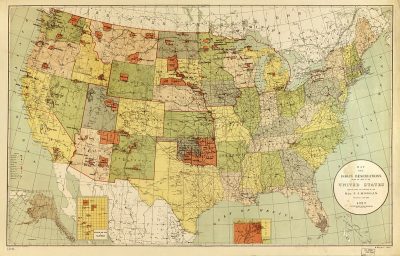 This map on display at the National Library’s exhibit was produced by the US Office of Indian Affairs and showed “Indian Reservations within the Limits of the United States” in 1892. PHOTO: Nasjonalbiblioteket
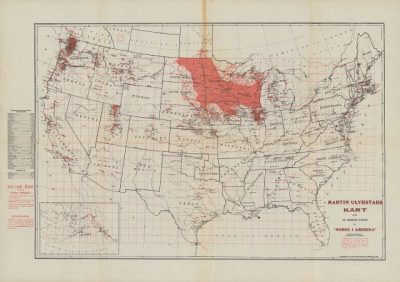 This map, also on display, was produced in 1901 by Norwegians in Minneapolis especially for Norwegian immigrants. The red areas show concentrations of Norwegian settlement, especially in the upper Midwest that attracted many Scandinavians through the federal government’s offers of land once held by indigenous peoples. PHOTO: Nasjonalbiblioteket
Blackhawk said there’s recently been “a tremendous outpouring of new understandings from the Native American perspective,” also of the challenges faced by the indigenous population where the majority of Scandinavian immigrants settled. Some tribes had already agreed to re-settle themselves, Blackhawk noted, through treaties with the US government that were supposed to give them rights to preferred areas best-known to them, but the borders of those areas didn’t prove to be respected. That led to major conflicts.
Some of the newly arriving Scandinavian immigrants joined family members already in areas that became the US states of Wisconsin in 1848, Minnesota in 1858 and North Dakota in 1889, which had all been home for centuries to various indigenous groups. Then the US Homestead Act of 1862 offered many new immigrants land, luring even more and all part of the federal government’s westward expansion effort that was complicated by the Civil War. Blackhawk made a point of explaining how that war also led to great “chaos” in the west and, not least, violations of the treaties that the US government didn’t have the capacity to enforce.
Many of the Native American uprisings that followed involved treaty violations by both natives and immigrants, and led to horrific battles. The National Library’s new exhibit includes an account of a Norwegian immigrant survivor’s letter home describing the deaths of family members killed in the violence. It also includes information about how the millions of indigenous people who’d been living on the continent that became North America were reduced to just over 200,000 already by the 1890s.
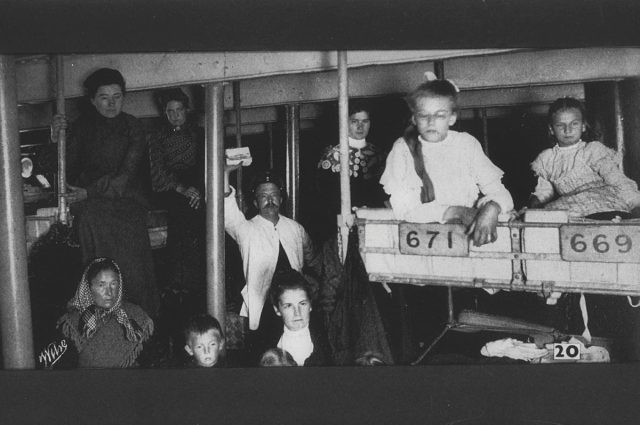 By the time this photo of a Norwegian emigrant family was taken on board a ship leaving Norway in 1904, many of the worst battles were over, but tensions remain. PHOTO: Anders Beer Wilse/Nasjonalbiblioteket
Current events tied to the bicentennial of the Norwegian emigration to the US otherwise tend to highlight the positive. Norwegian Prime Minister Jonas Gahr Støre, for example, referred to the emigration bicentennial in his recent meeting with US President Donald Trump at the White House, stressing how it illustrates the “long and lasting ties” between Norway and the US that he’s keen to preserve amidst political turmoil and Trump’s threatened trade wars.
The Norwegian Embassy in Washington DC is also using the 200 years of Norwegian immigration to nurture ties between Norway and the US, even though that raises ironies on both sides. Immigration is currently controversial in both Norway and the US, with strict limits put on it even though today’s immigrants seek the same things Norwegian immigrants did when they left for the US: Freedom and prosperity. In Norway’s case, the embassy itself reports that more than a third of Norway’s entire population emigrated to America between 1825 and 1940.
 Norway’s ambassador to the US Anniken Huitfeldt (second from left) invited the new US Defense Secretary Pete Hegseth to celebrate 200 years of Norwegian emigration to the US. Hegseth, a conservative politician in an administration that opposes immigration now, said he was proud of his own Norwegian roots but his visit sparked more controversy around via comments to the embassy’s Facebook page . PHOTO: Utenriksdepartementet/Norwegian Embassy in the US
The ironies further surfaced when the embassy recently welcomed the US’ controversial new defense minister, Pete Hegseth, to a celebration of the massive Norwegian emigration. They also presented him with a detailed account of his own Norwegian roots that Hegseth embraced. Newspaper Aftenposten reported on how Hegseth said he was proud of his Norwegian ancestors who sought a better life in the US. His own government, meanwhile, is keen on restricting immigration to the US, keeps reinforcing its wall along the Mexican border, and is undertaking mass deportations of those who arrived illegally but also to seek a better life and offer an important if exploited source of labour.
Professor Blackhawk, meanwhile, thinks there’s still “little history of what was going on behind the lines of the (US’ early westward) expansion” but he’s glad it’s emerging. He stressed how French explorers successfully negotiated fur trading with native tribes for years before all the hostilities broke out. While much of the western expansion involved resistance and compliance, he sees new signs of an emphasis on resilience.
Scandinavians were clearly involved in some of the serious conflicts of the 1800s in their new land, but given language difficulties, perhaps didn’t understand treaty terms. Blackhawk suggested that it’s not just a history of oppressors “but perhaps more power brokers of a different kind.” Again he pointed to the difficulties of enforcing more than 300 treaties with Native Americans during and after a Civil War that wasn’t just about slavery but “predicated on expansion of western land.” It was also in the US’ interests to settle and develop the west.
The conflicts surrounding European emigration to America have also been the subject of western movies and other films for years, not least the two versions of The Emigrants based on Swedish emigration history but also the iconic Little Big Man from 1970. It features both a Swedish immigrant wife and the most famous of all the battles that also involved conflicts within native tribes. It ends after the following exchange between the main character, a young white man taken in by Native Americans after an attack on his own family, and his new Native American “grandfather:”
“Why do you want to die, Grandfather?”
“Because there’s no other way to deal with the white man, my son. Whatever else you can say about them it must be admitted: You cannot get rid of them.”
NewsinEnglish.no/Nina Berglund