Some dismiss the Elon Musk-led Department of Government Efficiency (DOGE) as ineffective in streamlining government and cutting spending.
Others slam DOGE for overstepping legal boundaries, accusing it of violating the separation of powers, infringing on employment and privacy laws and defying the judiciary.
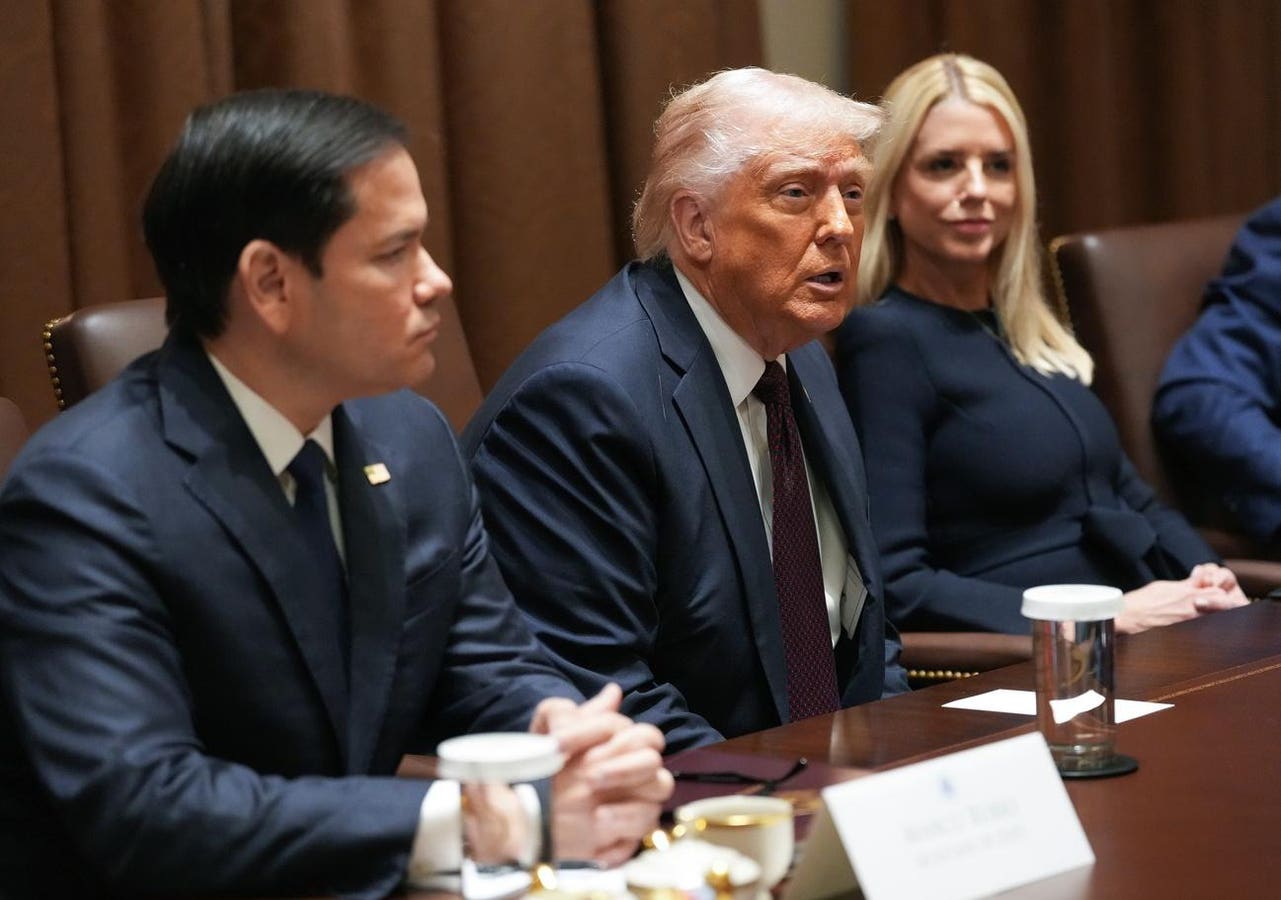
WASHINGTON, DC – MARCH 24: U.S. President Donald Trump (C) delivers remarks as he is joined by … More Secretary of State Marco Rubio and Attorney General Pam Bondi during a cabinet meeting at the White House on March 24, 2025 in Washington, DC. This is Trump’s third cabinet meeting of his second term, and it focused on spending cuts proposed by the Department of Government Efficiency (DOGE). (Photo by Win McNamee/Getty Images)
Getty Images
But that quarter claiming overreach is notably selective—executive boldness received their deference when the shoe was on the other foot. Joe Biden ushered in “whole-of-government” crusades, unilateral and unfair student loan forgiveness and eviction moratoria—all more radical than DOGE’s mission to protect taxpayers from these very sorts of unauthorized spending and regulatory escapades.
As for alleged overreach in 2025, critics may have a point—but not in the way they intend. After more than a century of progressive centralization, Congress has already assumed virtually every imaginable power—and delegated fulfillment to the executive branch. So despite invective aimed at Trump and DOGE, limiting executive power is hardly what progressives want. For example, at this very moment in the “one big beautiful bill” budget reconciliation debate, Democrats are fighting efforts to require congressional affirmation of major rules issued by the unelected administrative state.
What really alarms critics seems to be the opposite of what they claim. It’s not just fear that Trump and DOGE might curb executive overreach—it’s the deeper threat that they could shrink the executive branch itself (such as by commencing abolition of the Department of Education) and even mount a legitimate challenge to the power of a co-equal branch. After all, Congress has long overstepped its bounds by both delegating vast lawmaking authority to the administrative state and ignoring the limits of its enumerated powers. In calmer times, efforts to restore that balance would simply be called checks and balances.
DOGE-like efforts aren’t entirely unprecedented. George H. W. Bush’s White House Council on Competitiveness aimed to reduce regulatory burdens. The first Trump adminsitration installed “Regulatory Reform Officers” at agencies–early versions of today’s “DOGE Team Leads.”
Flashy but temporary, the more aggressive DOGE is slated to dissolve during the July 4, 2026, America 250 celebrations. But its scope, like the executive branch itself, is inherently limited–so a better perspective is needed than the fury and headlines invite. Even Executive Order 14158—the directive establishing DOGE—states it “shall be implemented consistent with applicable law.” That clause is a standard feature in most executive orders.
A key question: Are DOGE’s policies more or less invasive than the actual or intended actions of those now attacking it? Does an unfettered administrative state align with the rule of law—or is it DOGE-like attempts to constrain the unelected that better uphold it?
Cuts in Workforce
As for alleged “gutting,” DOGE can’t abolish agencies outright–only Congress can. Working with agency heads, however, DOGE can deflate and scale back operations. For example, USAID, long criticized for its global aid adventures and taxpayer-funded NGO subsidies, has reportedly been largely folded into the State Department under Marco Rubio.
Workforce reductions are prioritized across the bureaus. These face legal challenge, with a California judge Susan Illston just this past week blocking DOGE/Trump reorganizations and reductions at 21 departents and agencies. Buyouts and attrition are claimed to have resulted in cuts of some 150,000 personnel. By contrast, termination of federal employment for not submitting to the COVID vaccine prompted little comparable outrage from opponents of Trump downsizing.
Donald J. Devine, who served as Ronald Reagan’s Office of Personnel Management (OPM) director and author of Reagan’s Terrible Swift Sword, has chronicled how that administration slashed the bureaucracy by 100,000. Regarding DOGE, Devine observes that under Article II, “The voters elect the president, and he is to execute policy through Article II and his agency officials subject only to the law.” This includes the authority to reorganize and reduce the federal workforce. Trump’s E.O. 14210 (introducing a 4-for-1 attrition model) and E.O. 14170 (prioritizing merit-based hiring) position DOGE as a legitimate continuation of this tradition. Probationary employees and non-essential functions, subject to fewer protections, can be reduced for budgetary or organizational efficiency—as long as due process is observed.
Judge Illston’s restraining order follows a lawsuit from the taxpayer-funded American Public Health Association and the American Federation of Government Employees, mirroring other lawsuits by grant-dependent NGOs such as the Center for Biological Diversity over environmental agency cuts, and Public Citizen over data access at the Treasury Department and over DOGE’s structure. One cannot help but notice that success for such coalitions means protecting their taxpayer-supplied federal funding.
The attack on DOGE’s structure rings hollow in this context. A stronger case might be made that it’s federal unions and taxpayer-backed NGOs perpetually aligned with government expansion that warrant scrutiny—not DOGE.
Cuts In Non-Statutory Programs And Contracts
Amid reductions in force and downsizing, DOGE has so far claimed $165 billion in savings. Granted, that is well short of the $2 trillion Musk touted back in October. Even that lower claim is widely challenged, which contracdicts claims of DOGE evisceration. But since the cuts strike at some of Washington’s most entrenched in-house lobbying and NGO funding pipelines like USAID, their long-term consequences may prove considerably more significant than today’s dollar figures imply.
The same would go for cancelled contracts that seem unimpressive in dollar terms. If a tide rather than a ripple is being stemmed, “butterfly-effect” style, the effect could be enormous. Policymakers often remind us the U.S. is the world’s largest purchaser of goods and services. That makes the laundering of regulation through subsidies, grants, contracts and state grants-in-aid a major concern. Trump’s E.O. 14222 (“Implementing the President’s ‘Department of Government Efficiency’ Cost Efficiency Initiative”) not only audits these channels for waste but also indirectly promises to cut regulatory excesses embedded in these expenditures (such as federally funded broadband rollout) that tend to happen with minimal public input or oversight.
While Congress holds the purse strings under Article I, Article II affords the president narrow leeway to shape the prioritization and execution of discretionary funds within Congress’s mandates. DOGE’s critics petitioning federal courts at seemingly every turn had few concerns when the Biden administration embedded DEI and climate policy throughout the government, including at independent agencies. DOGE now seeks to reverse that discretionary tilt with a discretionary tilt. Shuttering programs that lack explicit statutory authority and refocusing agencies on core missions is a valid, constitutional exercise of executive authority.
Deregulation
While congressional action obviously is required to eliminate agencies and enabling statutes outright, legitimate deregulation can begin with the same zeal that created overregulation. DOGE Team Leads, under E.O. 14219, are directed to “commence the deconstruction of the overbearing and burdensome administrative state,” fast-tracking the repeal of significant rules crowding the Federal Register and Code of Federal Regulations. Rescissions of rules are prioritized based on recent Supreme Court decisions limiting administrative overreach.
A Trump memorandum eelaborating on E.O. 14219 invokes the Administrative Procedure Act’s “good cause” exemption to bypass notice-and-comment when repealing certain rules—a controversial move, but one routinely used largely without controversy to add regulations. Years ago, the Government Accountability Office found that a third of federal rules were issued without proposed rulemaking. If using that shortcut to remove rules is “abuse,” it’s a far milder one than using it to impose them.
Concerns Over Privacy and Data Access
Lawsuits also challenge DOGE’s foundational mandate for “full and prompt access to all unclassified agency records, software systems, and IT systems,” citing privacy risks for federal employees’ personal information. However, much of this access may align with longstanding data collection practices at OPM. Concerns about Social Security numbers or student loan records are valid, but in the context of a public already facing potential social credit scores, deplatforming, and even remote automobile disabling under Biden’s infrastructure law, DOGE seems among the lesser threats to privacy, particularly given an explicit mission to weaken federal scope.
Critics also worry about Musk’s ties to private-sector firms like Tesla and SpaceX, given DOGE’s access to contracts and data. Those are fair concerns, but such conflicts are hardly unique to this administration. Business-government entanglements, revolving doors, and public-private partnerships have been a bipartisan tradition for decades and should be addressed in total.
Conclusion: More Barking, More Biting
While several of Trump’s more than 160-plus executive orders invoke DOGE, a number with spending and deregulatory tilt do not. This suggests the broader Trump rollback effort is much wider than DOGE’s temporary remit. Just this past week, for example, Trump issued directives to end unpopular water pressure standards for faucets, showers, bathtubs and toilets, to require faster rule publication in the Federal Register and to end overcriminalization in federal rules. None of these invoked DOGE.
Legal battles over Trump-era spending and regulatory authority will extend well beyond DOGE’s July 2026 expiration. But at bottom, DOGE appears to represent a creative and controversial but not illegal use of executive power to shrink the state. It’s less aggressive than decades of power expansions by both the executive and Congress. Compared to Biden’s expansions, DOGE and the Trump rollbacks hardly present a constitutional crisis. That crisis and the disregard of rule of law came earlier, with the erosion of enumerated powers and the bipartisan drift toward centralized overreach that sidelined the Framers’ vision of limited government.
Ironically, Trump’s own “swampy” impulses—like antitrust crusades, tariffs, a sovereign wealth fund, campus speech codes, regulation of concert ticket prices, new drug price controls and even a DOGE savings dividend—may lay the groundwork for future progressive regulatory grabs. In that light, DOGE hasn’t gone nearly far enough and needs sharper teeth.