you were supposed to mark all the correct solutions (in this case there are 2)
[deleted]
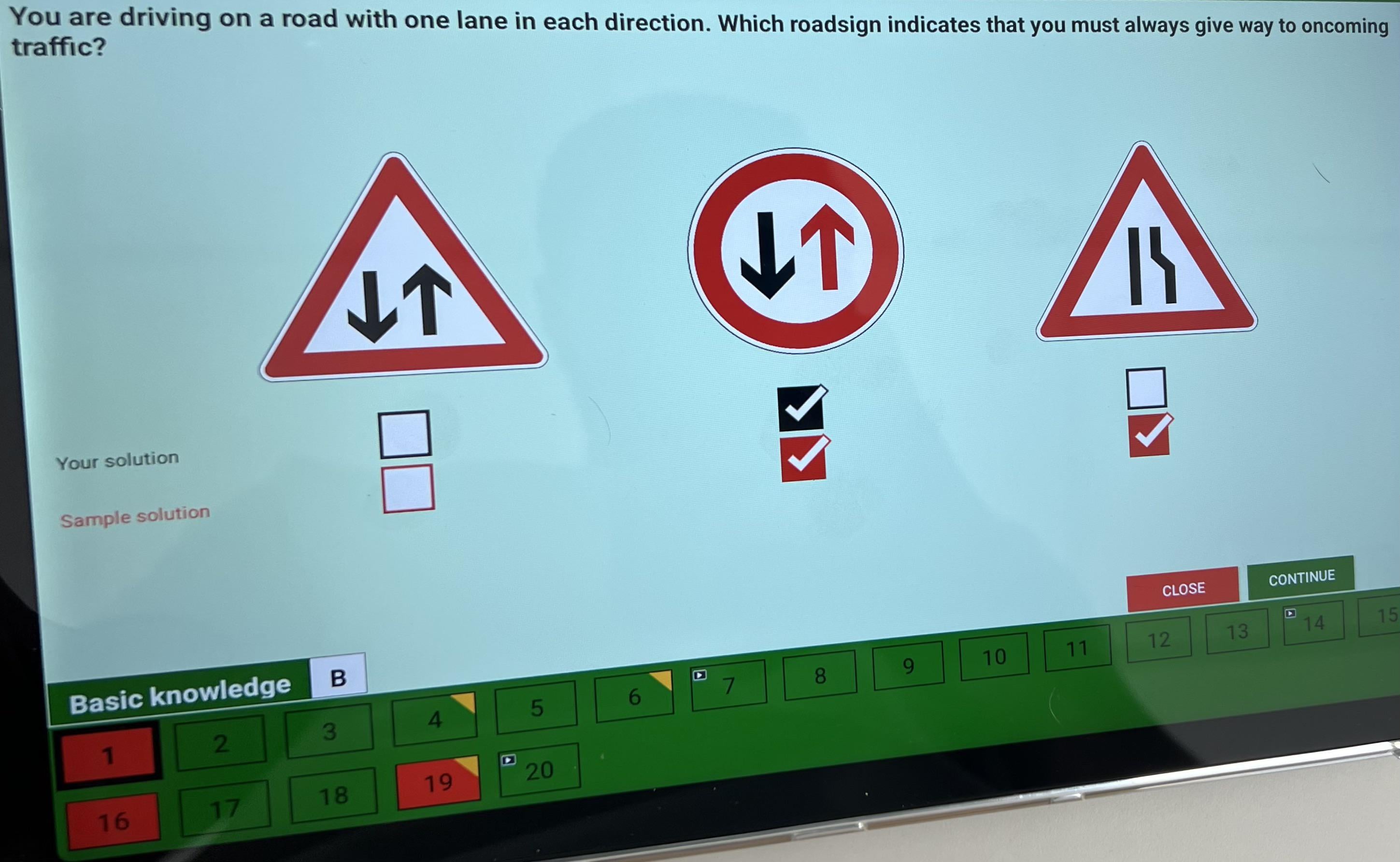
The second sign is literally called give way to oncoming traffic. The third sign means road smalling from your side, so oncoming traffic also has priority.
The lane with a hindrance in it must always give way to an unblocked lane. Thus when the road narrows on your side, you must wait before the narrow until the other lane is clear. Same for when a car is parked on your side.
§ 6 S. 1 StVO: “Wer an einer Fahrbahnverengung, einem Hindernis auf der Fahrbahn oder einem haltenden Fahrzeug links vorbeifahren will, muss entgegenkommende Fahrzeuge durchfahren lassen.”
Who wants to pass through a Fahrbahnverengung (which is the case) on the left (also the case) must let oncoming traffic pass.
I even asked chatgbt about it ! He told me 1000times am right
[deleted]
I made the same mistake yesterday when training for the test. This is the formal explanation my training app gave me:
“The traffic sign warns of a narrowing on the right-hand side of the carriageway. As the person in front of the obstacle has to wait, it is your duty in this case to give priority to oncoming traffic. (translated)”.
As always for driving lesson questions, you have to mark every correct answer
B is correct, because sign 308 indicated right of way before oncoming traffic, in this orientation meaning your side has to wait, oncoming traffic has right of way
C is correct because sign 121 (121-10) indicates a significantly tighter road oder blockage on your side of the road and the STVO rules that if there is blockage on your side of the road, you have to be more careful and give way to oncoming traffic. This is also true if there is no sign to indicate that. The sign is mostly just directing your attention to the dangerous area if it isn’t easily visible or inside an active construction zone. Because of that, if you see this sign, you have to give way, which makes C correct.
Important thing though, this is question 1.4.40-013 and I just looked up the question in German. Your issue here is semantics. The German original question is asking “at which of the road signs do you need to yield to oncoming traffic” no word about the pure meaning of the sign, but about the meaning of the rule.
Also if you have additional question, r/StVO is a great community for discussing German traffic rules.
The traffic sign “road narrowed on one side from the right” means that your lane will narrow significantly. Here you have to give way to oncoming traffic. The traffic sign “Give priority to oncoming traffic” shows with the red arrow that you must give priority to oncoming traffic.
If you have more detailed questions later on i can also recomend r/StVO but its german
The third sign means your side and only your side of the road is blocked, getting more narrow.
If any kind of obstacle blocks your side, the oncoming traffic has priority.
The middle sign literaly means you must wait for the oncoming traffic.
The first side is signifiying the end of a one way street, when a one way street becomes a regular street and you must pay attention to oncoming traffic and other rules, which don’t apply in a one way street.
Iirc, Circles are an instruction, triangles warnings/information.
Based on the comments OP made, I am glad that there is no possibility for a re-evaliation.
Didn’t the question say it’s one lane each way? I always see the 3rd sign when two lanes turn into one.
Weird post. People explained very well why you were wrong but you cant accept that and keep arguing about it. Why even ask then
Last one is a warning sign for an obstruction in your lane, so you will always have to give way.
This one also never sat right with me. I just memorized it in the end. I understand that if the road narrows on the lane you’re in that you should let the people on the left lane pass first but realistically, where would a road narrow / end that there would be oncoming traffic in the first place? Then it would be a single lane that can be used in both directions…?
The first sign, just tells you, that there is now opposing traffic. It stands usually, when a 4 lane road with median merges into a 2 lane road.
The second signs tells you to give way to opposing traffic. This stands usually on narrow roads, where only 1 car can pass through. Most common bridges, but could also be on other narrow pathways, sometimes also on roadworks.
The third sign just means the the right lane gets narrower, In most of the cases
The question asks you which sign indicates you must give way, and not what sign has a specific textbook name. If you see a sign where your side merges into the oncoming, you have to give way to them.

20 comments
you were supposed to mark all the correct solutions (in this case there are 2)
[deleted]
The second sign is literally called give way to oncoming traffic. The third sign means road smalling from your side, so oncoming traffic also has priority.
The lane with a hindrance in it must always give way to an unblocked lane. Thus when the road narrows on your side, you must wait before the narrow until the other lane is clear. Same for when a car is parked on your side.
§ 6 S. 1 StVO: “Wer an einer Fahrbahnverengung, einem Hindernis auf der Fahrbahn oder einem haltenden Fahrzeug links vorbeifahren will, muss entgegenkommende Fahrzeuge durchfahren lassen.”
Who wants to pass through a Fahrbahnverengung (which is the case) on the left (also the case) must let oncoming traffic pass.
I even asked chatgbt about it ! He told me 1000times am right
[deleted]
I made the same mistake yesterday when training for the test. This is the formal explanation my training app gave me:
“The traffic sign warns of a narrowing on the right-hand side of the carriageway. As the person in front of the obstacle has to wait, it is your duty in this case to give priority to oncoming traffic. (translated)”.
As always for driving lesson questions, you have to mark every correct answer
B is correct, because sign 308 indicated right of way before oncoming traffic, in this orientation meaning your side has to wait, oncoming traffic has right of way
C is correct because sign 121 (121-10) indicates a significantly tighter road oder blockage on your side of the road and the STVO rules that if there is blockage on your side of the road, you have to be more careful and give way to oncoming traffic. This is also true if there is no sign to indicate that. The sign is mostly just directing your attention to the dangerous area if it isn’t easily visible or inside an active construction zone. Because of that, if you see this sign, you have to give way, which makes C correct.
Important thing though, this is question 1.4.40-013 and I just looked up the question in German. Your issue here is semantics. The German original question is asking “at which of the road signs do you need to yield to oncoming traffic” no word about the pure meaning of the sign, but about the meaning of the rule.
Also if you have additional question, r/StVO is a great community for discussing German traffic rules.
The traffic sign “road narrowed on one side from the right” means that your lane will narrow significantly. Here you have to give way to oncoming traffic. The traffic sign “Give priority to oncoming traffic” shows with the red arrow that you must give priority to oncoming traffic.
If you have more detailed questions later on i can also recomend r/StVO but its german
The third sign means your side and only your side of the road is blocked, getting more narrow.
If any kind of obstacle blocks your side, the oncoming traffic has priority.
The middle sign literaly means you must wait for the oncoming traffic.
The first side is signifiying the end of a one way street, when a one way street becomes a regular street and you must pay attention to oncoming traffic and other rules, which don’t apply in a one way street.
Iirc, Circles are an instruction, triangles warnings/information.
Based on the comments OP made, I am glad that there is no possibility for a re-evaliation.
Didn’t the question say it’s one lane each way? I always see the 3rd sign when two lanes turn into one.
Weird post. People explained very well why you were wrong but you cant accept that and keep arguing about it. Why even ask then
Last one is a warning sign for an obstruction in your lane, so you will always have to give way.
This one also never sat right with me. I just memorized it in the end. I understand that if the road narrows on the lane you’re in that you should let the people on the left lane pass first but realistically, where would a road narrow / end that there would be oncoming traffic in the first place? Then it would be a single lane that can be used in both directions…?
The first sign, just tells you, that there is now opposing traffic. It stands usually, when a 4 lane road with median merges into a 2 lane road.
Here an example:
[https://maps.app.goo.gl/j966jPQk6vvFNTTD7](https://maps.app.goo.gl/j966jPQk6vvFNTTD7)
___
The second signs tells you to give way to opposing traffic. This stands usually on narrow roads, where only 1 car can pass through. Most common bridges, but could also be on other narrow pathways, sometimes also on roadworks.
Example:
[https://maps.app.goo.gl/eVxRdimPpCvo2L2TA](https://maps.app.goo.gl/eVxRdimPpCvo2L2TA)
the opposing sign is blue and will give you the right of way
[https://maps.app.goo.gl/eok43yztSZ2bpK719](https://maps.app.goo.gl/eok43yztSZ2bpK719)
__
The third sign just means the the right lane gets narrower, In most of the cases
The question asks you which sign indicates you must give way, and not what sign has a specific textbook name. If you see a sign where your side merges into the oncoming, you have to give way to them.
Comments are closed.