
War movies are something I got interested in from my great-grandfather, whom I was lucky enough to have met. He served in World War II as part of the Royal Canadian Navy and made sure to tell me as many stories as he could before he passed, so that someone would know what he had really been through. It sort of bred a fascination in me, and to this day, I can still see my old Papa in various aspects of many films.
So, throughout my 25 years of life, I’ve seen a lot of different war movies, exploring a wide variety of conflicts and eras. Sadly, many begin to feel the same, with the same general message and overall energy. War is hell, I get it, but sometimes, filmmakers need to come up with better ways to say it. Well, if you’re looking for something a little different, no matter how, I’m happy to say there are many films I’ve seen that have definitely stood out. I’ve seen countless entries in the genre, so you can believe me when I tell you these war movies feel truly singular, and you’ll be doing yourself a favor by watching them.
10
‘1917’ (2019)
Directed by Sam Mendes

Image via Universal Pictures
Alright, so movies about World War I are definitely nothing new or strange, but there’s a lot that 1917 has going for it that helps set it apart from other movies on the topic. The main aspect about it is that it’s filmed in such a way that it feels like one continuous take, which is a really clever way of keeping the audience where the action is. It’s definitely not the first movie that ever made use of such a technique, but it’s not a common thing for war movies to use.
It’s a surefire way to keep the audience invested, though, I’ll tell you that. I think one of the best parts about it is that the protagonist, George MacKay’s Lance Corporal Schofield, is pretty much entirely alone for much of his journey–it really is about Schofield’s journey rather than the war or the battle itself. It’s nothing emotionally profound, in my book, but it’s by far the most organic and original movie I’ve seen in terms of sheer execution and formatting.
9
‘When the Wind Blows’ (1986)
Directed by Jimmy T. Murakami

Image via Kings Road Entertainment
There are lots of animated war movies out there, and there are many of them that I’ve seen. But something about When the Wind Blows just hits different. The movie is set in the English countryside as a nuclear war engulfs the landscape, following an aging couple as they do everything in their power to survive the devastation. The animation style is really interesting. Some of the sets look oddly realistic, but the characters and props have this really unconventional art style that I can’t quite compare to anything else.
Some surreal and emotional moments are set to music meant to represent a certain thing without saying it, and it definitely leaves an impact. It’s not a particularly frightening movie in the same sense as other nuclear war films, but it’s by far one of the most depressing films ever made, as it depicts two vulnerable people at a time when they need the most help. Tragically, no one else is around to offer it to them, leading to a miserable existence, in spite of their attempted optimism.
8
‘Civil War’ (2024)
Directed by Alex Garland

Image via A24
Civil War is a hypothetical film, centring on a Second Civil War in the United States. The whole “America under siege” thing isn’t a new concept in cinema, by any means, but normally, this concept only serves as a backdrop for action and excitement. This movie isn’t just about that, because there’s an actual point that Alex Garland makes here. He’s said that it’s supposed to be about the demonization of the press, with many politicians telling their followers not to trust journalists, even when war correspondents are doing good work and risking their lives in active war zones to bring home news.
It would appear that the only way for Westerners to truly understand what these journalists go through is to have the war hit somewhere closer to home. As such, Civil War is pretty much entirely about journalists, though it’s not without its more action-packed parts. It’s not every day that a movie both makes a unique and relevant point while presenting an interesting hypothetical. On top of that, it’s about changing public opinion about the press. I might not totally be considered a journalist, but what can I say? I’ve got a soft spot for that.
7
‘Beasts of No Nation’ (2015)
Directed by Cary Joji Fukunaga
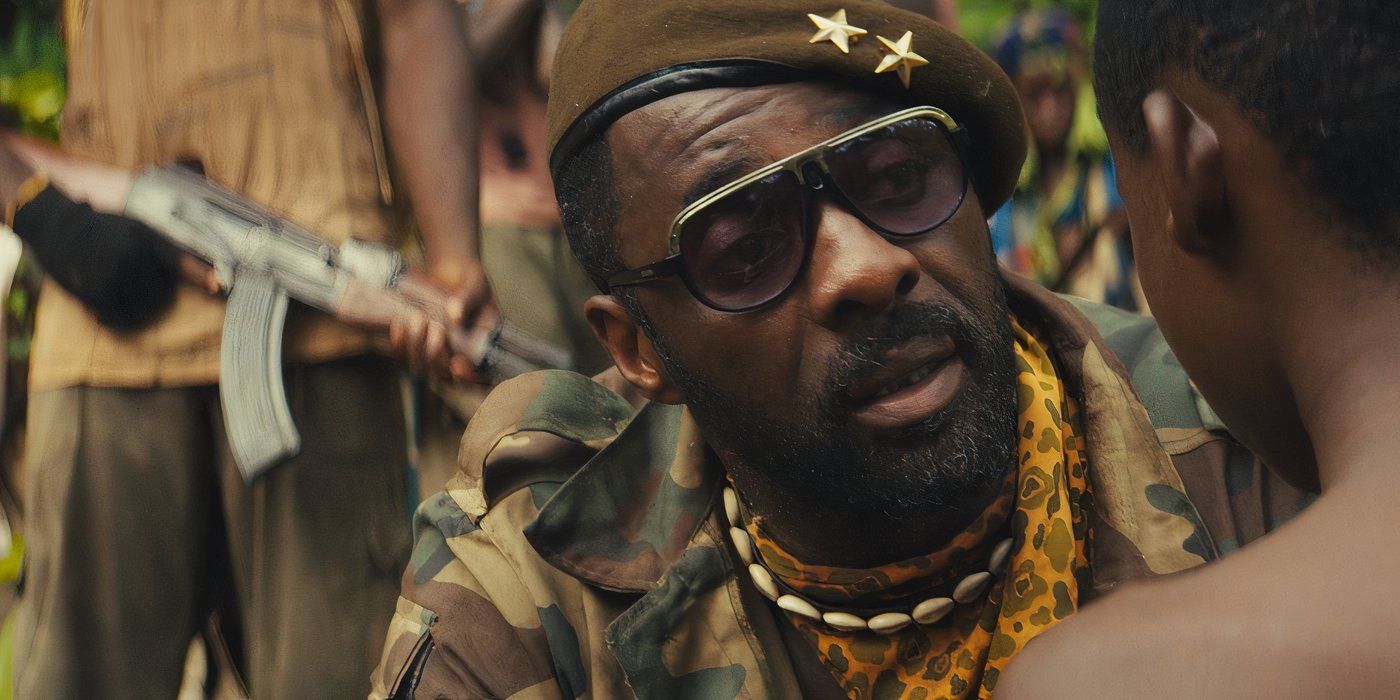
Image via Netflix
Beasts of No Nation likes to be a little bit vague about when and where it’s taking place, but I feel that it does it on purpose. The point of this film is that the when and where of it doesn’t matter, because the problems it’s addressing are seriously detrimental to the human race, regardless of circumstances. Based somewhere in Western Africa, Beasts of No Nation is about a child named Agu (Abraham Attah), who loses his family in his country’s civil war before being scooped up by the rebel forces.
These rebels train him to be a child soldier and force him to perform acts that no one, much less a child, should have to do. I’m not sure I’ve ever seen a movie that portrays the plight of child soldiers this way. It’s not that it hasn’t been done before in movies; it’s just never been done in such a brutal way, as far as I’m concerned. It’s one of the most disturbing war movies I’ve ever seen. It’s not that it’s absolutely brimming with brutal violence, but it shows how kids in civil wars are exploited and abused for profit.
6
‘300’ (2007)
Directed by Zack Snyder

Image via Warner Bros.
So, most people have seen 300 at this point, but that doesn’t change the fact that there’s a lot that sets it apart from other war films, to the point where a lot of people probably don’t even consider it a part of the genre. 300 does have some fantasy aspects, but it is still a (highly embellished) true story about the Battle of Thermopylae during the Greco-Persian Wars in the Fifth Century BCE. Here, King Leonidas (Gerard Butler) of Sparta led a sacrificial mission to delay the Persian invaders so that the rest of Greece would have time to prepare.
The main reason it’s so unlike anything else is due to its cinematography. Many movies about ancient warfare tend to show the carnage in a fast, chaotic way. However, this movie is extremely stylized, utilizing a lot of slow-motion shots and close angles to keep the audience right in the middle of the action and give time for them to really absorb the events unfolding. 300 doesn’t want you to miss a single second, and with the way it’s shot, I can honestly say it’s way more exciting than just seeing two huge armies clash because here we get to see some choreography with the swordplay, which certainly isn’t common.
5
‘CSA: The Confederate States of America’ (2004)
Directed by Kevin Willmott

Image via IFC Films
If you’ve never heard of CSA: The Confederate State of America, allow me to enlighten you. This mockumentary film is an alternate history flick about the American Civil War, attempting to show what the world would have looked like had the Confederacy triumphed over the Union. The movie is framed like a British documentary being broadcast to American audiences, and even comes with commercial breaks. The film features several comedic aspects, but also a lot of deliberately offensive things, but it’s not only for shock value.
Director Kevin Willmott is Black himself and made the film as a reminder of how awful the practice of slavery is and a critique of how aspects of it are still deeply embedded into American society. It’s not offensive just to get attention or to poke fun at anyone; it’s offensive in a way that it wants its viewers to feel disgusted, to effectively make its point. In any case, I don’t think I’ve ever seen a movie that has made so many poignant metaphors in such a striking way, utilizing the format of daytime TV to make it feel so much more real. It’s a necessary watch that feels like it exists in a distinct genre, and I wholeheartedly recommend it. That said, it’s not for everyone, and if you don’t want to watch it because of its (intentionally) offensive script, I understand completely.
4
‘Letters From Iwo Jima’ (2006)
Directed by Clint Eastwood

Image via Warner Bros.
I think one of the most off-putting parts about a lot of war films is how many of them are blatant propaganda, clearly defining American troops as the good guys and depicting the villains as inhuman, faceless savages who are just there to stir up trouble. Of course, there’s often a whole heck of a lot more to it than that, which is probably why I liked Letters From Iwo Jima so much. In spite of being an American film made by American producers, it’s very sympathetic to the Japanese side of the Second World War.
It’s not sympathetic in a pro-fascism way, but in an individual, more human way, as it examines the lives the Japanese troops led when they weren’t at war, only to be forced to leave their lives behind to serve the Empire. The movie also makes it clear that good and evil are not necessarily binary concepts, and that anyone is capable of both, regardless of their affiliation. Some American soldiers commit atrocities, and some Japanese soldiers do their best to save as many people as they can. It’s a movie that completely abolishes the “hero/villain” fallacy of war cinema, which makes it much more emotional and impactful.
3
‘All Quiet on the Western Front’ (2022)
Directed by Edward Berger

Image via Netflix
The 2022 adaptation of All Quiet on the Western Front might just take the cake for my favorite movie of all time. I will fully acknowledge that it’s definitely not the greatest in terms of sheer quality, although it is certainly up there, but I can confidently say that this is the movie that I ended up liking the most. Why? For a number of reasons, actually. First off, I can’t even describe the way this movie makes me feel: There’s just something so sinister, so off about it, from the cinematography to that bone-chilling soundtrack that implies something terrible is just on the horizon.
For a previous list that I wrote shortly following its release on Netflix, I had to watch and rewatch the film three or four times, yet I never grew tired of it. I think the main reason it’s so unique is that this might just be one of the only true anti-war movies. Some movies claim to be anti-war, yet still make it seem like the death happening is for some noble cause, and that it meant something. This movie tells the cold, hard truth of it: The deaths during war are, for the most part, meaningless, especially during the First World War. Not a lot of movies have the guts to make a statement like that, and I think that’s why I like this one so much.
2
‘Come and See’ (1985)
Directed by Elem Klimov

Image via Sovexportfilm
Come and See is set during World War II, but if you want my advice, don’t accept the title’s invitation. Do not, I repeat, do not go and watch Come and See. Not because it’s a bad movie — in fact, it’s quite the opposite. But the things you’ll witness within its approximately two-and-a-half-hour runtime are not to be taken lightly, and will certainly burn themselves into your brain until the day you die.
It’s mostly about a young boy named Flyora (Yuri Kravchenko), who joins the Belarusian partisans as the Nazis invade World War II. But the adolescent witnesses things that no human, regardless of age, should ever see. Some of the scenes and implications are so awful and despicable that I can’t even put them into words. Even though the movie is of astounding quality, it was clearly meant to be a realistic depiction of war and stands above the other films as being exactly that. I know a lot of people hope to see that sort of thing in a movie without the dramatization of cinema, but be careful what you wish for. Watch if you dare, but don’t say I didn’t warn you.
1
‘Threads’ (1984)
Directed by Mick Jackson

Image via BBC
Aside from war movies, I also happen to be a huge fan of horror movies. I’ve seen enough horror movies that, like many other horror fans, they don’t necessarily affect me as much as first-time viewers, and I rarely find myself afraid during a film. But I can tell you with 100% honesty that Threads is the only movie I’ve ever seen that genuinely terrified me. It feels like my life is divided into two parts: Before I saw this film and after, because I never looked at the world the same way again. I had heard of how deeply disturbing Threads was, yet I naïvely thought to myself, “Come on, how bad can it be?” Out of all the words in the English language, I couldn’t string enough of them together in a way that accurately describes the experience of watching Threads.
This is a hypothetical movie about what life would be like if nuclear war broke out, focusing specifically on Sheffield, England. Most films of this calibre like to make the implication that there is hope for the future, but not Threads. This movie makes it abundantly clear that any potential for humanity’s future following nuclear war is utterly hopeless, carrying a heavy presence that, without hyperbole, I physically felt weighing down on me. As important as I feel this movie is, and as much as I loved it, I cannot, in good conscience, recommend it to anyone. Nothing else out there is like it, but honestly, thank God for that.