A critical Nato base in Britain could be knocked out by an undersea cable attack, a parliamentary committee has chillingly been warned.
The Allied Maritime Command, known as ‘Marcom’, could face a communications blackout if deep sea cables connecting the UK to Europe and the US are sabotaged.
It comes as MPs were warned of the renewed threat posed by Russia, which is thought to be behind a string of alleged attacks against critical subsea infrastructure.
Marcom is based at the Northwood military base in Hertfordshire and acts as the operational HQ for the international alliance’s maritime forces.
The secretive facility is one of several to rely on vital fibre-optic cables connecting the UK with the rest of Nato.
However, a retired Royal Navy Commodore warned MPs and peers the critical seabed links were potentially vulnerable to a co-ordinated, multi-pronged attack.
Asked if Marcom could be knocked out by such an onslaught, Cdre John Aitken told members of the joint committee on national security: ‘Yes, they would be in a very difficult position.
‘There was a known fragility around those cables. It is something that is being treated at the moment, I think.
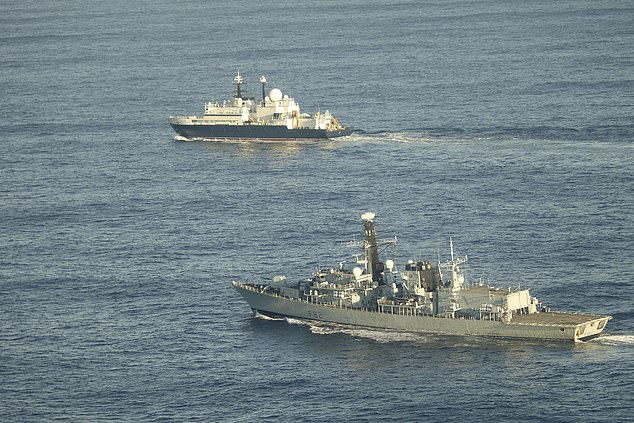
British frigate HMS Somerset (pictured front) flanks the Russian spy ship Yantar near UK water – which was feared to be hoovering up intelligence about the UK’s underwater infrastructure
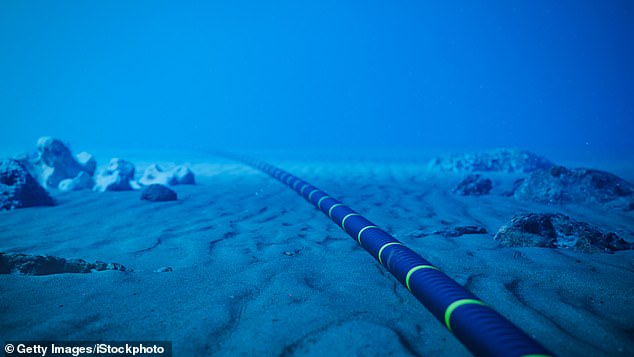
Underwater fibre-optic cables which lie on the ocean floor allow for global communication and internet connectivity between continents, whilst other cables are responsible for carrying electricity (stock image)
‘There are reversionary systems available, but they wouldn’t be immediately available, and they would offer a reduced capability.
‘But yes, if there were a coordinated attack against specific cables, then there would be a loss of capability – which would take hours to restore.’
In the hearing on Monday, MPs were also warned Britain and Nato had forgotten how important its deep sea infrastructure was to modern society.
Military chiefs and political leaders were accused of putting a greater focus on ‘distant wars’ in recent years, instead of shoring up the defences of the cables.
The vulnerability of the underwater web of fibre optics has been thrown into question amid a slew of worrying sabotage attacks across European subsea cables and pipelines, believed to have been sponsored by Russia.
In yet another warning, Niels Markussen, a captain in the Danish navy, claimed the alliance was ‘behind the curve’ in tackling such threats, reports the Telegraph.
Capt Markussen, who is the director of Nato’s Maritime Centre for Security of Critical Undersea Infrastructure, said: ‘I think what we haven’t focused on, what we haven’t realised, is how important this is and how important it has grown over time. We have simply forgotten that.
‘So security has, in a long period of time where we have been fighting the distant wars, moved a long way from [where it is] in our head, so we haven’t really thought [about] security in this area.’
Your browser does not support iframes.
Britain’s major tech and finance industries rely heavily on the underwater data wires.
Should a hostile state like Russia, China or Iran, target them, the nation could face being crippled.
It’s believed about 500 cables around the world carry roughly 95 per cent of all international data.
However, their remote locations and length some of them span, make it almost impossible to be monitored and defended, leaving them vulnerable to attack.
It’s an issue that has already plagued countries across mainland Europe.
In 2022, a series of underwater explosions targeted the Nord Stream pipeline causing gas leaks on three out of four natural gas pipelines, rendering them inoperable.
And since October 2023, at least 11 subsea cables in the Baltic Sea have been damaged in suspected attacks.
Further incidents in the North Sea have seen cables running on the seabed damaged.
The combination has fuelled speculation over who could be responsible for the attacks – with defence sources pointing towards the Kremlin.
It comes after more than 50 Russian ships were observed lurking over areas of high cable density.
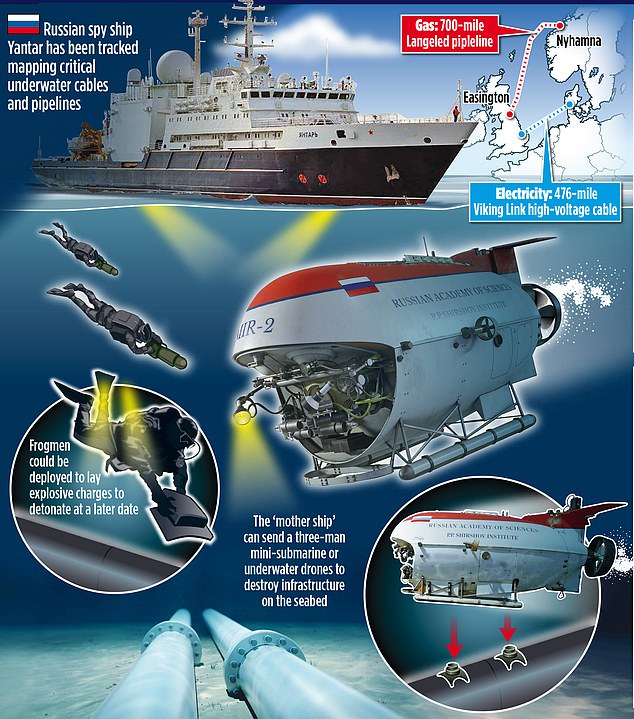
Among them include a Russian ‘spy ship’ which was dramatically headed off by a Royal Navy submarine in November in the Irish Sea close to UK undersea cables.
Nuclear-powered sub HMS Astute rose from the depths and surfaced just yards away from the vessel, called Yantar.
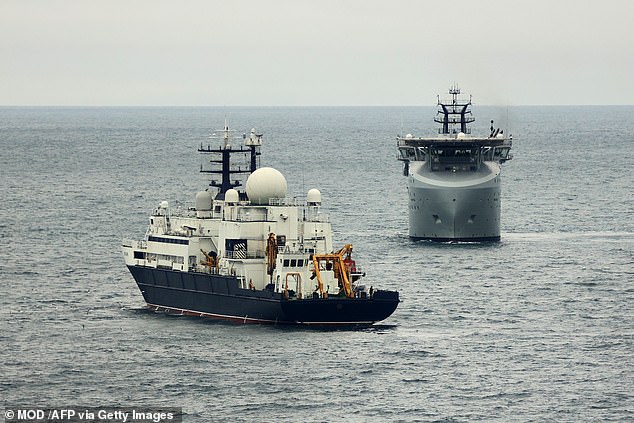
A handout picture released by the Britain’s Ministry of Defence (MOD) in London on January 22, 2025 shows Royal Navy Royal Navy of RFA Proteus (R) patrolling near the Russian vessel Yantar (L), in November 2024

Britain’s Defence Secretary John Healey (R) talks to Commanding Officer of RFA Proteus, Captain Martin Jones (L) as he sits at the dynamic positioning desk on the bridge during his visit to RFA Proteus on February 20, 2025
Your browser does not support iframes.
The purpose-built spy vessel was being used to gather intelligence and study this country’s underwater communications infrastructure, UK Defence Secretary John Healey MPs earlier this year.
It’s thought Yantar is part of Russian tyrant Vladimir Putin’s ‘shadow fleet’ of merchant vessels allegedly used on spying and sabotage missions.
Details about the encounter between the navy submarine and the Yantar were revealed in January by Mr Healey.
Describing the incident, the Defence Secretary also issued a stern warning to Russia, telling MPs: ‘I also want President Putin to hear this message: we see you, we know what you are doing, and we will not shy away from robust action.’
MailOnline has approached Nato for comment.
However, speaking to the Telegraph, a spokesman told the paper it would not comment on ‘hypotheticals’, insisting Nato remained ‘flexible and agile’ in its ability to lead the alliance’s forces.
A spokesman for the UK’s Ministry of Defence added: ‘We are committed to maintaining and enhancing the security and resilience of critical undersea infrastructure.
‘Just as the Defence Secretary called out the activities of the Russian spy ship Yantar hovering over our undersea cables, let those who threaten the UK or our allies be in no doubt that we will defend our undersea infrastructure.
‘This is one area that the Strategic Defence Review is looking at in order to enhance our homeland security.’