As millions around the world tuned in to final of the Eurovision Song Contest last weekend, Russia announced plans for its own international pop music show: Intervision.
Billed as a revival after 45 years of a Soviet-era contest that brought together musicians from across the eastern bloc, Intervision is Moscow’s answer to being banned from Eurovision in 2022 over its full-scale invasion of Ukraine.
The show, due to take place this autumn by decree of Russian President Vladimir Putin, with an organising committee made up of Russian state officials, is likely to differ in tone from the flamboyant European festival of pop.
“The main condition for participating countries: to share our spiritual values,” Russian deputy prime minister Dmitry Chernyshenko said.
By creating homegrown versions of international events, Russia is seeking to restore its cultural and geopolitical clout. Last summer, Russia also staged its own version of the Olympic Games, to compensate for its exclusion from the actual event.
So far, organisers have announced only acts from Russia, Belarus, and Kyrgyzstan. But invitations have been sent out across the former Soviet Union and as far afield as China, Cuba, and Iran. No western or “unfriendly” states are on the list so far.
Some individual performers from the US and European countries have been invited, however, and might even “risk coming”, Moscow’s special representative for cultural co-operation Mikhail Shvydkoi said, without sharing any names.
But “a lot depends on the quality of the performer”, he told local media earlier this month. “This is not a competition for amateurs, after all.”
 Bek Israilov will represent Kyrgyzstan at Intervision © Bek Israilove/Instagram
Any participants will have to square not just with the geopolitics of the event, but also share a stage with active supporters of Russia’s invasion of Ukraine.
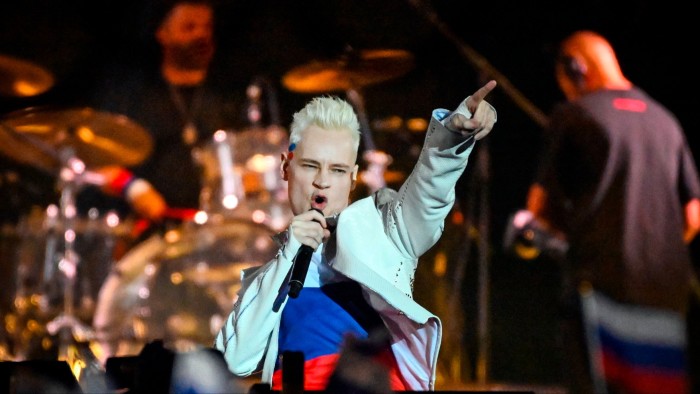
On the weekend of the Eurovision final, Russian state media announced that Yaroslav Dronov, who goes by the stage name Shaman, would represent Moscow at Intervision.
Shaman, who is under EU sanctions for his support for the invasion of Ukraine, is a rising star of the Russian pro-war movement, and has performed ballads such as “I am Russian” at shows in occupied areas of Ukraine.
Bek Israilov, a singer who will be representing Kyrgyzstan at the event as part of the soul trio Nomad, denied feeling uncomfortable about being on a show alongside Shaman.
“We would like to congratulate him and wish him luck,” Israilov said. “He is preparing over there, we will be preparing over here.”
Israilov admitted that the Soviet-era contest was his second-best choice.
“All my life I’ve dreamt of performing at Eurovision, but of course it wasn’t possible,” he said. “Kyrgyzstan is not a participating country in the European competition — even though Australia and Israel have also been allowed to take part.
“But now we have this incredible opportunity,” Israilov added. “I think Intervision will turn out to be even better.”
It marks the end of Russia’s own Eurovision journey. In the early 2000s, it submitted performances by the female duo t.A.T.u., who kissed on stage and spoke out in support of LGBT rights, only to backtrack on this later. In 2009, Moscow hosted the contest after Russian singer Dima Bilan won the year before.
After 2014, as Russia’s international isolation grew over its annexation of Crimea, Moscow increasingly began to present itself as a bastion of conservative, traditional family values.
Eurovision came under regular attack from state media pundits and politicians for championing diversity and inclusivity, including prominent queer performers such as Conchita Wurst, who won in 2014.
In one TV tirade that year, politician Vladimir Zhirinovsky described the drag artist’s win as the “death of Europe”, while the audience shouted “Russia! Russia! Russia!” and waved Russian flags.
The original Intervision was held for a few years in the 1960s and again in the 1970s, first in Prague and then in the Polish coastal city of Sopot. It was never held in Russia.
Though widely seen as an alternative to Eurovision, which was founded in 1956, the Soviet contest also featured artists from countries such as Canada and West Germany: the German group Boney M performed their hit Rasputin in 1979.
Some of its history may not be as palatable to Intervision’s modern-day organisers: in 1978, the grand prize was won by Soviet superstar Alla Pugacheva.
Long considered the true icon of Russian pop music, Pugacheva left Russia after the start of its invasion of Ukraine and lives in exile with her husband, a comedian who has denounced the war. Pugacheva herself has also criticised the Kremlin in cryptic but politically significant ways.
Intervision’s organisers make no secret of its positioning the show as an alternative to the European contest.
“When you’re not particularly welcome somewhere, it looks weak to keep knocking on that door. It’s a much stronger position to make something of your own,” Viktor Drobysh, a music producer, is quoted as saying by the event’s promoters.
Shaman’s partner, the pro-Kremlin political activist Ekaterina Mizulina, known for her prolific writings denouncing Europe’s alleged “woke propaganda”, said Eurovision artists were increasingly “strange”.
“We need to stop looking around all the time at how they do things over there,” Mizulina said. “We need to create our own.”