 Moviment Graffitti
The Palestinian ambassador to Malta Fadi Hanania is urging the country not to wait any longer to recognise Palestine, insisting that the country needed recognition “now.”
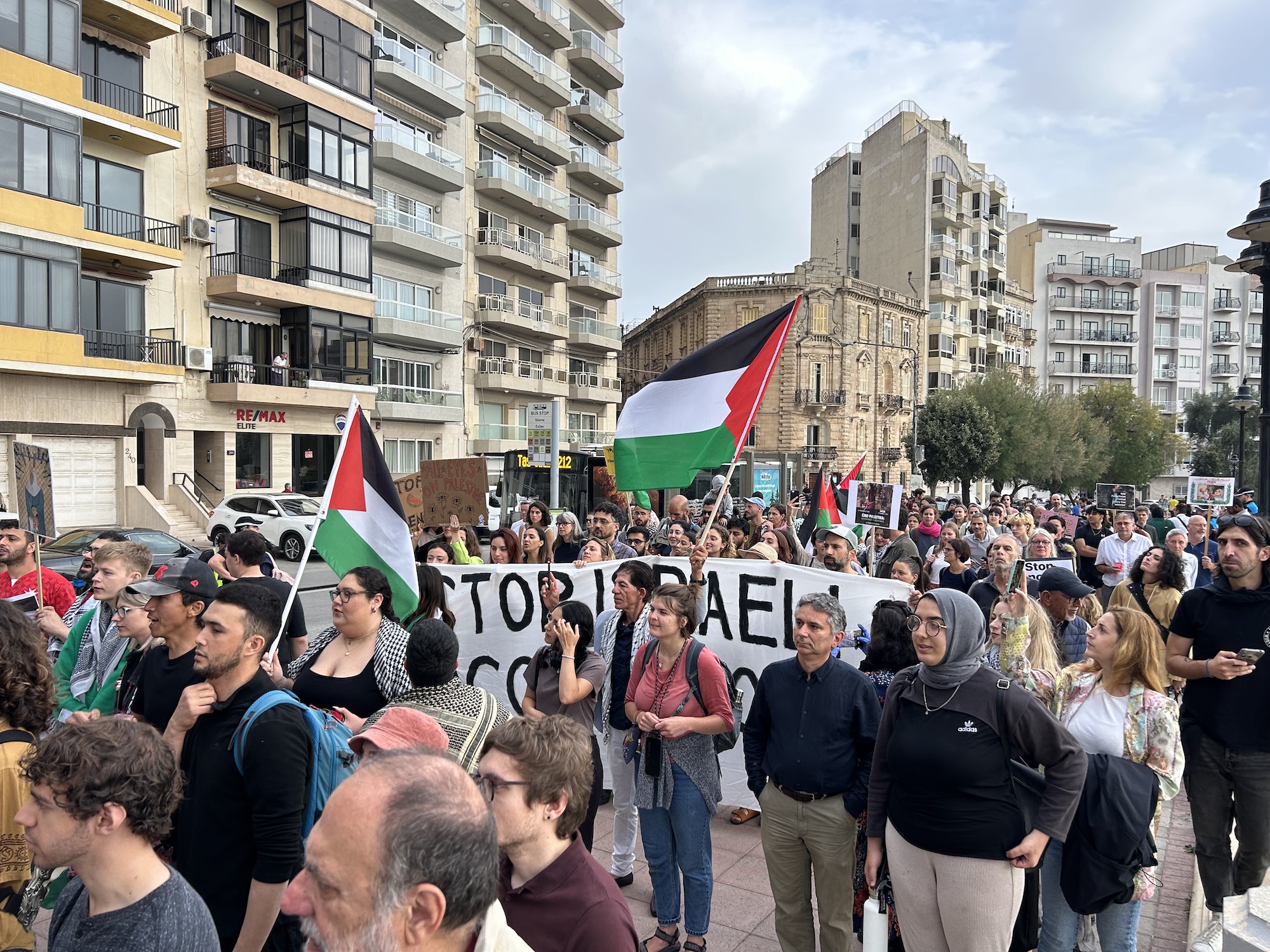
Hanania was addressing a pro-Palestine demonstration in Sliema on Sunday when he reacted to prime minister Robert Abela’s pledge that Malta would recognise Palestine on 20 June, the scheduled date of a United Nations conference.

Abela’s statement comes as Israel’s actions in Gaza – widely considered to constitute a genocide by genocide scholars – receive increasing condemnation from the international community, a development that may suggest that a previously-reluctant Malta now feels “safe” to take such a step.
But Hanania made clear that Malta should not take any more time to act, even as he expressed appreciation for the gesture.
“Honourable prime minister, now is the right time, there is no better time to recognise Palestine,” he exclaimed to a cheering crowd.
“With all our appreciation for what you are doing for our people, we need recognition now!”
A quick first step, followed by decades of dithering
The State of Palestine was formally established on 15 November 1988, when the Palestine Liberation Organisation proclaimed the Palestinian Declaration of Independence.
Malta took the first step to recognise it the very next day, making it one of the first countries on earth to do so.
For many years, Malta’s proclamation was widely considered to be a de facto recognition of Palestine, including by Palestine itself, which maintains a full embassy in Malta. A number of documents presented by Palestine at the United Nations have listed Malta among the countries that recognise it, as recently as 2024, Mauritania, Saudi Arabia and Uganda included Malta in among the countries recognising Palestine in identical letters calling for Palestine to be admitted to the UN. Palestinian government websites also included Malta among the list of countries recognising the State of Palestine ahead of the present Gaza war.
But Malta’s effort to recognise Palestine does not appear to have ever been properly ratified, and in recent years the government has made a point of arguing that Malta merely recognises Palestinians’ legitimate aspirations for statehood.
And while Malta joined three other European countries – Ireland, Slovenia and Spain – in declaring itself ready to recognise Palestine in March 2024, it failed to follow suit even though all others recognised Palestine before the summer. In the aftermath, Abela kept insisting that Malta would recognise Palestine at the “right time.”
Abela now appears to have found the “right time” he was hoping for, even if Hanania – and by extension the State of Palestine he represents – believes an immediate recognition is preferable.