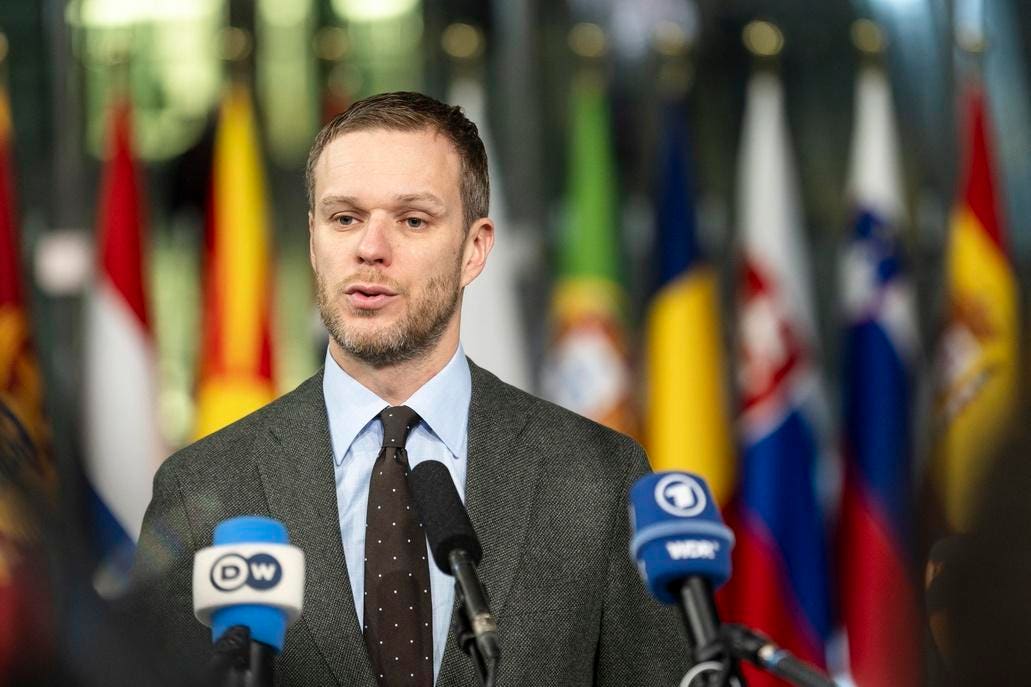
Gabrielius Landsbergis, then the foreign minister of Lithuania, speaks to the press in December … More 2024. (Photo by BOB REIJNDERS/Middle East Images/AFP via Getty Images)
Middle East Images/AFP via Getty Images
Former Lithuanian foreign minister Gabrielius Landsbergis sums up his concerns about NATO with an image borrowed from quantum mechanics: Schrödinger’s cat.
“We’re in an ambiguous position,” Landsbergis explained in an interview last week. President Donald Trump makes inflammatory statements about the alliance, threatening to walk away unless Europe steps up to carry more of the cost. But then Secretary of State Marco Rubio appears in Brussels or some other forum and calms Europe down—Landsbergis calls it “normalizing the situation.” The upshot: confusion and uncertainty. “NATO is challenged and not challenged at the same time,” the former diplomat says. And in his view, this creates a perfect, bone-chilling opportunity for Russian strongman Vladimir Putin.
It isn’t hard to imagine how the scenario would play out. If Putin can convince the White House that the U.S. will benefit from a better relationship with Moscow—as he apparently has—Trump may hesitate to jeopardize the opportunity, even if a NATO ally is attacked.
It’s Landsbergis’ worst nightmare: “Trump will say, ‘I’m in the middle of a conversation with Putin. I can’t break it off. I’m sorry, guys. I’m unable to help. You’re on your own.’” As the Lithuanian sees it, Putin has already maneuvered the U.S. into a kind of “limbo position” that poses grave dangers for the alliance. “Putin may think this is the moment to act—to change the reality” on the ground in Europe.
Gabrielius Landsbergis: Many European Leaders Are Starting To Think About Plan B
No wonder leaders across the continent are starting to think about Plan B. Trump doesn’t have to withdraw from NATO, as he has threatened repeatedly over the years. He is already destroying the trust that made the transatlantic alliance so effective, protecting its members and deterring its enemies through the Cold War and beyond.
One such Plan B is the self-dubbed “coalition of the willing” that came together to support Ukraine after Trump’s brutal Oval Office encounter with Ukraine’s Volodymyr Zelensky. Among its goals: continued military aid for Kyiv, tougher negotiations with the Kremlin, and a just, lasting peace, guaranteed by a European “reassurance force” stationed on Ukrainian soil.
Landsbergis has been sharply critical of the effort. “Why is it so hard to find evidence that the coalition of the willing is actually willing to do anything meaningful, let alone game-changing?” he asked in a recent online post. The group’s premise isn’t wrong, he explains to me. “We’re seeing our world unravel. But something needs to be done—something more—to avert the threat.”
Landsbergis’ own Plan B starts with his home region, the Baltic countries, which have been among the most stalwart in warning the world about Russian aggression and providing aid for Ukraine.
Absorbed by the Soviet Union at the end of World War II and occupied for nearly 50 years, until 1991, the three Baltic states—Estonia, Latvia, and Lithuania—understand Russian imperialism better than almost anyone except maybe Ukraine. According to the Kiel Institute for the World Economy, the three small states—along with Denmark, also on the Baltic Sea—have spent proportionately more to support Ukraine than any other country, including the U.S. (The Baltic countries have contributed between 1.5% and 2.2% of GDP, the U.S. just .5%.)
These three small nations alone—total population, just over 6 million—can’t hope to fill in for NATO. But they’d stand a better chance, Landsbergis argues, in coalition with seven other states that also front or depend on the Baltic Sea: Finland, Sweden, Norway, Denmark, Iceland, Poland, and Germany. All 10 already belong to an existing international organization, the Council of the Baltic Sea States (CBSS), that Landsbergis and a coauthor of a recent report, former Estonian president Toomas Hendrik Ilves, believe could be recast and reinvented as a powerful regional alliance.
Formed in 1992 as a kind of beginners’ club—a forum to help the Baltic states and Poland, all just emerging from the Soviet sphere of influence, understand what it would mean to join Europe—the group long ago outlived its original mission. “In ordinary circumstances, if we felt NATO was strong enough,” Landsbergis explains, “we wouldn’t be having this conversation. We’d thank the CBSS for what it did, and that would be that. But our world is changing. We need alternative security formats.”
The former diplomat sees the Baltic council as a “bit more than a coalition of the willing.” It comes with a ready-made organizational infrastructure—rotating leadership, working groups, a secretariat, and staff. In the short term, it would be largely a political forum focused on the northern response to Russian hybrid warfare—sabotage, disinformation, undersea cable-cutting, and the like. But if the climate were to get worse—if NATO continued to lose power and influence—it could take on a larger role, including regional defense planning and military coordination.
“Look,” Landsbergis says. “The Baltic countries are nervous.” He points to the bilateral security agreement signed earlier this month by France and Poland. “Does France think Europe ends in Warsaw? We need to protect ourselves.” A coalition that includes Poland, currently NATO’s biggest defense spender, and the newly re-arming Germany, would have significant military muscle. “Germany is going to spend half a trillion euros on defense in coming years,” Landsbergis notes. “We need to keep its eyes focused north.”
Patching A Collapsing Roof?
What about NATO itself? Why, I ask skeptically, are Landsbergis and other worried Europeans focused on regional alliances? Aren’t they just putting patches on a collapsing roof? Wouldn’t it make more sense to rethink NATO?
Landsbergis doesn’t disagree. His report recommending an overhaul of the CBSS is suitably deferential: “Ultimately, major security decisions will always flow through NATO and the EU,” it states. But he admits he and his coauthor were being diplomatic. And in the long run, he recognizes, there may be a need for more fundamental, far-reaching reform.
The problem: no one wants to abandon ship until it’s absolutely necessary. European leaders are worried about what Landsbergis calls a “self-fulfilling prophecy.” The continent could trigger the breakup of the alliance just by talking about it, prompting Trump’s anger and a sudden U.S. withdrawal. “Our ministers are in a tough position,” the former diplomat says empathetically. “They will be forced to deny the reality until the very last moment.”
He has no expectations for the upcoming NATO summit, scheduled to take place in The Hague at the end of June. Far from confronting alliance tensions, he predicts, it will continue to paper over reality with an upbeat message about increased military spending. All 32 members, with the possible exception of Spain, are expected to commit to reaching Trump’s target, spending 5% of GDP on defense and related infrastructure. “They will raise the hand of a barely alive person,” Landsbergis forecasts sardonically, “and say, ‘Look, it’s waving.’”
Where does that leave Europe in the short term, as Russia escalates attacks on Ukraine and expands its military presence on NATO’s eastern flank, increasing defense spending and building bases along the Finnish border? Maybe the only answer for now is a patchwork of Plan B partial alternatives.
“I’m speaking as someone who is worried about the future of my country,” Landsbergis explains. “We need to be able to defend ourselves. How long would we have to fight if we were fighting alone?”