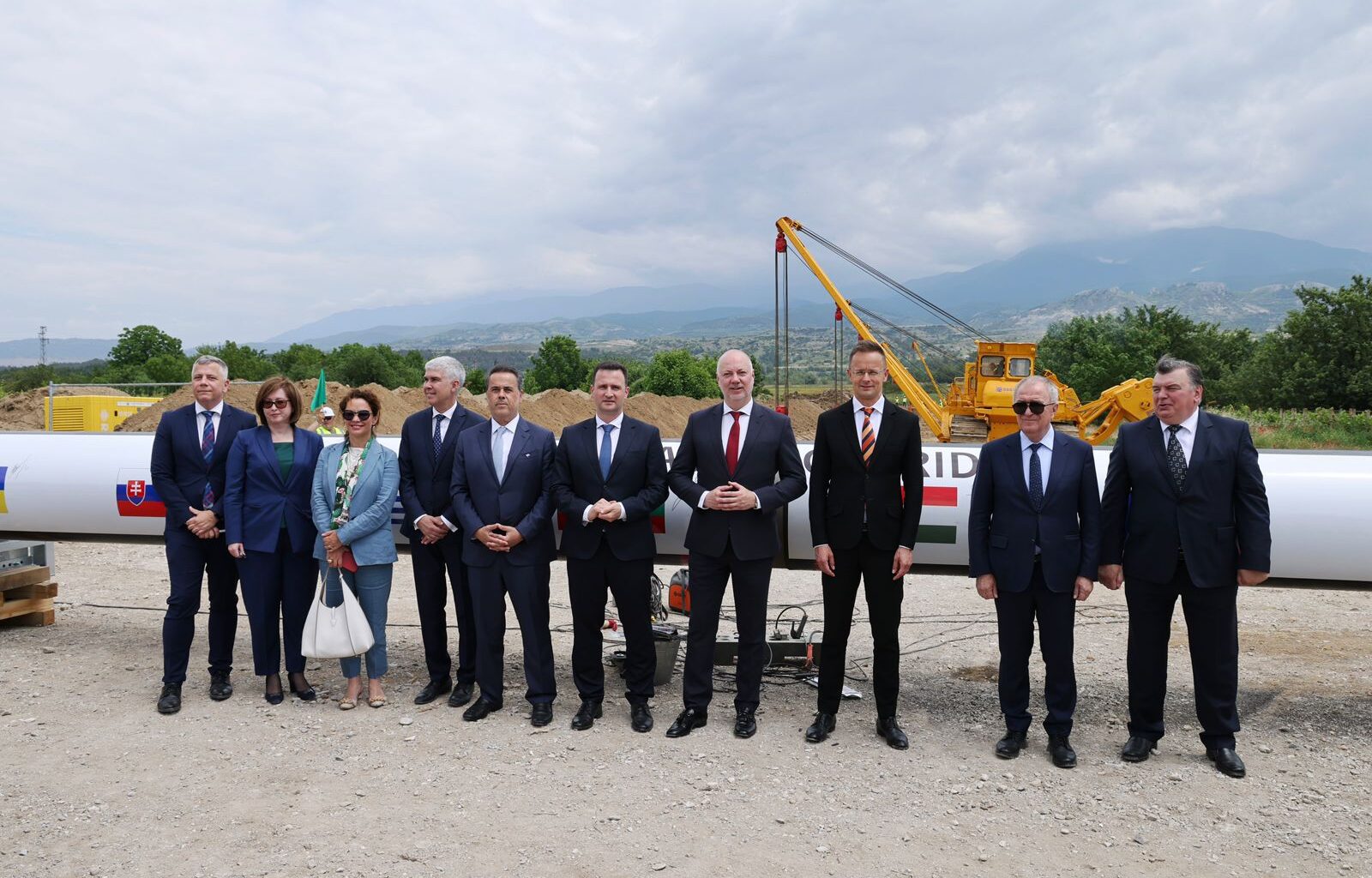
The Bulgarian Minister of Energy, Zhecho Stankov, the Prime Minister of Bulgaria, Rosen Zhelyazkov, the Hungarian Minister of Foreign Affairs, Péter Szijjártó, and the Greek Minister of Environment and Energy, Stavros Papastavrou, visited Kresna in Bulgaria to inaugurate the construction of a major branch of the Bulgarian natural gas transmission network, within the framework of the Vertical Corridor.
The first 15 kilometres of pipeline along the 48-kilometre route between Kulata and Kresna have been laid and welded, with almost the entire section cleared and prepared.
The construction of the Bulgarian part of the project is divided into three sections: from Kulata to Kresna, from Piperevo to Pernik and from Rupcha to Vetrino.
Capacity increase
The project is expected to be completed in the first quarter of 2026 and is linked to capacity expansions from Greece to Bulgaria (via the Sidirokastro interconnection point) and from Bulgaria to Romania (via the Kresna interconnection point).
The Kulata–Kresna loop will increase the capacity of the existing pipeline by 50 per cent, from 2.3 billion to 3.6 billion cubic metres per year. Once the Rupcha–Vetrino section at the Bulgarian–Romanian border is completed, the corridor’s capacity will double.
The Vertical Corridor will provide Hungary with a new gas route
The Vertical Corridor facilitates natural gas flows from terminals in Greece to countries in Northeastern and Central Europe. The goal is to fully diversify supply sources for the region and enhance its energy autonomy with seven countries, Greece, Bulgaria, Romania, Hungary, Slovakia, Moldova and Ukraine, participating.
“Accelerating key infrastructure projects in the country is among the government’s top priorities,” said Zhecho Stankov. “Today, we are taking a decisive step towards its implementation, and I am confident that we will complete the Vertical Gas Corridor on time and to a high standard.”
Péter Szijjártó said the Vertical Gas Corridor would provide Hungary with a new gas delivery route via Romania, adding that expanding the interconnector capacity between the two countries was back on the agenda. He emphasised that Bulgaria is a reliable transit partner, delivering over 20 million cubic metres of gas per day to Hungary through the TurkStream pipeline.
“The South–North vertical axis is becoming a reality,” said Stavros Papastavrou. “The natural gas starting from our country will reach Central and Eastern Europe. This has great energy value, as it highlights our country’s leading role in Europe’s energy autonomy and security. It also holds significant geostrategic importance, as new interconnection arteries are being created. The government is moving forward decisively, with a clear strategy to strengthen our country’s position in Europe.”
The TSOs of the seven countries of the Vertical Corridor recently offered a bundled route capacity for Ukraine, but the first auction failed to allocate any volumes.