Does someone know the absolute terms,? Like 50% alone or more/less?
[OC] Hi everybody! I work at “Our World in Data” and this is a chart I made for our work on Time Use. The data comes from the U.S. Bureau of Labor Statistics ([American Time Use Survey](https://www.bls.gov/tus/)) and we made the visualization using our tool grapher.
>Young Americans spend much more time alone than they did in the past.
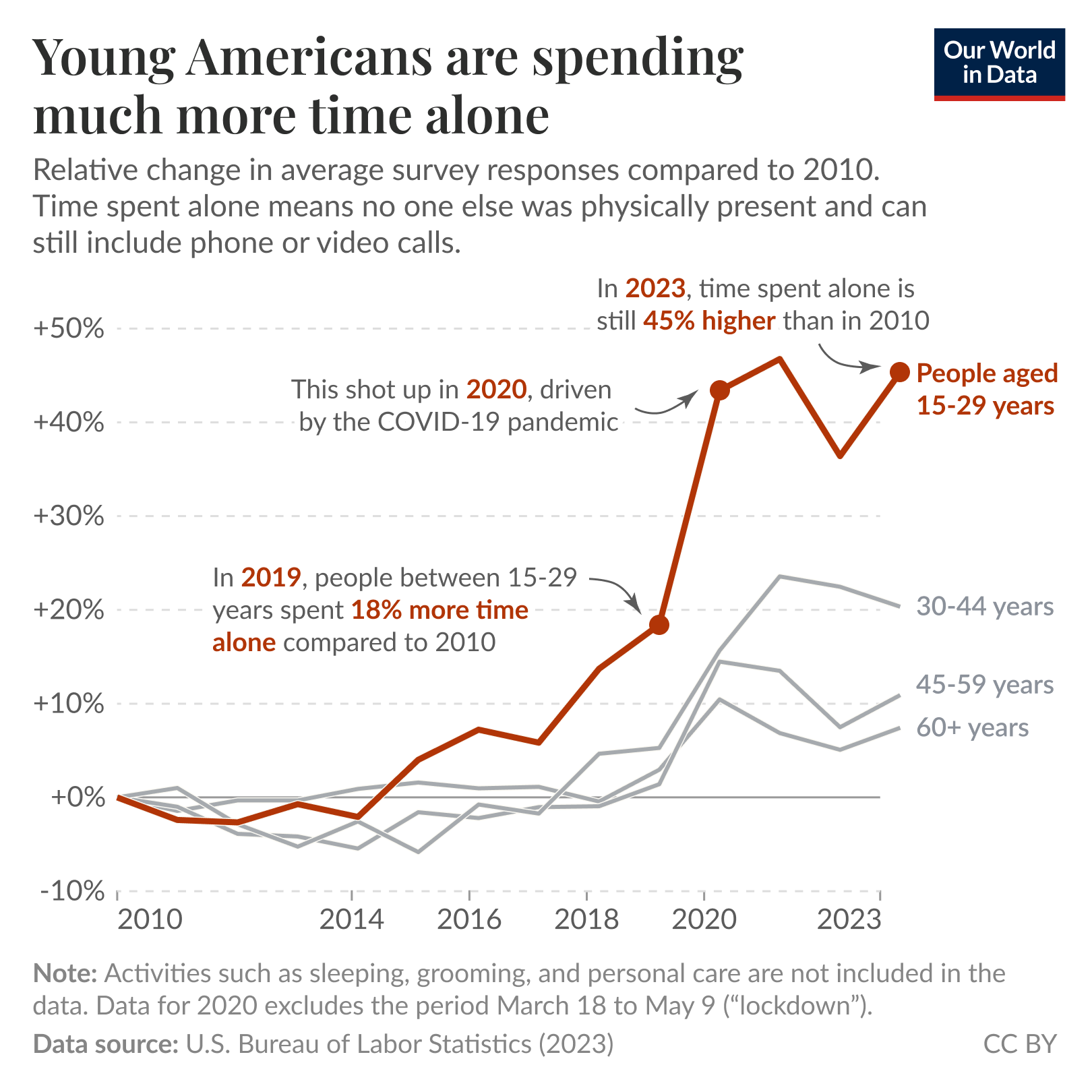
>According to data from the US Bureau of Labor Statistics’ American Time Use Survey, people aged 15–29 spent about 45% more time alone in 2023 than in 2010. The survey classifies all time spent without anybody physically present as “time spent alone”. This can include time spent talking on the phone or video calls.
>Time spent alone among young people increased slowly in the second half of the 2010s and then rose sharply during the COVID-19 pandemic. It hasn’t fallen back to earlier levels since then.
>In absolute terms, young people spent around four hours alone per day in 2010. By 2023, that number had grown to six hours per day.
>Although all Americans spend more time alone, the increase is much smaller for older age groups. Those aged 30 to 44 spend about 20% more time alone now than in 2010, while for people 45 and older, the increase is about 10%. While time alone can help with rest and personal reflection, it can also lead to loneliness and declining well-being. As time spent alone has increased, young people’s time with family, and even more so with friends, has decreased.
>The survey classifies all time spent without anybody physically present as “time spent alone”.
I think this is what needs be to highlighted in this data. While I don’t think spending time online with your friends in games/chat rooms/video calls is equal to spending time physically with those people, it is certainly not the same as time spent completely alone either.
Phone or video calls are classified as alone time. 15 years ago you couldn’t just facetime someone like you can now.
People can access interaction and lust all through their phone
A lot of people here are justifying spending time online instead but it’s not the same at all. Spending time with others outside in person builds valuable social skills and the current generation’s lack of social literacy is a direct result of this. In less than two years a whole part of a generations social skills were doomed you can see the stark contrast between people born in 2005-6 and people born in 2009-now
As both a teacher and parent of a teen and a preteen, I hate this for them. Sure, FaceTime or whatever is cool, but nothing beats actually hanging out with friends. I push my kids to go to school dances, church youth group, volunteer opportunities, etc. because if I don’t, they’d be content to just stay home and do various solo activities. Opportunities ARE there – we as parents might just need to nudge them that direction a bit more than previous generations.
Would be better off with actual time on the Y-axis. A percentage change means very little (according to the actual data, it’s an increase from 4 hours to 6 hours. But it could have been 1 hour to 1.5 hours or 8 hours to 12 hours)
Teenagers I know are NEVER alone — they are constantly on FaceTime calls with friends whenever possible. I think this study’s headline is missing the real interesting sea change: the issue isn’t “alone,” it’s “background togetherness.” It’s like friends as the soundtrack to your life.
a big part o0f this is just that there’s no affordable third places anymore. Sure, we can go to my place, or your place, but there’s just nothing affordable that’s neither of those places anymore.
It’s interesting to see how we were already trending in this direction BEFORE Covid. And arguably the Covid period was just a blip. If things are “back to normal” as of 2023, it certainly looks like it’s following the same trend that began all the way back in 2014. I initially thought that Covid might have “accelerated” this progression, but ultimately the trend settles back to what’s been happening for the last decade.
Time will tell if this is a good thing or a bad one. Independence is highly valued in the United States. But the cost of human connection shouldn’t be ignored.
“People aged 15-29 years”. Yes we did
I blame lack of third places for an increasingly suburban society.
Don’t see anyone mentioning work from home yet. That is 20 hours a week I used to be in an office building with others that I am now home alone. Others work from home even more than my hybrid schedule. I don’t see people clamoring to go back to office due to loneliness.
![[OC] Young Americans spend much more time alone than they did fifteen years ago](https://www.europesays.com/wp-content/uploads/2025/05/rgq8do0zbx3f1-1620x1024.png)
14 comments
Does someone know the absolute terms,? Like 50% alone or more/less?
[OC] Hi everybody! I work at “Our World in Data” and this is a chart I made for our work on Time Use. The data comes from the U.S. Bureau of Labor Statistics ([American Time Use Survey](https://www.bls.gov/tus/)) and we made the visualization using our tool grapher.
My colleague Bastian wrote a [short article ](https://ourworldindata.org/data-insights/young-americans-spend-much-more-time-alone-than-they-did-fifteen-years-ago)to go along with it, I’m quoting it below. You can follow the last link to explore more of our research on Time Use!
>Young Americans spend much more time alone than they did in the past.
>According to data from the US Bureau of Labor Statistics’ American Time Use Survey, people aged 15–29 spent about 45% more time alone in 2023 than in 2010. The survey classifies all time spent without anybody physically present as “time spent alone”. This can include time spent talking on the phone or video calls.
>Time spent alone among young people increased slowly in the second half of the 2010s and then rose sharply during the COVID-19 pandemic. It hasn’t fallen back to earlier levels since then.
>In absolute terms, young people spent around four hours alone per day in 2010. By 2023, that number had grown to six hours per day.
>Although all Americans spend more time alone, the increase is much smaller for older age groups. Those aged 30 to 44 spend about 20% more time alone now than in 2010, while for people 45 and older, the increase is about 10%. While time alone can help with rest and personal reflection, it can also lead to loneliness and declining well-being. As time spent alone has increased, young people’s time with family, and even more so with friends, has decreased.
>[Explore more research and data on how people spend their time](https://ourworldindata.org/grapher/who-americans-spend-their-time-with?country=~15-29+years)
>The survey classifies all time spent without anybody physically present as “time spent alone”.
I think this is what needs be to highlighted in this data. While I don’t think spending time online with your friends in games/chat rooms/video calls is equal to spending time physically with those people, it is certainly not the same as time spent completely alone either.
Phone or video calls are classified as alone time. 15 years ago you couldn’t just facetime someone like you can now.
People can access interaction and lust all through their phone
A lot of people here are justifying spending time online instead but it’s not the same at all. Spending time with others outside in person builds valuable social skills and the current generation’s lack of social literacy is a direct result of this. In less than two years a whole part of a generations social skills were doomed you can see the stark contrast between people born in 2005-6 and people born in 2009-now
As both a teacher and parent of a teen and a preteen, I hate this for them. Sure, FaceTime or whatever is cool, but nothing beats actually hanging out with friends. I push my kids to go to school dances, church youth group, volunteer opportunities, etc. because if I don’t, they’d be content to just stay home and do various solo activities. Opportunities ARE there – we as parents might just need to nudge them that direction a bit more than previous generations.
Would be better off with actual time on the Y-axis. A percentage change means very little (according to the actual data, it’s an increase from 4 hours to 6 hours. But it could have been 1 hour to 1.5 hours or 8 hours to 12 hours)
Teenagers I know are NEVER alone — they are constantly on FaceTime calls with friends whenever possible. I think this study’s headline is missing the real interesting sea change: the issue isn’t “alone,” it’s “background togetherness.” It’s like friends as the soundtrack to your life.
a big part o0f this is just that there’s no affordable third places anymore. Sure, we can go to my place, or your place, but there’s just nothing affordable that’s neither of those places anymore.
It’s interesting to see how we were already trending in this direction BEFORE Covid. And arguably the Covid period was just a blip. If things are “back to normal” as of 2023, it certainly looks like it’s following the same trend that began all the way back in 2014. I initially thought that Covid might have “accelerated” this progression, but ultimately the trend settles back to what’s been happening for the last decade.
Time will tell if this is a good thing or a bad one. Independence is highly valued in the United States. But the cost of human connection shouldn’t be ignored.
“People aged 15-29 years”. Yes we did
I blame lack of third places for an increasingly suburban society.
Don’t see anyone mentioning work from home yet. That is 20 hours a week I used to be in an office building with others that I am now home alone. Others work from home even more than my hybrid schedule. I don’t see people clamoring to go back to office due to loneliness.
Comments are closed.