The rise of Italian tennis has clearly emboldened the president of its national federation. Basking in the aftermath of a successful national open this month, Angelo Binaghi demanded a piece of the grand-slam pie by calling for Rome to join London, Paris, Melbourne and New York as the fifth major.
“In what other part of society is there a monopoly that lasts for more than 100 years?” Binaghi said. “Why are there always four and always the same four? It’s absolutely unfair and doesn’t help tennis grow.”
The likelihood of this is slim as there appears to be no widespread urge in the sport for a new grand-slam tournament, but then again maybe it is unwise to completely dismiss Binaghi’s wish. The 64-year-old has already proved many wrong by overseeing a remarkable transformation for tennis in his country ever since he became president in 2001.

On top of the world: Italy successfully defended their Davis Cup title in Spain last year when beating the Netherlands
MATT MCNULTY/GETTY IMAGES FOR ITF
It would be going too far to describe Italy’s newfound prominence in the sport as a takeover, but there certainly has been quite a power shift both on and off the court in recent years. The figurehead of this is the men’s world No1, Jannik Sinner, whose status is so grand now that he was granted an audience with Pope Leo only six days after white smoke emerged from the Sistine Chapel chimney.
Sinner’s success is the main driver of tennis’s increasing popularity in Italy. At the age of 23 he is already the country’s greatest player of all time, winning three grand-slam titles. The last Italian man to win a major before Sinner was Adriano Panatta at the 1976 French Open.
In a country that is dominated by a love for football, tennis now proudly sits as the nation’s second- most popular sport. Sinner’s matches around the world regularly attract large television ratings and there are often tales from Italy of hordes of people gathered around the screens in cafes and bars when he is playing.
“A Jannik Sinner match is like a football match in Italy,” Paolo Lorenzi, a former player who is now the Italian Open’s tournament director, told a television documentary entitled Forza Jannik, which aired in January.
But the on-court success goes far beyond Sinner. In total, there are nine Italian men’s singles players ranked inside the world’s top 100, with the 23-year-old Lorenzo Musetti establishing himself as a contender at the biggest tournaments at a ranking of No7. No non-grand-slam-hosting nation has more.
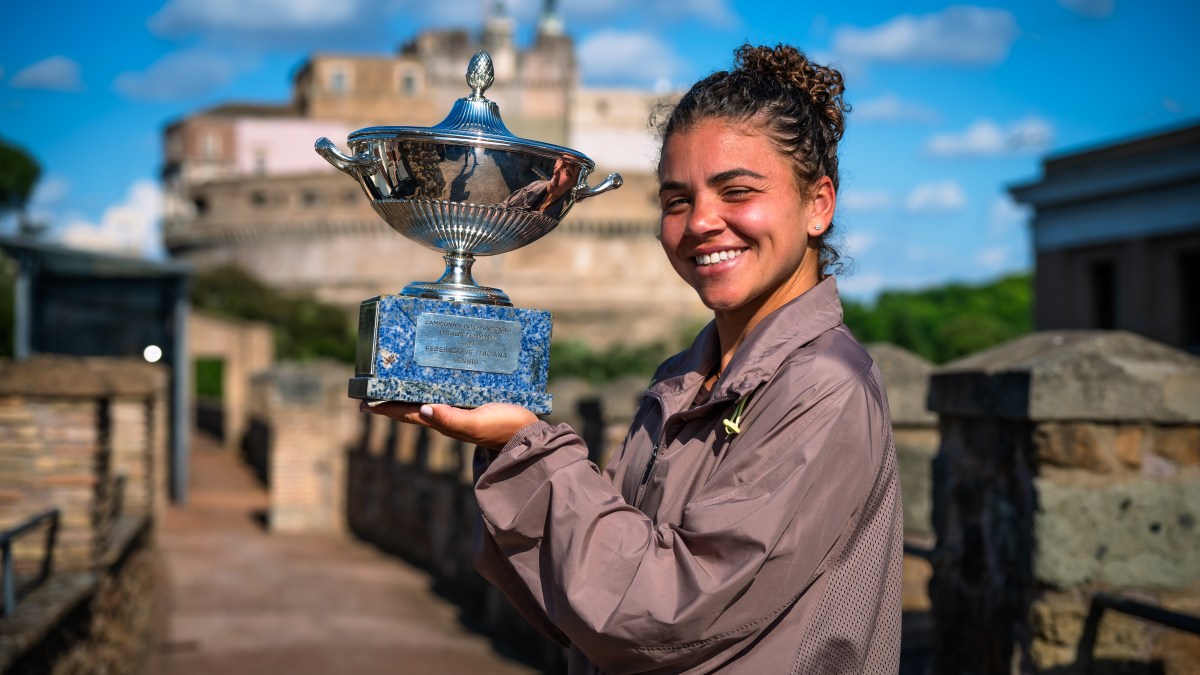
The depth is not yet as strong on the women’s side, with three inside the top 100, but the leading player is now part of an elite group at the top. Jasmine Paolini, 29, is at a career high of No4 after finishing runner-up at Wimbledon and Roland Garros last year, and recently became the first home player to win the Italian Open since Raffaella Reggi in 1985.

Musetti, the world No7, is fast becoming a contender to win the world’s biggest tournaments
SHI TANG/GETTY IMAGES
The feel-good factor across the board was evident last year when Italy competed a double in tennis’s team competitions by winning the men’s Davis Cup and the women’s Billie Jean King Cup. And it probably should also be considered a notable coup for the country that the present boss of the ATP tour, Andrea Gaudenzi, is Italian.
“We have great players, boys and girls, but great persons too, which is I think very important,” Filippo Volandri, the Italy Davis Cup captain, said.
There are three main areas in which the Italian federation has fuelled this success. The first is a significant investment in the number of tournaments held on home soil. The ATP Finals and Davis Cup Finals, two of the sport’s most high-profile events, are hosted by Turin and Bologna, respectively.
More notable, though, is an increase in tournaments at the lower levels. Last year a total of 19 men’s tournaments took place in Italy on the second-tier ATP Challenger Tour and 35 on the third-tier ITF Futures circuit. In comparison, Great Britain held five Challengers and 12 Futures last year, although it must be acknowledged that the weather is far more conducive to hosting outdoor events in Italy.

Anything you can do: Italy’s women join their male counterparts with victory in the Billie Jean King Cup
JON NAZCA/REUTERS
This has enabled Italian players to essentially build the foundations of their careers by earning many ranking points on home soil, rather than incurring the expense and effort of chasing points around the world.
“That helps the younger players gaining job opportunities and also competition opportunities without having to travel because one of the issues is the cost of travelling and playing different tournaments around the world,” Gaudenzi said.
Clay has historically been the natural surface for Italians, but the federation has put more investment into hard courts over the past decade or so, allowing young players the opportunity to better develop an all-round game for the tour. There has also been emphasis on the training of coaches, improving their skills, which with the increase in tournaments has allowed for quality networking.

The Campo Centrale in Rome is an intimidating venue
SHUTTERSTOCK EDITORIAL
“The players bring the coach who can walk and talk with other coaches from other countries, so they are going to improve,” Lorenzi said. “That’s why after 20 years the Italian federation has so many good players and coaches.”
There was another masterstroke pulled in 2008 with the launch of the federation’s own free-to-air television channel, SuperTennis. This gave greater visibility across the country to tournaments at all levels and has eventually resulted in a significant increase in the number of Italians who follow tennis, doubling since 2016 to 39 per cent. The total of registered club players is also now more than one million, having been 129,000 in 2001.
The ambition knows no bounds. As part of the bid to claim grand-slam status, the Italian Open announced plans this year to build a retractable roof over the main stadium, Campo Centrale, at a cost of £50million. Whether this is enough for the tournament to become the fifth major remains to be seen, but there is no shortage of belief after the recent success.
“We’re now the world champion both on the court and at the organisational level,” Binaghi bullishly said.