Probably doesn’t help that a) you’re getting your constant dopamine fix from a phone instead of something else. b) you have parents that don’t/didn’t want you running around then neighborhood engaged in unsupervised/unstructured play time.
I’m not surprised. Phones and social media definitely play a part in the dynamic shift to younger folks spending significantly more time alone, but I think another factor might be that younger folks don’t have the support systems already set up that a lot of older folks do.
A lot of people 25 and up already had families, spouses, etc when the pandemic started, but people below that age didn’t. The pandemic wrecked our existing social structure and then social media and technology stepped in to fill that void. But once things started going back to “normal” the damage was already done. People became reliant on the internet to make those connections, a lot of spaces where we used to meet up and get to be around people went out of business or lost funding, and now it’s hard to adjust to that damage.
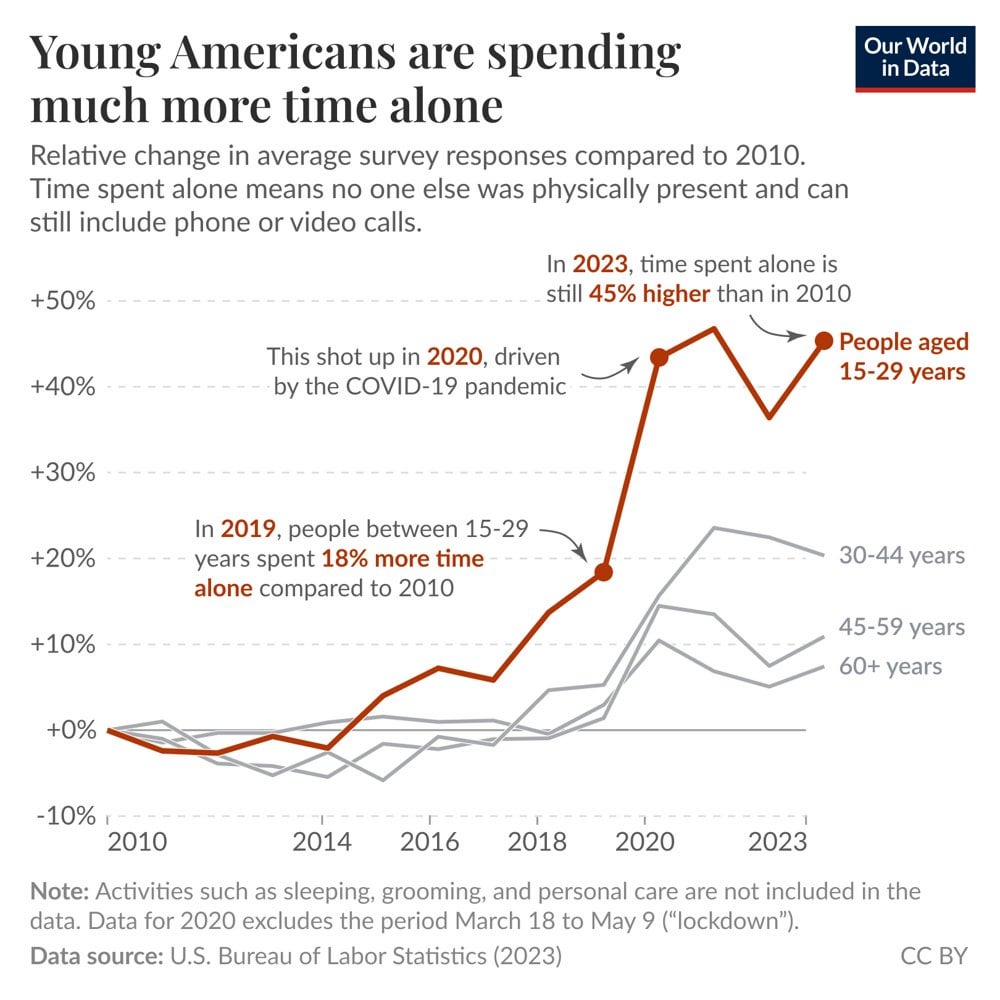
(Granted the pandemic alone wasn’t the main cause. The data shows that the trend was already ticking up before then, it started around 2014, when social media started to boom, just the pandemic was the major shift in the trend where it started going up more significantly.)
It’s crazy. I feel the effects of it, a lot of my friends do too. I don’t know if things will get better. We lost so many spaces where we could go to meet up with people, and ultimately, once you become reliant on social media to make those connections and get that social interaction, your brain chemistry and your dopamine regulation changes. And It’s very hard to change it back
Data is a bit unclear. e.g. spending time with children, as the data includes averaged out for folks who don’t have kids
Your data shows that time spent with kids drops by an hour a day, and alone time is increasing for the young group by 2hr/day, folks are just having kids later, that basically removes the entire 1hr/day of ‘more alone time’ right there, so the 15-29 agegroup would have really no difference than other age groups.
you can see the 15-24 parental rates dropping in concert with this data, so I wonder that the conclusions this site gives are missing the mark a bit?
Other age group similar drops are not from being more alone, but more attributable to the rise of WFH, as coworker time is what drops, but also absent from the analysis.
I just turned 30. When I was 15 I was virtually never alone even though we had iphones and ipads.
Always surrounded by friends, going places and meeting new people. In part just the age, but after going back to university at 28 the kids do not seem to be alright.
Then they blame everyone else for their shitty lives
I think it’s cause a lot of third places are dying out leaving Little to no places for them to hang out
No one can change that FOR them
As someone who aged from 17 to 30 in that time, I can confirm that I spent a lot more time alone at the end than at the beginning.
8 comments
Probably doesn’t help that a) you’re getting your constant dopamine fix from a phone instead of something else. b) you have parents that don’t/didn’t want you running around then neighborhood engaged in unsupervised/unstructured play time.
I’m not surprised. Phones and social media definitely play a part in the dynamic shift to younger folks spending significantly more time alone, but I think another factor might be that younger folks don’t have the support systems already set up that a lot of older folks do.
A lot of people 25 and up already had families, spouses, etc when the pandemic started, but people below that age didn’t. The pandemic wrecked our existing social structure and then social media and technology stepped in to fill that void. But once things started going back to “normal” the damage was already done. People became reliant on the internet to make those connections, a lot of spaces where we used to meet up and get to be around people went out of business or lost funding, and now it’s hard to adjust to that damage.
(Granted the pandemic alone wasn’t the main cause. The data shows that the trend was already ticking up before then, it started around 2014, when social media started to boom, just the pandemic was the major shift in the trend where it started going up more significantly.)
It’s crazy. I feel the effects of it, a lot of my friends do too. I don’t know if things will get better. We lost so many spaces where we could go to meet up with people, and ultimately, once you become reliant on social media to make those connections and get that social interaction, your brain chemistry and your dopamine regulation changes. And It’s very hard to change it back
Data is a bit unclear. e.g. spending time with children, as the data includes averaged out for folks who don’t have kids
Your data shows that time spent with kids drops by an hour a day, and alone time is increasing for the young group by 2hr/day, folks are just having kids later, that basically removes the entire 1hr/day of ‘more alone time’ right there, so the 15-29 agegroup would have really no difference than other age groups.
if you look at similar data, [https://www.reddit.com/r/dataisbeautiful/comments/dnuhbb/births_by_age_group_of_mother_in_the_united/](https://www.reddit.com/r/dataisbeautiful/comments/dnuhbb/births_by_age_group_of_mother_in_the_united/)
you can see the 15-24 parental rates dropping in concert with this data, so I wonder that the conclusions this site gives are missing the mark a bit?
Other age group similar drops are not from being more alone, but more attributable to the rise of WFH, as coworker time is what drops, but also absent from the analysis.
I just turned 30. When I was 15 I was virtually never alone even though we had iphones and ipads.
Always surrounded by friends, going places and meeting new people. In part just the age, but after going back to university at 28 the kids do not seem to be alright.
Then they blame everyone else for their shitty lives
I think it’s cause a lot of third places are dying out leaving Little to no places for them to hang out
No one can change that FOR them
As someone who aged from 17 to 30 in that time, I can confirm that I spent a lot more time alone at the end than at the beginning.
Comments are closed.