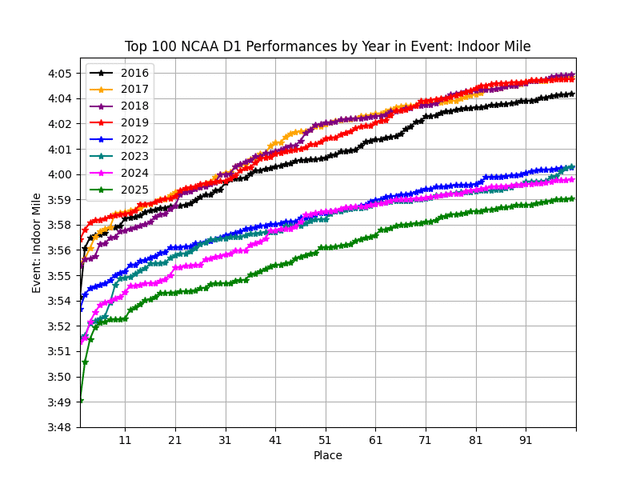
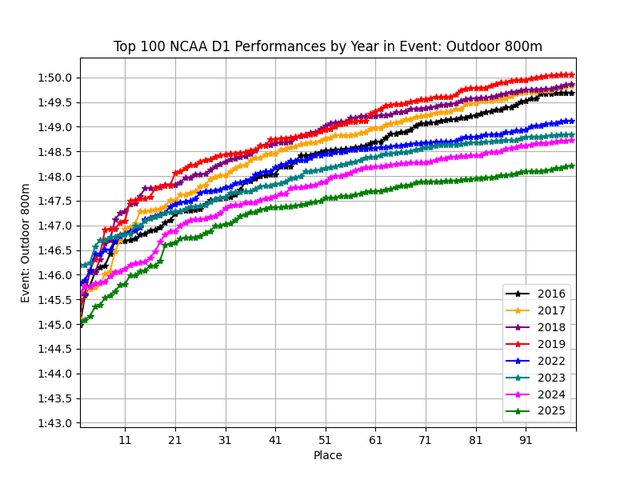
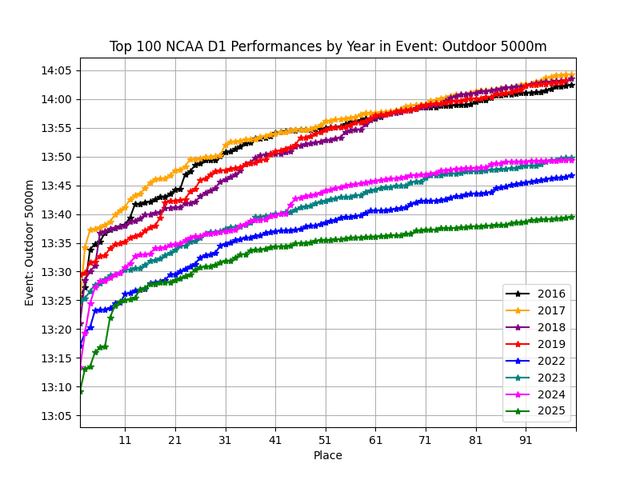
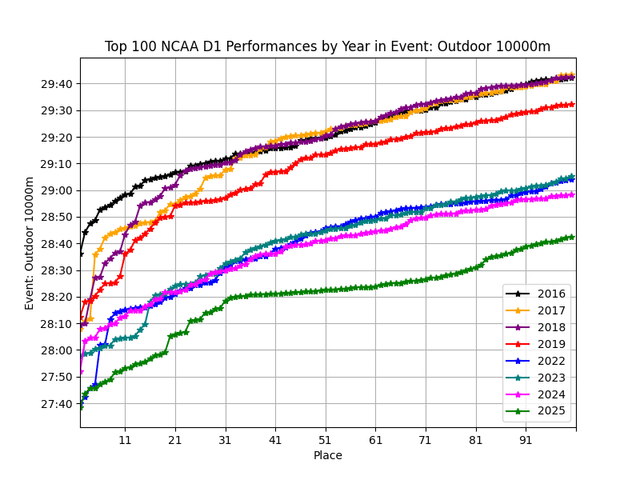
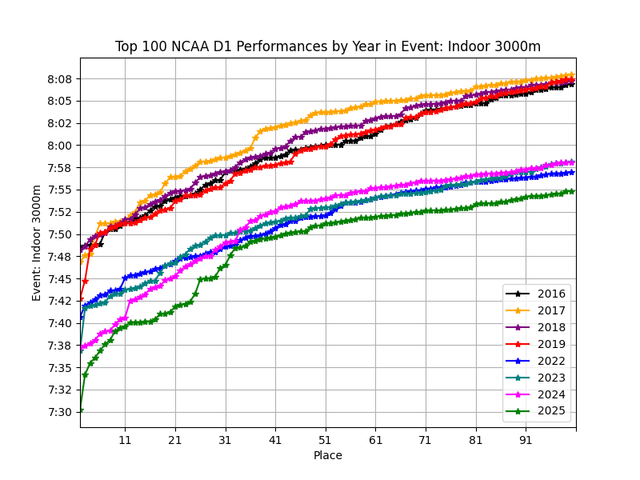
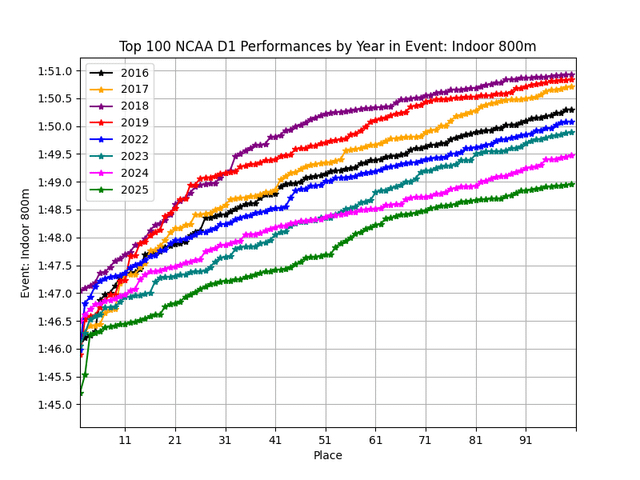
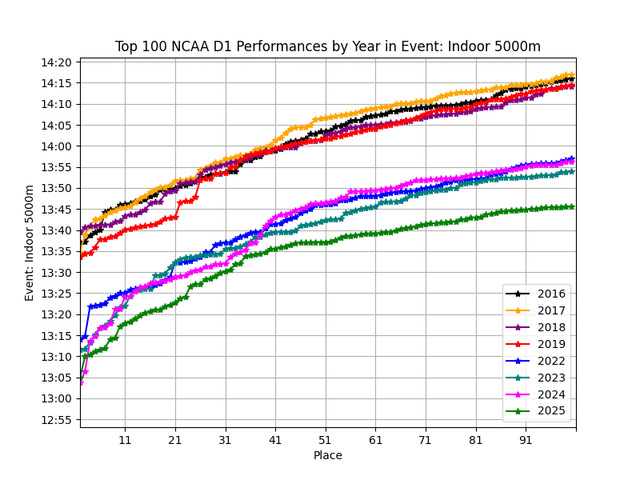
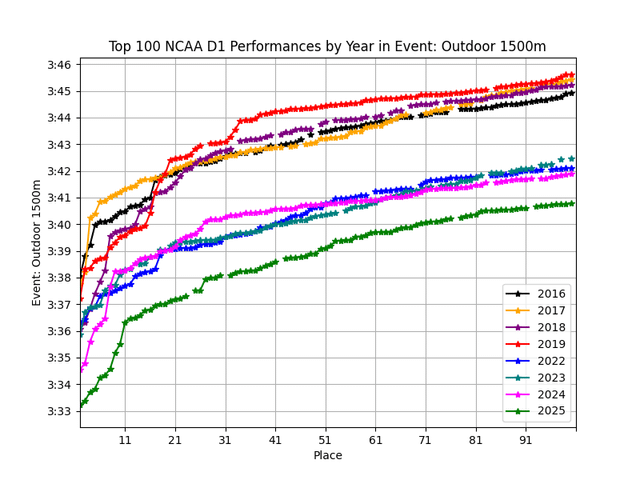
Pulled the leaderboard data from TFFRs with a web scraper and analyzed and created the charts with python.
Posted by EstablishmentOk6147
Pulled the leaderboard data from TFFRs with a web scraper and analyzed and created the charts with python.
Posted by EstablishmentOk6147
7 comments
Honestly kinda wild they didn’t ban these the way swimming did
Half the time on this sub, I think it’s very much the opposite of ‘data is beautiful’, but this is good. I would love to see them have official half and full marathon distances also. Thanks for sharing.
Would be more beautiful if you used a sequential color map so you didn’t have to look at each color/year individually
The color scheme makes it really hard to follow a trend
The shoes aren’t improving this much each year. There are multiple variables, carbon shoes being just one. Nutrition science, new recovery methods, and new material technologies used in the surface of tracks have likely played the biggest role in these gains.
Ah, the sneaker effect. Now we’re running in the silicon era, where it’s not just the human but also the shoe that’s been engineered to perfection. Amazing analysis, by the way!
This aligns with the numbers I’ve seen across the broad and anecdotally. There has undoubtedly been a huge progression with supershoes and superspikes for distance running in the past decade. I’m a dated collegiate miler, so full disclosure: that gives me some bias. It’s easy to look at the times guys are running now and feel like they’ve got a huge edge — but the reality is, we had our own advantages over the generation before us too.
The evolution of gear in our sport has always played a role. Athletes used to dig holes on cinder tracks before the advent of starting blocks. Now we’ve got state-of-the-art Mondo tracks and carbon-plated spikes with energy-returning foam. I had a technological advantage over those who came before me and those who came later likely have a similar advantange. So yes, the tech is real, and it’s part of the sport’s progression.
To back that up, here are the numbers I pulled for NCAA D1 sub-4 milers indoors, along with the 100th best mile time in each season:
2025 – 139 (100th: 3:58.81)
2023 – 97 (100th: 4:00.38)
2021 – 38 (100th: 4:06.49)
2019 – 33 (100th: 4:04.71)
2017 – 30 (100th: 4:04.81)
2015 – 32 (100th: 4:03.81)
2013 – 30 (100th: 4:05.03)
2011 – 22 (100th: 4:05.85)
From 2011 to 2025, the *100th-best mile* has dropped nearly **7 seconds**, and most of that drop came after 2020 — when superspikes became widely adopted. The number of athletes running sub-4 at the NCAA has more than tripled. That kind of shift doesn’t happen from training alone. It’s the shoes.
It doesn’t take away from how fit these athletes are — not at all. But it does underscore how much **technology is part of the performance equation**, just like breakthroughts in swimming and cycling.
Comments are closed.