
From reproductive rights to climate change to Big Tech, The Independent is on the ground when the story is developing. Whether it’s investigating the financials of Elon Musk’s pro-Trump PAC or producing our latest documentary, ‘The A Word’, which shines a light on the American women fighting for reproductive rights, we know how important it is to parse out the facts from the messaging.
At such a critical moment in US history, we need reporters on the ground. Your donation allows us to keep sending journalists to speak to both sides of the story.
The Independent is trusted by Americans across the entire political spectrum. And unlike many other quality news outlets, we choose not to lock Americans out of our reporting and analysis with paywalls. We believe quality journalism should be available to everyone, paid for by those who can afford it.
Your support makes all the difference.
Read more
Mount Etna has erupted on Monday, sending a kilometres-high plume of ash into the sky and sending tourists fleeing from the popular World Heritage area.
Italy’s National Institute of Geophysics and Volcanology said the eruption began around 3.50am local time (2.50am BST), following volcanic tremors which began around midnight local time.
The institute said eruption activity has continued since then with “increasing intensity” and was currently “almost continuous”.
Click here for live updates on the eruption.

open image in gallery
(AFP/Getty)
“From a seismic point of view, the values of the tremor amplitude are currently high with a tendency to increase further,” the institute said in an 11am update.
Where is Mount Etna?
Mount Etna, known as “Mongibello” locally, is on the east coast of Sicily, between the cities of Messina and Catania.
According to the Royal Geographic Society, about 20 per cent of Sicily’s population of roughly 4.8 million people lives on the slopes of the volcano (but far from the explosive craters), because the fertile soil is ideal for growing fruit and vegetables.
Less than a hundred people live within 5km (3 miles) of the volcano, according to the Smithsonian Institution’s Global Volcanism Programme, while just under 3,300 live within 10km of Etna. A little over a million people live within 30km of the volcano.
Etna is one of the tallest active volcanoes in Europe, although its height varies due to eruptions.
It has been nicknamed the ‘Lady of the Rings’ due to the rings it produces made of condensed water vapour.
How often does it erupt?
People have documented eruptions on Etna as far back as 1500 BCE. A particularly destructive eruption in March 1669 destroyed at least 10 villages, and lava flow reached the city walls of Catania five weeks after the initial event.
The frequency of those eruptions also makes it one of the world’s most active volcanoes: in 2021, according to the Weather Channel, it erupted 11 times in just three weeks.
The volcano had two major eruptions last year, with Catania Airport forced to close both times due to the volume of ash spewed into the air.
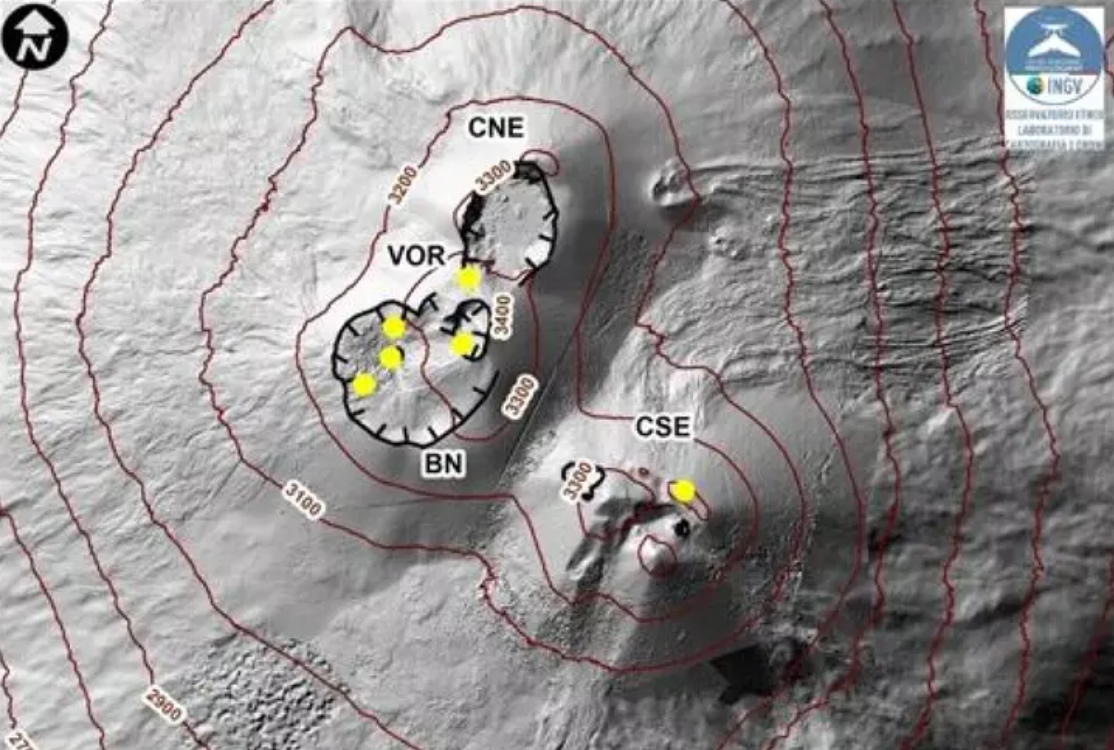
open image in gallery
Etna has several major craters at its peak (Italy’s National Institute of Geophysics and Volcanology)
It has erupted several times this year, including in February when thousands of tourists flocked to Etna to see the spectacle. Dozens of people who were not wearing appropriate mountain gear went missing as unprepared tourists clamoured for a glimpse of the lava flows, the Guardian reported.
“There was around, I think, 13 reported eruptions in the year. And often they can be quite small. Occasionally, they can start with an explosive phase like this one has,” he told The Independent.
Lava has also begun to flow from that crater, but the institute said it has not passed the edge of the Valley of the Lion on the volcano.
Mount Etna has a few main active craters close to the summit, according to Sicily’s tourist website, which are the main sites of eruptions.
Previous strong eruptions have destroyed towns, and an eruption in March 2017 injured 10 people including a BBC television crew.

open image in gallery
Ash spews from Mount Etna (Reuters)
How concerned should tourists and locals be about the eruption?
Bill McGuire, professor emeritus of geophysical and climate hazards at UCL, said this behaviour was “nothing unusual” for the popular volcano.
“Although this can appear terrifying to tourists visiting the volcano, this activity is nothing unusual for Mount Etna, which is almost continually active and has these sorts of eruptions every year or two,” he told The Independent.
Prof McGuire said the ash and volcanic gas spewing from the crater can cause respiratory issues, but most likely only near the summit.
“If the eruption grows and there is heavier ash fall further away, then face masks can deal with the worst of the ash,” he said.
“There is a danger from falling blocks and volcanic ‘bombs’ (semi-molten fragments), but only close to the erupting crater. It goes without saying that this should be avoided.”
While ash fall can sometimes cause Catania’s airport to close, that is only temporary.
“The biggest problems are caused by lava flows that erupt on the volcano’s flanks, which can be very destructive. So far, this does not seem to be happening during this eruption,” Prof McGuire said.
Prof Jerrem said the thing to look out for was whether the volcanic activity continues for some time.
The thing to look out for is whether this then does carry on for some significant time.It can often go on for several days, weeks and even months, whether that leads to more significant lava flows in the not-too-distant future,” he said.