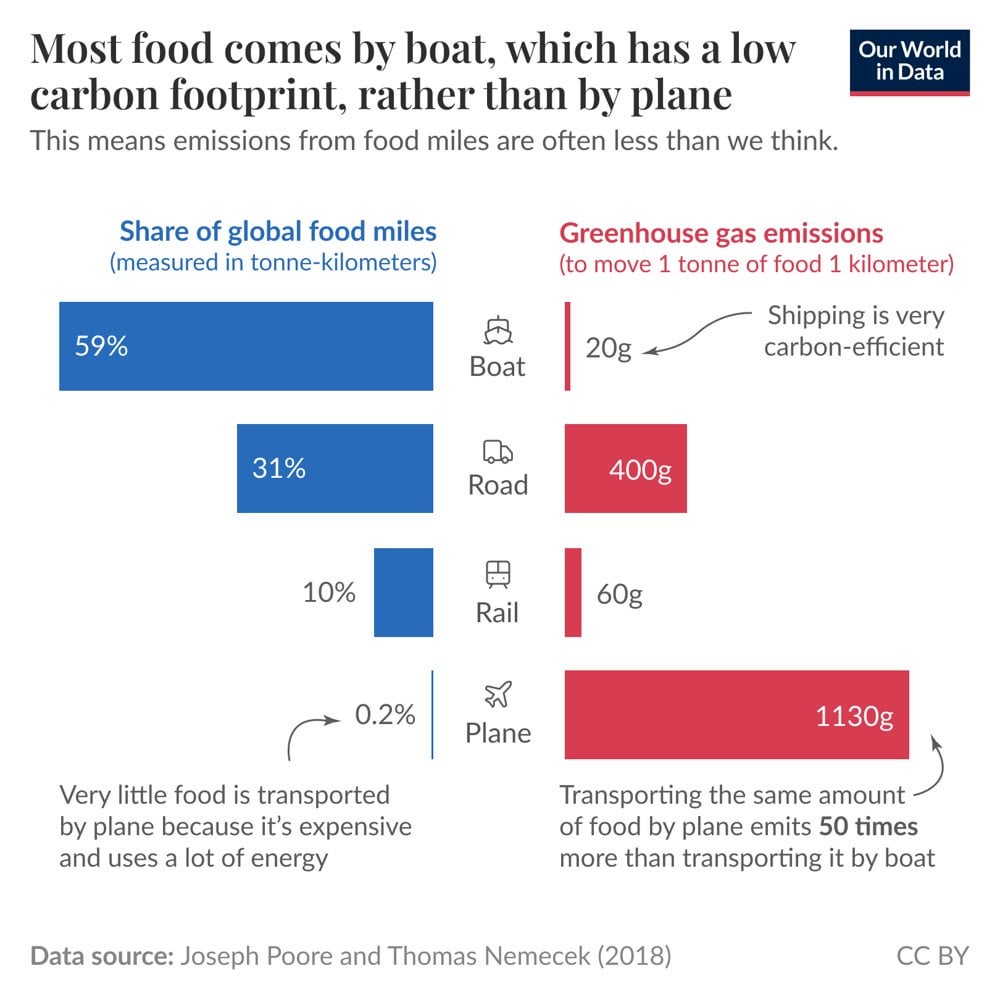
Quoting the author's text accompanying the chart:
Many people are interested in how they can eat in a more climate-friendly way. I’m often asked about the most effective way to do so.
While we might intuitively think that “food miles” — how far our food has traveled to reach us — play a big role, transport accounts for just 5% of the global emissions from our food system.
This is because most of the world’s food comes by boat, and shipping is a relatively low-carbon mode of transport. The chart shows that transporting a kilogram of food by boat emits 50 times less carbon than by plane and about 20 times less than trucks on the road.
So, food transport would be a much bigger emitter if all our food were flown across the world — but that’s only the case for highly perishable foods, like asparagus, green beans, some types of fish, and berries.
This means that what you eat and how it is produced usually matters more than how far it’s traveled to reach you.
Posted by cgiattino
5 comments
So you’re saying I’m on a seafood diet. I see food, and it travels by boat.
Vegetarianism/Veganism are the only climate-friendly diets
I think that the article is not really accurate.
1. The sheer volume of food being transported by boat dwarves the volume transported by plane. On a ton by ton case then yes boats create less emmisions but when it comes by total tonnage its not even a comparrison
* Over **90% of global food trade by volume** is transported via **sea freight**.
* **Air freight** accounts for **less than 1% by volume**, but often **over 10–15% by value**, as it is used for high-value or perishable goods (e.g., berries, flowers, seafood).
Source
[https://www.ics-shipping.org/shipping-fact/shipping-and-world-trade-world-seaborne-trade/?utm_source=chatgpt.com](https://www.ics-shipping.org/shipping-fact/shipping-and-world-trade-world-seaborne-trade/?utm_source=chatgpt.com)
2. Spoilage. The real climate thief is spoilage of food during transport. **Approximately 30% of food produced for human consumption is lost or wasted globally.** This figure encompasses losses throughout the entire supply chain, from post-harvest handling to consumption.
[https://en.wikipedia.org/wiki/Food_loss_and_waste](https://en.wikipedia.org/wiki/Food_loss_and_waste)
So that makes me wonder what’s happening to all that food we’re growing in the continental US – it wouldn’t be traveling by boat to get here, and it’s plenty enough to feed the entire country.
Guess my ‘ship diet’ has a new meaning now!
Comments are closed.