Here’s some additional information about the data that I share in the post.
**Project types**
There are 959 carbon capture projects in the CCUS projects database.
They belong to one of six project types:
1. Capture (401)
2. Full chain (172)
3. Storage (157)
4. Transport & Storage (107)
5. Transport (64)
6. Capture for use (58)
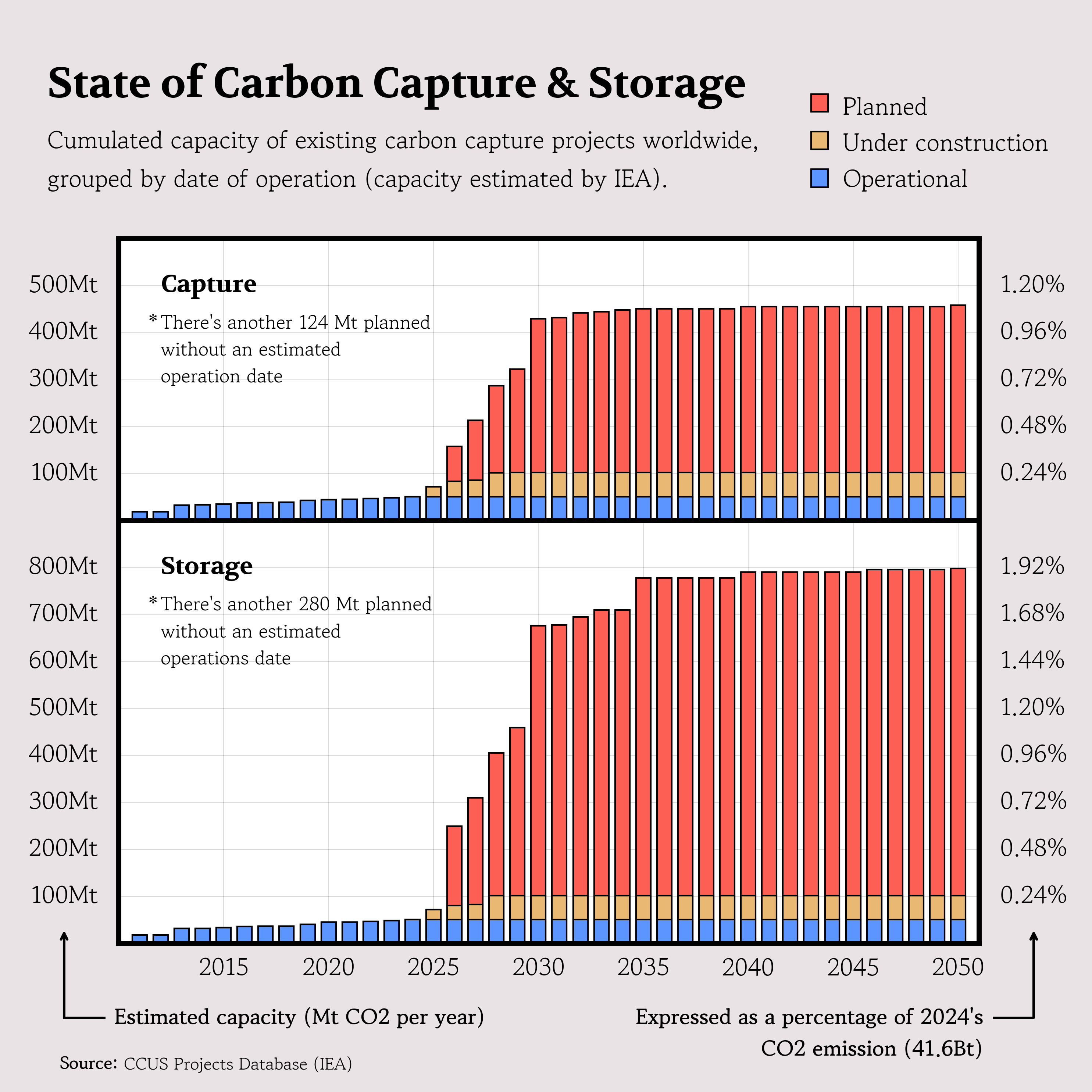
In the chart, capture is the sum of estimated capacity for projects with type “Capture”, “Full chain”, or “Capture for use”.
Storage shows the sum of projects with type “Transport & Storage”, “Storage“, and “Full chain“.
Transport project doesn’t include any capture or storage.
**Sectors for carbon capture**
There are projects for capturing up to 582 Mt of carbon per year and they capture carbon from one of the following industries.
* Power and heat (30.4%)
* Hydrogen or ammonia (19.6%)
* Natural gas processing (14.4%)
* Other fuel transformation (10.8%)
* Cement (7.4%)
* Biofuels (6.7%)
* Chemicals (3.9%)
* Iron and steel (2.4%)
* Direct air capture (2%)
* Other industries (2.4%)
**Conclusion**
Current carbon capture projects can handle around 1% of current CO2 emissions. That’s not enough to change the trajectory of climate change.
Looking at project that are operational or under construction, that number becomes as low as 0.24%.
Let’s hope for some promising progress leading the way for the development of more ambitious projects soon.
You should create one where the top of the scale is the total CO2 emission.
Are those “I build a coal power plant, but look, I capture ‘most’ of my CO2” (ie still an overall net emission), or Direct Air Capture (ie “I take CO2 that is already there and remove it, resulting in an overall net decrease”)? And in the latter, does it take into account the origin of the power need?
Somehow I bet the graph looked the same 10 years ago. All planned, never completed.
Wow crazy how much effort we are going to put in, tomorrow
Carbon capture looking like it’s still stuck in the “nice try” phase, but gotta start somewhere.
![[OC] The Current State of Carbon Capture & Storage Projects](https://www.europesays.com/wp-content/uploads/2025/06/43zpl6jbax4f1-1920x1024.png)
7 comments
The lumber industry alone captures 2,000 Mt of carbon per year, dwarfing all of these numbers.
I created this chart for my my newsletter [Data Squares](https://datasquares.substack.com/)
Here’s some additional information about the data that I share in the post.
**Project types**
There are 959 carbon capture projects in the CCUS projects database.
They belong to one of six project types:
1. Capture (401)
2. Full chain (172)
3. Storage (157)
4. Transport & Storage (107)
5. Transport (64)
6. Capture for use (58)
In the chart, capture is the sum of estimated capacity for projects with type “Capture”, “Full chain”, or “Capture for use”.
Storage shows the sum of projects with type “Transport & Storage”, “Storage“, and “Full chain“.
Transport project doesn’t include any capture or storage.
**Sectors for carbon capture**
There are projects for capturing up to 582 Mt of carbon per year and they capture carbon from one of the following industries.
* Power and heat (30.4%)
* Hydrogen or ammonia (19.6%)
* Natural gas processing (14.4%)
* Other fuel transformation (10.8%)
* Cement (7.4%)
* Biofuels (6.7%)
* Chemicals (3.9%)
* Iron and steel (2.4%)
* Direct air capture (2%)
* Other industries (2.4%)
**Conclusion**
Current carbon capture projects can handle around 1% of current CO2 emissions. That’s not enough to change the trajectory of climate change.
Looking at project that are operational or under construction, that number becomes as low as 0.24%.
Let’s hope for some promising progress leading the way for the development of more ambitious projects soon.
You should create one where the top of the scale is the total CO2 emission.
Are those “I build a coal power plant, but look, I capture ‘most’ of my CO2” (ie still an overall net emission), or Direct Air Capture (ie “I take CO2 that is already there and remove it, resulting in an overall net decrease”)? And in the latter, does it take into account the origin of the power need?
Somehow I bet the graph looked the same 10 years ago. All planned, never completed.
Wow crazy how much effort we are going to put in, tomorrow
Carbon capture looking like it’s still stuck in the “nice try” phase, but gotta start somewhere.
Comments are closed.