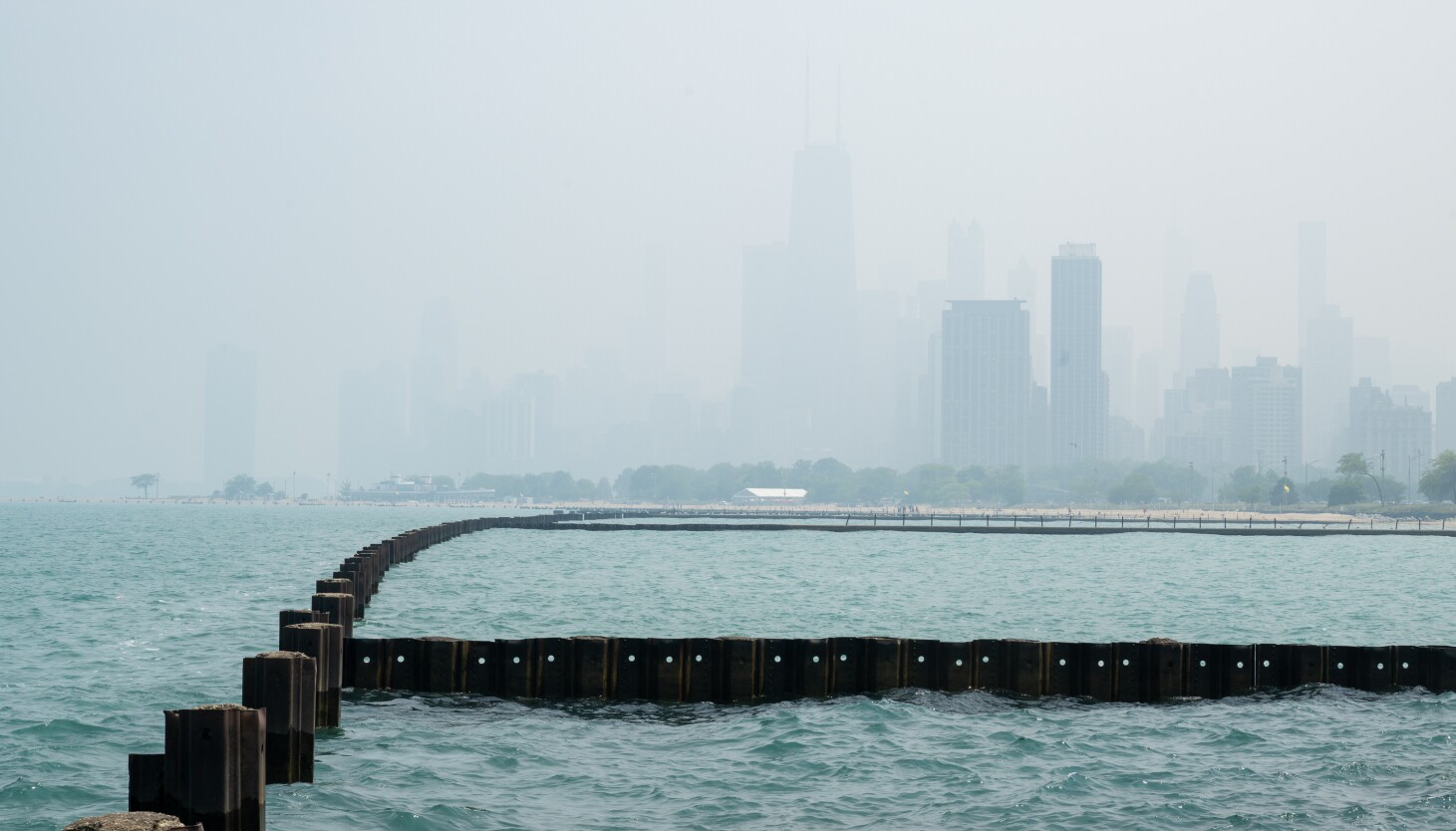
Chicago’s air quality was among some of the worst populated cities in the world after Canadian wildfire smoke drifted south to create unhealthy conditions for many people.
The Weather Company, an organization that provides weather data, forecasting, and insights, ranked Chicago as having the ninth-worst air quality globally for cities with a population of over 4 million as of 9 a.m. Thursday.
The poor air quality is due to Canadian wildfire smoke in the region which prompted an air quality alert for the Chicago area Thursday.
“Today is a day to be very cautious about going outside,” said Dr. Brady Scott, a respiratory therapist and professor of cardiopulmonary sciences at Rush University Medical Center.
People with respiratory conditions, such as asthma, have to be particularly careful, said Scott, who added that even healthy individuals should be careful to not overdo it with strenuous activities given the air quality.
The Illinois Environmental Protection Agency issued an Air Pollution Action Day for the Chicago metropolitan area that is in effect until midnight due to elevated particle pollution, according to a state news release.
Cook, DuPage, Kane, Kendall, Grundy, Lake, McHenry and Will counties were all included in the action day, officials said.
In Illinois, a Chicago Air Pollution Action Day is issued when air quality is forecast to be at or above the “unhealthy for sensitive groups” category — or a Level 2 on a scale of 6 — for two or more consecutive days for Chicago metropolitan area.
Some areas in the city had air quality ranking at Level 3, or unhealthy for everyone, according to AirNow.gov.
IQ Air, a Swiss technology company that sells humidifiers, ranked Chicago among the top three current most polluted cities worldwide, though the Illinois EPA didn’t verify those exact rankings.
Symptoms for sensitive individuals to look out for include wheezing, coughing, a fast heartbeat, fatigue, chest pain, and shortness of breath. If symptoms worsen, call 911 or a physician.
“There is no level at which fine particles cease to cause health problems,” said Brian Urbaszewski, director of environmental health programs at Respiratory Health Association in Chicago.
Urbaszewski recommends a series of precautionary measures for those who are most vulnerable to the bad air. They include staying indoors with windows closed, using air filters and following advice from a doctor on medication and physical activity.
Chicagoans are also encouraged to limit driving, conserve energy, use environmentally-friendly household and cleaning products and avoid gasoline-powered equipment.
The smoke contains small particle pollution, which can be embedded deep in human lungs.
“It’s probably a good idea to limit time outside,” Kevin Doom, a meteorologist with the National Weather Service, said. “Doing a lot of heavy breathing is probably not ideal on a day like today.”
Northern winds have blown smoke from wildfires in central Canada down to Chicago over the last several days, causing the poor air quality, though conditions are expected to improve over the next few days, according to the weather service.
“The smoke should be starting to thin out a little bit now that the winds kind of changed direction,” Doom said.
Recently retired WGN meteorologist Tom Skilling told the Chicago Sun-Times there were several factors in Canada’s and Chicago’s weather patterns that resulted in the poor air quality.
“The clarity in which these wildfire events are occurring over the [United States] and southern Canada is a byproduct of our warming climate and changing precipitation patterns,” Skilling said. “The moisture situation in Canada this year is one of below normal precipitation. So you set the stage for these fires when it’s dry and on top of that you put abnormally mild or warm temperatures over the area then you get into deep trouble.”
Skilling noted that lower air quality readings are coming from counties adjacent to Lake Michigan because of a temperature inversion that’s created when northeasterly winds bring cooler air that sits over the lake.
Wind blows the smoke south toward Lake Huron before pulling it back northeast toward Lake Michigan, according to Skilling.
“Normally when you go up in the atmosphere, the temperature drops with height,” Skilling said. “When air is heated, it wants to rise and [when there’s a temperature inversion] you shut down the ability of that air to rise and ascend and cut down the vertical mixing of air that thins out air pollutants,” Skilling said.
“So we have lower air quality in Chicago than out in the far west suburbs where this cool lake dome of air doesn’t reach and therefore there can be at least some mixing of the pollutants.”
Skilling said conditions shouldn’t be as severe in the coming days, but that it’ll be a while before the air quality completely returns to normal.
“These fires are not going away up there anytime soon,” Skilling said. “We’ve got some time left where we’re gonna have some pollution, some air quality issues here.”
“We all breathe air, and so modifying our exposure to the bad air is a good way to proceed,” Skilling said.
“We can’t be totally divorced from our environment.”