![[OC] The collapse of 3rd parties in Canada: how each district voted in 2021 vs. 2025](https://www.europesays.com/wp-content/uploads/2025/06/taobaecmv85f1-1600x1024.png)
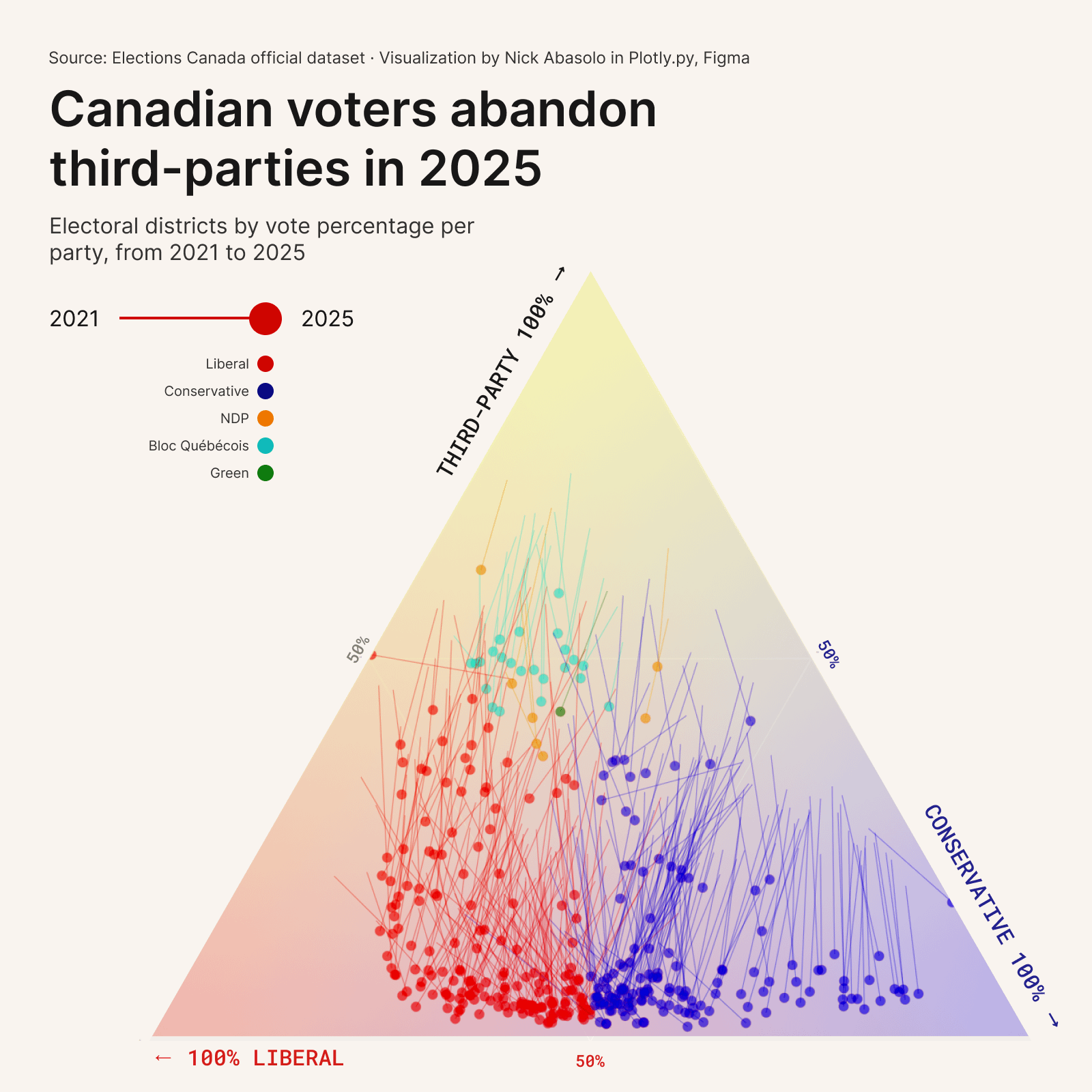
Despite their historical influence, Canada’s third parties saw a major collapse in support in 2025, as voters consolidated around the Liberal and Conservative parties.
This ternary plot shows vote share percentages by electoral district: the closer a point is to a corner, the more support that party received. Each line represents how much a district shifted from 2021 to 2025.
You can see a clear pattern of "downward" shifts away from the NDP, Bloc Québécois, and Greens, and moving towards the two major parties.
Data: Official datasets from Elections Canada. Note that 2021 results are based on Elections Canada’s official transposed data (due to a redistricting between elections, 2021 votes were mapped onto the new 2025 district boundaries).
Tools: Built in Python using Plotly, then polished in Figma.
Posted by Ube_Solo
11 comments
**Despite their historical influence, Canada’s third parties saw a major collapse in support in 2025, as voters consolidated around the Liberal and Conservative parties.**
This ternary plot shows vote share percentages by electoral district: the closer a point is to a corner, the more support that party received. Each line represents how much a district shifted from 2021 to 2025.
You can see a clear pattern of “downward” shifts away from the NDP, Bloc Québécois, and Greens, and moving towards the two major parties.
**Data:** Official datasets from Elections Canada. Note that 2021 results are based on Elections Canada’s official *transposed* data (due to a redistricting between elections, 2021 votes were mapped onto the new 2025 district boundaries).
**Tools:** Built in Python using Plotly, then polished in Figma.
Fortunately, this shift is likely to be temporary
That’s what happens when the electorate decides that the tertiary parties are failing at their jobs, combined with a fear where ‘the other party’ (Conservative *or* Liberal) will take the country.
We all need more 3rd parties but I guess the fortunate thing is that Canada seems to be shifting more liberal, bucking the worldwide trend, unless I am misreading the graph?
The opposite is happening here in Australia, the 3rd party primary vote share was more than one of the two major parties for the first time ever this election. 34.56% Labor, 33.62% 3rd party and 31.82% Lib/Nat Coalition.
Modern conservatism has shown that their policies shift right towards more extreme views. The right wing increasingly shows unwillingness to ease their most controversial ultra partisan policies. Given the first past the post electoral system, this generally forces center and left leaning voters to shift votes to the non-conservative party that has best chance to prevent conservative win, rather than being the party of choice. This has benefitted Liberal Party in the past several election cycles. Canada really needs electoral reform.
Good.
In the current landscape in Canada, 3 parties nationally is essentially just the left being divided, enabling Conservatives to sometimes get a mandate.
In Quebec, it’s been 22 years of right and center right because of a divided left, even though the province skews very progressive as a whole.
Great visualization, it remind me of the wind map on my phone so it is very easy to understand.
Oh, the NDP and the Bloc aren’t *over*, Nick. They just needed a change of leadership
great work! how did you polish in figma?
This is quite normal in Westminster style democracies when “things get real” and the country is on the line somewhat.
Comments are closed.