![[OC] 🌅 🇨🇱 Chile just became the world's solar energy champion, and it happened faster than anyone expected...](https://www.europesays.com/wp-content/uploads/2025/06/4ez3heh8ic5f1-1920x1024.png)
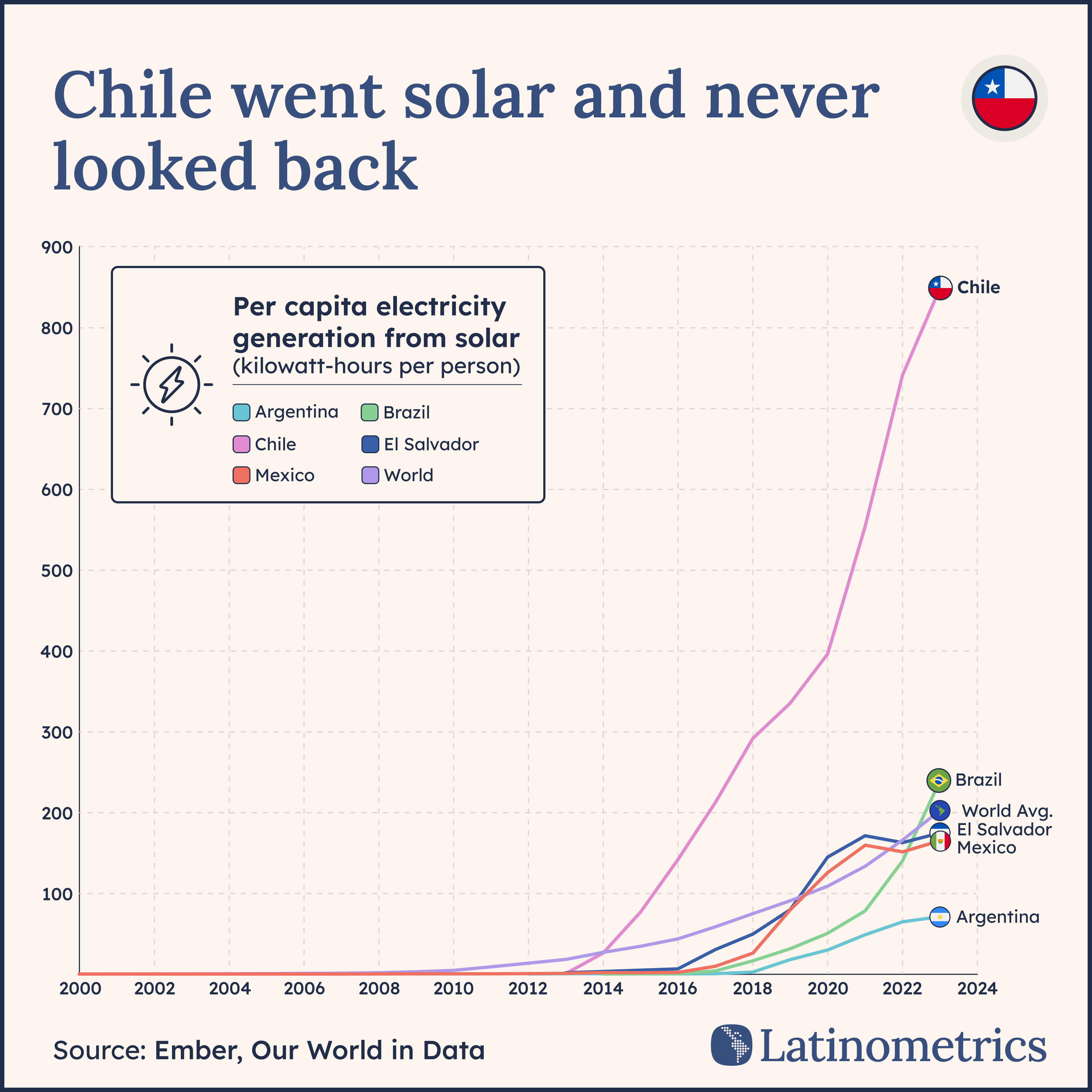
☀️🏜️ Did you know there's a desert so perfect for solar power that it's literally changing how an entire country gets electricity?
The Atacama Desert in northern Chile is home to a great many things. The port city of Antofagasta, which over a century later the Bolivians still want returned. Some of the most advanced telescopes mankind has ever built.
Oh, and the highest amount of solar potential of any place in the world.
On account of its altitude, aridity, and sun exposure, northern Chile is Earth’s most solar-primed location. For over a decade now, the country has embraced this clean, renewable energy source as it seeks to decarbonize and reduce dependence on fossil fuels.
In June of 2014, a 100-megawatt photovoltaic solar plant went online in the Atacama Desert. At the time, it was the largest in Latin America. A number of nearby smaller solar parks were inaugurated in the months and years following, explaining the soaring rise of Chile’s solar energy production over the last decade.
Indeed, Chile has long since left behind both its regional and global peers in adopting solar energy as the power source of the future. Electricity production from solar has tripled multiple times in fewer than ten years. Private national and foreign firms have teamed up with local universities and researchers to roll out a solar program which will be the world’s envy, guided by the government’s Roadmap to 2050.
How successful has the switch to solar been?
Well, in 2022 Chileans officially got more electricity from renewable energy than coal. Today the country is by far the global leader in solar power utilization, ahead even of more-developed sunny countries like Australia and Spain.
And there remains work to be done; per the Roadmap to 2050, the county has only just reached the point for its solar-power goal.
Another impressive feat for one of Latin America’s most impressive countries.
Sources: Per capita electricity generation from solar, Share of energy consumption by source
Posted by latinometrics
25 comments
Good work, Chile … not so good work, OP, for posting selected data that proves your point, by filtering out all countries with a higher per-capita solar energy production (look at Australia, completely different scale!)
I’d be interested to see China and India in this dataset too. They have had a massive push in solar.
Solar and wind are the future of energy generation. Especially since it’s become stupid cheap thanks to China’s over production
Nice. Is there a lot of battery storage to go with that or does Chile have so much hydroelectricity that it’s not necessary?
According to this graph they already were in 2015
My friend moved to Chili, did PhD in Energy and have been working there last 15 years in solar energy research. I was always like “wtf man, studying and working in Chili? Really? are you really doing research over there?”. Now I believe he seriously contributed to something great.
Doing my part for Mexico, but it seems like we have a long way to go! Nice work Chile!
Although I do see more solar panels in places in places I would not expect, and it just makes so much sense in this region because the sun conditions are usually very good to gather a lot of energy.
kWh per person per what measure of time? I would assume annually, but should specify.
In 2024 for Chile it’s 19.9 TWh of solar (roughly 27% of generation) and 26.5 TWh of hydro per year. And saying they “never looked back” is a bit incorrect given that they increased hydro more than solar between 2022-2024. But yes, solar is the primary growth in the past ~10 years.
[https://ember-energy.org/data/electricity-data-explorer/?entities=Chile&entity=Chile&tab=main](https://ember-energy.org/data/electricity-data-explorer/?entities=Chile&entity=Chile&tab=main)
Chilean here. And the electricity bill is only going up and up to the point that I am using LPG and timber to heat my house instead of electrical heaters. I am sure that we will reach carbon 0 once everyone is cooking and warming themselves with coal and timber because electricity is becoming every week more unaffordable.
[https://www.adnradio.cl/2025/06/04/cuentas-de-luz-suben-mas-de-60-en-tres-anos-cuando-es-el-proximo-aumento-en-chile/](https://www.adnradio.cl/2025/06/04/cuentas-de-luz-suben-mas-de-60-en-tres-anos-cuando-es-el-proximo-aumento-en-chile/)
Renewables are such a scam in the sense that they have convince people that in the future somehow electricity will come down with all these solar and wind plants and there is absolutely no downsides to it, where the reality is the opposite. The “greener” your grid is, most costly is to run it and the prices are always dictated by the most expensive reliable power source which in our case is either fossil fuels or Hydroelectric.
Chile went so damn solar they merged with the sun
Their entire northern half is pure desert. Like Atacama desert.. some of it in tropical latitude. That’s a lot of sunshine pal
This is false. There are several countries that produce more per capita than Chile.
[https://en.wikipedia.org/wiki/Solar_power_by_country](https://en.wikipedia.org/wiki/Solar_power_by_country)
Australia produces more than twice as much per capita.
Chile was at 20th in the world, according to data from 2024.
That’s really great news for the most developed countries, all in the northern hemisphere, where it’s cold and rainy. But luckily, global warming promises that everyone will soon be a solar champion, which is… bad. The times we live in!
>Well, **in 2022 Chileans officially got**[ **more electricity**](https://www.elmostrador.cl/destacado/2022/10/25/chile-da-un-paso-firme-en-sustentabilidad-por-primera-vez-generacion-de-energias-renovables-superan-a-la-de-carbon/) **from renewable energy than coal**. Today the country is by far the global leader in solar power utilization, ahead even of more-developed sunny countries like Australia and Spain.
That comparison is ridiculous; Australia’s GDP is 5 times larger than Chile and Spain is 4 times larger. You couldn’t power those economies with the amount of solar energy produced in Chile. It’s still a great achievement, but context is important.
Assuming that kWh/year. That’s still only like 3 per day. Not a lot, frankly
US daily electricity consumption is 33 kWh. And total energy is 211.
So they still need to 10x just to cover traditional electricity consumption.
Misleading title, it says their the country with more Kwh per capita of solar generated when they are not. OP was just considering latin america.
> Today the country is by far the global leader in solar power utilization, ahead even of more-developed sunny countries like Australia and Spain.
According to your own source, that is clearly wrong
@2024 | KWh / person
—|—
Australia | 1866
Spain | 1223
Chile | 1008
Chile does actually appear 7th in the list though .. which is definitely something to be proud about
(and above it are the likes of Austalia, UAE, Spain, Greece, Netherlands .. and just behind Chile are US, Germany, Japan etc)
How do they handle energy storage?
Brazil has hydroeletric power plants to supply most of it’s energy, so it doesn’t surprise me it’s not that high in Latin America.
If anyone is winning the “solar race” as though it were the Space Race, then it’s China. They accounted for more new kWh of solar last year than every nation combined, and I guarantee the panels that Chile installed came from Chinese factories.
https://preview.redd.it/wy3fm39s0d5f1.png?width=1220&format=png&auto=webp&s=03bb60b582f47f246548b11e8e509ecf68d64884
Lot of improvements in past 5 years, congratulations to Chile
Isnt UTE alone expecting to produce 400 gwh from solar this year? Uruguay would be off the charts here. Genuinely confused – these are the annual not instantaneous numbers??
The data might be beautiful, but the post as a whole is horrible.
South American countries also have hydro power, include that and add in percentage of total electricity generated, it might give a better picture of renewable energy.
Netherlands hit over 1200kWh per capita in 2023. Impressive, yes but not “world champion” whatever that means.
Comments are closed.