Since the start of 2025, Russian courts have received 26,000 claims have received 26,000 claims seeking to have people recognised as missing or dead. When taking last year into account, the number of such claims filed since the beginning of 2024 is approaching 50,000. The vast majority are related to the war in Ukraine and are filed by military units in order to clear personnel lists for the recruitment of new fighters.
The wave of claims began to rise in the second half of 2024 and has picked up pace even more this year. The lawsuits are flooding Russia’s district and garrison military courts, but courts often obscure the details. Instead of listing the names of applicants, court websites frequently display the note “Information concealed”. Since the start of 2024, at least 18,900 such anonymised claims have been accumulated.

ArticleThe wave of the missing. Fitst half of 2025 sees more claims for MIA and KIA soldiers in courts than the whole previous year
In 11,780 claims, it is explicitly stated that a military unit commander is the applicant. Another 8,989 cases mention a branch of the Defence Ministry. This means that nearly 23,500 claims are definitively linked to military losses. A further 12,000 to 13,000 claims can be considered “extra” cases related to the war, when compared to the normal volume in previous years. This leads to an estimate that between 30,000 and 40,000 Russian service members have been filed in court as missing or dead by mid-2025.
This explosion in cases does not reflect a recent spike in soldiers going missing, but rather an administrative effort to clear a backlog from the war’s early stages, possibly a bureaucratic push by the new Ministry of Defence leadership aiming to cut costs, as service members listed as missing continue to receive a minimal salary; however, there is no clear insight into the internal logic.
The initiative for these court cases comes almost exclusively from the military, not from the families. Relatives often cling to the hope that their loved one will return, or mistakenly believe that a soldier remaining on an official list will prompt a more active search.
The high number of MIAs is a direct consequence of the war’s attritional nature. With frontlines static for months and the pervasive threat of drones, recovering the dead has become exceptionally dangerous. Bodies are often left in the no-man’s-land between trenches for weeks, or even months.
These tens of thousands of soldiers are unlikely ever to appear in publicly compiled casualty lists. When a soldier is declared dead by a court months or years after their disappearance, there is no funeral, no public farewell and often no grave; these are the primary sources for our open-source research.
What we know about losses
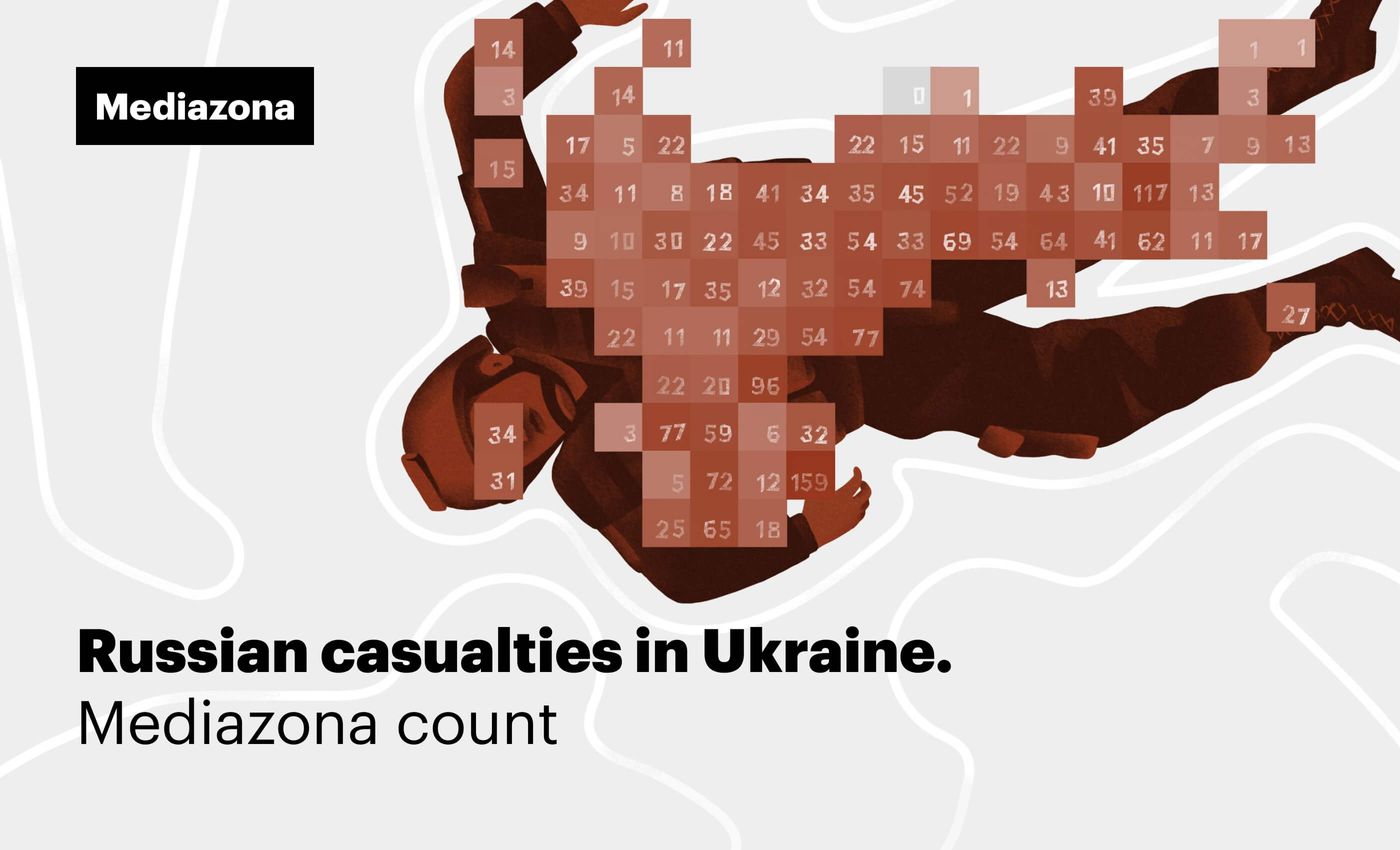
Here’s how the losses are distributed across Russian regions. These are absolute numbers, not adjusted for population or number of military units.
On the map, you can choose between total losses and losses by military branch, as well as see where the deceased mobilised soldiers were from.
In most cases, from death reports or indirect signs (uniform or sleeve patches in photos), it’s possible to determine which branch of the military the deceased served in, or how they joined the army (mobilised, volunteer, prisoner, etc.)
We compared these groups of servicemen on a separate graph.
From early summer and into the mid-fall season of 2022, volunteers bore the brunt of the losses, which is strikingly different from the situation in the initial stage of the war: in winter and early spring, the Airborne Forces suffered the greatest damage, followed by the Motorised Rifle troops.
By the end of 2022 and the beginning of the next year, losses among prisoners recruited into the Wagner PMC increased markedly. They were formed into “assault groups” to overwhelm Ukrainian positions near Bakhmut.
By March 2023, prisoners became the largest category of war losses. After the capture of Bakhmut, there have been no cases of mass use of prisoners so far.
By September 2024, volunteers once again emerged as the largest category among the KIA. This shift reflects a cumulative effect: prison recruitment had significantly waned, no new mobilisation had been announced, yet the stream of volunteers continued unabated.
By June 6, the death of 5,138 officers of the Russian army and other security agencies had been confirmed.
The proportion of officer deaths among overall casualties has steadily declined since the conflict began. In the early stages, when professional contract soldiers formed the main invasion force, officers accounted for up to 10% of fatalities. By November 2024, this figure had dropped to between 2–3%—a shift that reflects both evolving combat tactics and the intensive recruitment of volunteer infantry, who suffer casualty rates many times higher than their commanding officers.
Officers killed in Ukraine
To date, reports of the deaths of two deputy army commanders have been officially confirmed—Major General Andrei Sukhovetsky of the 41st Army and Major General Vladimir Frolov of the 8th Army.
On May 22, 2022, fighter pilot, 63-year-old retired Major General Kanamat Botashev died; most likely, he went to war as a volunteer. The deputy commander of the Black Sea Fleet, Captain 1st Rank Andrei Paliy, was also killed. On June 5, 2022, the death of Major General Roman Kutuzov was reported.
In June 2023, Major General Sergei Goryachev was killed. He was the chief of staff of the 35th Combined Arms Army and commanded the repulsion of the Ukrainian counterattack in the Zaporizhzhia region.
In July 2023, the death of the first Lieutenant General was confirmed—Oleg Tsokov, deputy commander of the Southern Military District.
In November 2023, Major General Vladimir Zavadsky was killed. He was the deputy commander of the 14th Army Corps.
In November 2024, Major General Pavlo Klimenko, commander of the 5th Separate Motorised Rifle Brigade (former DPR ‘Oplot’ Brigade), died. According to the pro-Ukrainian Telegram channel Spy’s Dossier, he was fatally wounded on November 6: Klimenko was attacked by an FPV drone while riding a motorbike between command posts.
The date of death of servicemen is specified in 87,700 reports. The number of losses per day according to this data hardly reflects the real picture, but it allows us to assume on which days the battles were the most intense.
It should always be taken into account that the data of the last few weeks is the most incomplete and may change significantly in the future.
Age is mentioned in 94,700 reports. In the first six months of the war, when the regular army participated in the invasion without volunteers, mobilised soldiers, and prisoners, most deaths were in the 21–23 age group.
Volunteers and mobilised soldiers are significantly older: people voluntarily go to war at 30–35 years or older, and the mobilised are generally over 25.
Our methods
Mediazona, together with a team of volunteers, meticulously studies posts on social networks, reports in regional media, and publications on government websites.
Our standard for confirmed deaths is stringent: it requires an official publication or social media post from a relative with corresponding details, accompanying photos or dates of burials from local messaging groups, or photos from cemeteries.
We do not count military losses of the self-proclaimed DPR and LPR republics. However, if a Russian citizen voluntarily went to war and joined the armies of these republics (or was sent there after mobilisation), we will count them.
We determined the branches of service based on reports of where the deceased served, or by insignia and uniforms, not by their military specialty. For example, if a soldier operated a self-propelled artillery unit in an Airborne Forces (VDV) unit, we classified him as Airborne, not as Artillery troops.
In the infographic, we classified FSB, FSO, Air Defence, NBC Protection troops, signal corps, and Air Force Ground Services as “other troops.”
We continue to collect data on deceased servicemen. If you see such reports, please send links to them to our Telegram bot: @add24bot. Instructions for contacting Mediazona (anonymously if needed) can be found here.