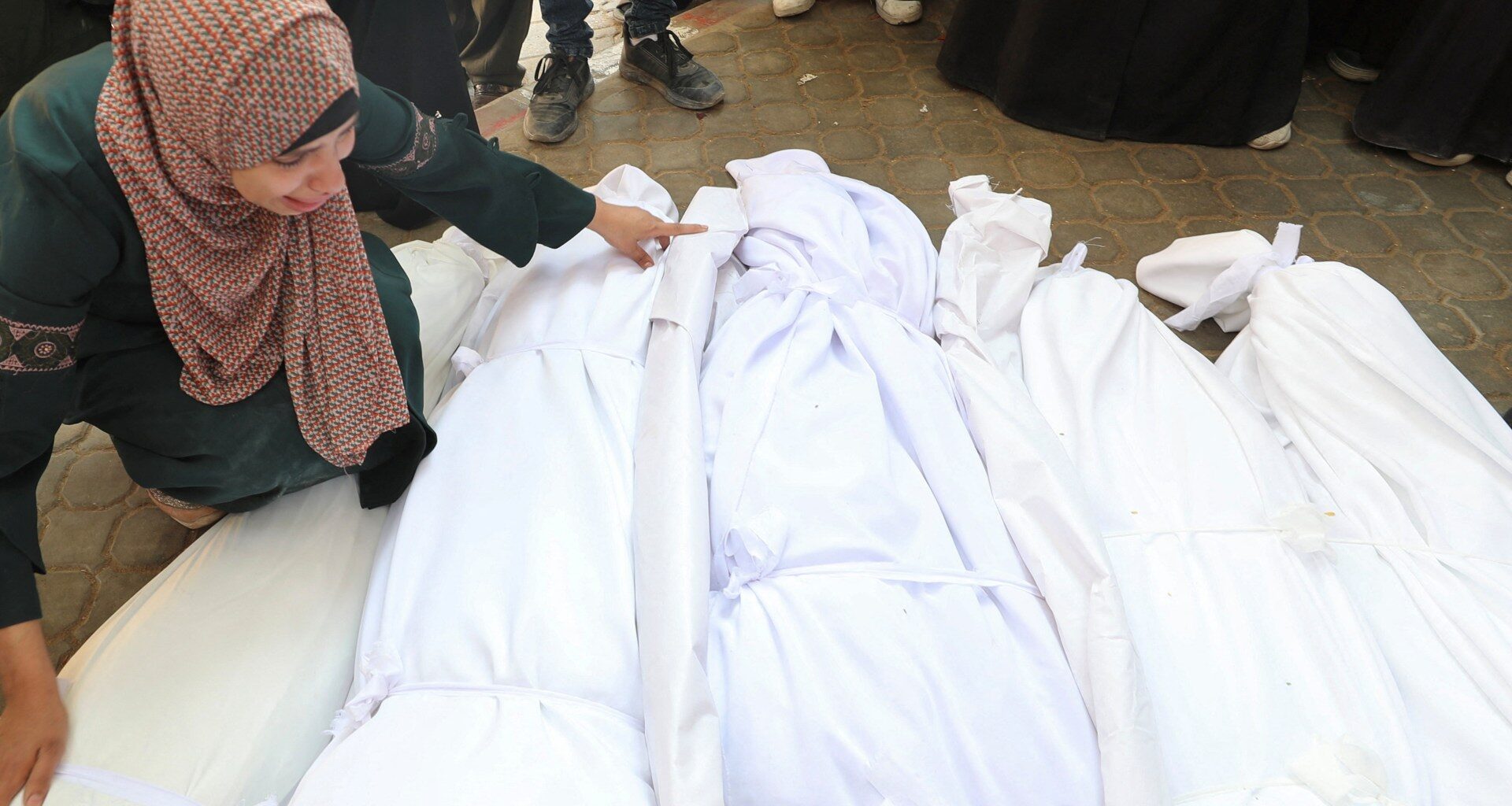
Israeli raids across Gaza have killed at least 75 Palestinians, with rescuers scrambling to find dozens of bodies under the rubble after the bombing of a residential building in Gaza City described by the enclave’s civil defence as a “full-fledged massacre”.
Palestinian Civil Defence spokesperson Mahmoud Basel told Al Jazeera that the Israeli army gave “no warning, no alert” before Saturday’s strike on the house in the Sabra neighbourhood of Gaza City that left at least 16 people dead, including women and children.
“This is truly a full-fledged massacre … a building full of civilians,” said Basel, who added that approximately 85 people were believed to be trapped under the rubble.
“We woke up to the strikes, destruction, yelling, rocks hitting us,” said Hamed Keheel, a displaced Palestinian at the site, noting that the attack had taken place on the second day of Eid al-Adha.
“This is the occupation,” he said. “Instead of waking up to cheer our children and dress them up to enjoy Eid, we wake up to carry women and children’s bodies from under rubble.”
Local resident Hassan Alkhor told Al Jazeera that the building belonged to the Abu Sharia family. “May God hold the Israeli forces and [Israeli Prime Minister] Netanyahu accountable,” he said.
The Israeli military said afterwards that it had killed Asaad Abu Sharia, the leader of the Mujahideen Brigades, who it claimed had participated in the October 7 Hamas-led attack on Israel in 2023, according to a report in the Times of Israel published Saturday.
Hamas confirmed the killing in a statement shared on Telegram, saying that Abu Sharia’s brother, Ahmed Abu Sharia, had also been assassinated in the attack, which it said was “part of a series of brutal massacres against civilians”.
‘A handful of rice for our starving children’
Also on Saturday, Israeli forces killed at least eight Palestinians waiting near an aid distribution site run by the US-backed Gaza Humanitarian Foundation (GHF) in southern Gaza’s Rafah, the latest in a series of deadly incidents around the group’s operations that have killed 118 people and left others missing in less than two weeks.
Gaza resident Samir Abu Hadid told the AFP news agency that thousands of people had gathered at the al-Alam roundabout near the aid site.
“As soon as some people tried to advance towards the aid centre, the Israeli [forces] opened fire from armoured vehicles stationed near the centre, firing into the air and then at civilians,” Abu Hadid said.
One woman told Al Jazeera her husband had been killed in the attack after going to the aid point to get “a handful of rice for our starving children”.
“He said he felt he was walking towards death, I begged him not to leave. He insisted to find anything to feed our children,” she said.
The GHF, a shadowy United States-backed private group engaged by Israel to distribute aid under the protection of its troops and security contractors, began operations in late May, replacing existing networks run by the United Nations and charities that have worked for decades.
Critics say the group does not abide by humanitarian principles of neutrality, claiming that its operations weaponise aid, serving Israel’s stated aims of ethnically cleansing large swaths of Gaza and controlling the entire enclave.
GHF said on Saturday that it was unable to distribute any humanitarian relief because Hamas issued “direct threats” against its operations. “These threats made it impossible to proceed today without putting innocent lives at risk,” it said in a statement. Hamas told the Reuters news agency that it had no knowledge of these “alleged threats”.
The United Nations, which has refused to cooperate with the GHF, has warned that most of Gaza’s 2.3 million population is at risk of famine after an 11-week Israeli blockade, with the rate of young children suffering from acute malnutrition nearly tripling.
‘Lost future generation’
As Israel continued its attacks amid the looming famine, it emerged that health authorities had recorded more than 300 miscarriages over an 80-day period in the enclave.
Expectant mothers face an increased risk of miscarriage and premature births, with basic medical supplies such as iron supplements and prenatal vitamins impossible to obtain.
Brenda Kelly, a consultant obstetrician at Oxford University Hospital, told Al Jazeera that Gaza was “losing a future generation of children”, alluding to a “staggering rise” in stillbirths, miscarriages and pre-term births.
“What we’re seeing now is the direct fallout of Israel’s weaponising of hunger in Gaza – impacting babies’ growth and growth restriction is one of the leading causes of miscarriages and stillbirth,” she said.
Severe malnutrition among pregnant women is compounded by severe stress and psychological trauma, as well as repeated displacement and a lack of safe shelter, she said.
Those babies that do survive face heightened health risks. “We know that famine experienced in-utero has lifelong consequences for children who then go into adulthood with much higher risks of cardiovascular disease and diabetes, as well as mental health disorders,” she said.