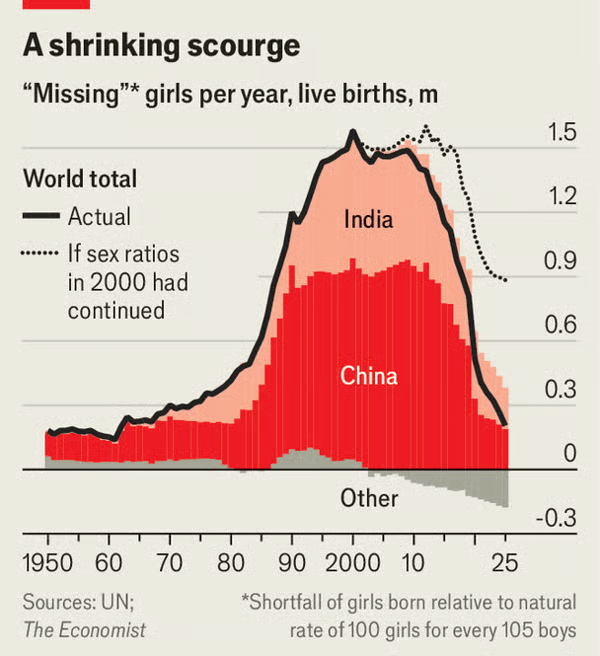
[OC] You may have heard of "missing girls" – the shortfall of women in the many countries where sons are preferred to daughters and people act on the preference. My analysis suggests this is rapidly ending. Two things are going on at the same time. One is that births are falling rapidly in places with strong boy preference (dotted line). The second is that even in these countries, boy preference is itself declining.
The news are, in other words, good. But, as we explore in the article, there are also the early signs of girl preference in the rich world. That preference may be a symptom of problems facing boys, and could, should people start acting upon it at scale, cause much frustration among young women in 20 years time.
Tools used: R, Illustrator
Sources: UN Population data (for '24-'25, projections)
Free to read gift link here: https://www.economist.com/briefing/2025/06/05/more-and-more-parents-around-the-world-prefer-girls-to-boys?giftId=7a9359af-fb17-4b80-ae3b-bcd1154b04df&utm_campaign=gifted_article / https://www.economist.com/briefing/2025/06/05/more-and-more-parents-around-the-world-prefer-girls-to-boys?giftId=d71bf259-1bfa-4134-8e0b-0982ab6affbc&utm_campaign=gifted_article / https://www.economist.com/briefing/2025/06/05/more-and-more-parents-around-the-world-prefer-girls-to-boys?giftId=e30cbe45-f60b-40c8-957e-f853bd864c8d&utm_campaign=gifted_article
Permanent link: https://www.economist.com/briefing/2025/06/05/more-and-more-parents-around-the-world-prefer-girls-to-boys
Posted by statisticalanalysis_
33 comments
The news *is*, in other words, good. The word “news” is an uncountable noun.
The y-Axis is number of global pirates by the way
What lifting massive swaths of population out of poverty does to a mf, also education!
Ive read elsewhere that a lot of these missing girls in china are actually just unregistered girls as to not get in trouble because of the one child policy.
Is Y 1.5 = 98.5 girls for every 105 boys?
Edit: It is not!
The y axis of your chart is unlabeled. This graph is confusing. While I know this fact already, because gendercide is being more seriously prosecuted in the industrializing third world, and women are now allowed to work jobs where they are not at a disadvantage (e.g. tech support vs farming) and can thus own their own money and become assets rather than liabilities for parents alongside the sundowning of china’s one child policy, it’s not clear what the 1.5 is.
They’re not “missing,” and I don’t know why you’re being coy. In societies that are exceptionally misogynistic, parents kill their infants when they are girls because they hate girls and want a boy. If they can only afford one child, they want it to be a boy so it can work and give them money instead of being a domestic slave like a girl.
First world countries, such as Canada, have a very slight majority in new births toward females, but this is minor variance. Middle class couples are not whelping boys, being surprised by the sex, killing them, and then trying again for a girl right away the way the chinese and india have done with girls. If you look at this data over a longer period of time, it will natrually swing back and forth because if you lump all births into a binary, one side or the other will have a little more since it’s not a perfect 50/50 split.
Where do your weird MRA talking points come from at the end there? If there’s an mra man and his tradwife broodmare who think men are disadvantaged in society (lol), they will be misogynists and prefer sons to daughters. They won’t practice selective abortion and prefer daughters and bias population numbers that way, what the hell are you talking about?
China graph seems to be highly correlated with the One Child Policy. It started in 1979 and ended in 2016.
Thank you for sharing a gift link to your work!
For China, the one child policy changed. People may still have a preference but not enough of one to not accept the child if there’s another chance.
Don’t think that future women’s frustration will happen. The contrary.
Preference isnt ending in China. They just dont give up the girls now
Y is labelled under the title so that’s why everyone’s confused. It’s the quantity of girls who are estimated to have been aborted every year by millions
i never got why the preference was for boys, if in chinese culture its expected of the boy to financially support the girl and her parents?
This is not shocking. The big part in China is a mix of cultural and societal issues classing at once. Chinese culture has traditionally had the wife become part of the husband’s family, taking care of his parents as they get older and leaving her parents to her brother’s wife. As the CCP put the One Child policy into place, many people only wanted sons because if you only had one child, then you needed your son so his wife would take care of you. Now that the population is majority male, women are a low supply item. Part of the reason the CCP had to remove the One Child policy. Now with education, many women want careers and do not want to take care of their husband’a family. Even worse the marriage culture is AWFUL in China. People will crash weddings, make demands of the bride and groom, bride families will make massive demands for son-in-laws, and more. Even with the repeal of One Child many families in China cannot afford more than one child.
Is it because shortage of girls increases demand for them and makes having one economically justified? I read a guy in China has to pay fortune to the bride’s parents now.
Ok, I know why this was a thing in China, but why did this happen in india too?
for india they had to ban sex determination during pregnancy, made many policies to benefit girl child, went after whole family if anyone asked for dowry ( culturally parents of bride are still expected to give some ‘gifts’ in wedding but nowhere near what blatantly used to happen) and had the biggest nationwide movement to make people slowly change their minds ( which still needs a lot of work to do) and the good thing is the guys don’t feel like they are neglected because of these things
So is this saying that since around 2000 the rest of the world apart from China and India has had a small but growing preference for girls (witnessed by a higher ratio of girls at birth than the expected 100:105 ratio)?
Why are you using such delicate language around this? This is not a graph depicting the “preference for boys”. This is a graph depicting the murder of female infants. Call it what it is.
Query: The US press and websites frequently report on gang rapes in India. Is this a unintended consequence of preferring male births and concomitant dearth of marriageable females?
We don’t hear that as much about China. Is that a factor of information suppression or are there cultural or criminal forces at work?
wait did you write the economist article?
Meanwhile my fiancee trying to talk me into having another child 24/7 because she wants a girl and we had a boy, even though everything is on me and I’m not at best mentally to take care of another child (I have a teenaged son too), and if it were another boy I’d hear no end of it again, at least she’s not visibly resentful of having a son anymore.
Maybe I need help I don’t know.
Women can work now. It won’t cause frustration.
Am I wrong or is this data just a euphemism for girls who are selectively aborted or killed at birth?
Awful data representation. I think this has to be the most confusing graph and labeling possible. Only way to make it worse is probably to lower the jpeg quality to 15.
The issues more girls would cause are way less of a problem than less boys though. Boys generally react more violently to depression and negative feelings, as such I expect in those countries for violence among young men to rather increase due to frustration of not finding a partner. I wouldn’t expect the same if genders are exchanged. Also, biologically a “harem” or polyamory with more girls than boys makes more sense, as a guy isn’t limited in how many children he can father at a time, but a woman can only have one child at a time and may want a limited amount, so the growth of a population is more limiting by a lack of women than a lack of men.
This is presented in a very confusing fashion.
how do you have negative missing girls?
What a messed up culture of misogyny.
The gray bars are astounding to me, since it`s genetically normal that you have 100–105 boys being born for every 100 girls.
Boy preference declining seems like it might be a sign that feminism is working, and that women are seen more-and-more as viable breadwinners.
This article has many issues.
>That preference [for boys] has since reversed, however. A study in 2017 led by Francine Blau, an economist at Cornell University, found that having a girl first is now associated with lower fertility rates in America.
“… we find that having a female first child still raises the likelihood of living without a father [and] is associated with lower fertility, particularly for natives.” ([Francine Blau et al., 2017](https://link.springer.com/article/10.1007/s00148-019-00760-7)). The author is leaving the *crucial* “single mother” out of his equation, which is basically misrepresenting what Blau et al. say. Also leaves this out, for some reason: “Immigrant families that have a female first child have significantly higher fertility and are more likely to be living without a father (though not significantly so).”
>In the natural course of things, there are roughly 105 male births for every 100 female ones, which appears to be an evolutionary response to higher male mortality. The rate does fluctuate somewhat, for reasons scientists do not fully understand. Male births tend to spike immediately after wars, for instance.
Unless there has been new research, the Returning Soldier Effect i.e. the sharp increase in male births during and after war, was observed ***for the World Wars***, **in Europe** (except Spain, Italy and Russia) and **in US whites** for WWII ([1](https://sci-hub.se/https://doi.org/10.1093/humrep/dem239), [2](https://pmc.ncbi.nlm.nih.gov/articles/PMC1037277/?page=1), [3](https://sci-hub.se/https://www.thelancet.com/journals/lancet/article/PIIS0140673605602346), [4](https://pmc.ncbi.nlm.nih.gov/articles/PMC1716540/?page=3), [5](https://pubmed.ncbi.nlm.nih.gov/13158334/)). Such trend has not yet been observed in other wars or in other places. *Male births tend****ed*** *to spike* ***during*** ***and*** *immediately after* ***the World Wars*** *w*ould be a much more correct assessment.
>… evidence is growing of an emerging preference for girls. Between 1985 and 2003, the share of South Korean women who felt it “necessary” to have a son plunged from 48% to 6%, according to South Korea’s statistics agency.
This is not evidence of preference for girls: it’s evidence that Korean women don’t feel it’s necessary to have boys. Maybe it’s that girls are seen as less undesirable, rather than more desirable than boys?
>But festivities that end in disappointment for the unsuspecting #boymom and pity from those attending have spawned a whole new genre on social media, “gender disappointment” videos, some of which attract millions of views. Countless posts show or describe “feeling sad you aren’t having a little girl”.
Uh, yeah, and there are also countless posts showing “feeling sad you aren’t having a boy,” “feeling happy you are having a boy,” and “feeling happy you are having a girl.”
This article relies on the Economist’s reputation and on the reader’s credulity to make its point. It is not a trustworthy one.
Wonderful news. Bout damn time!
Comments are closed.