
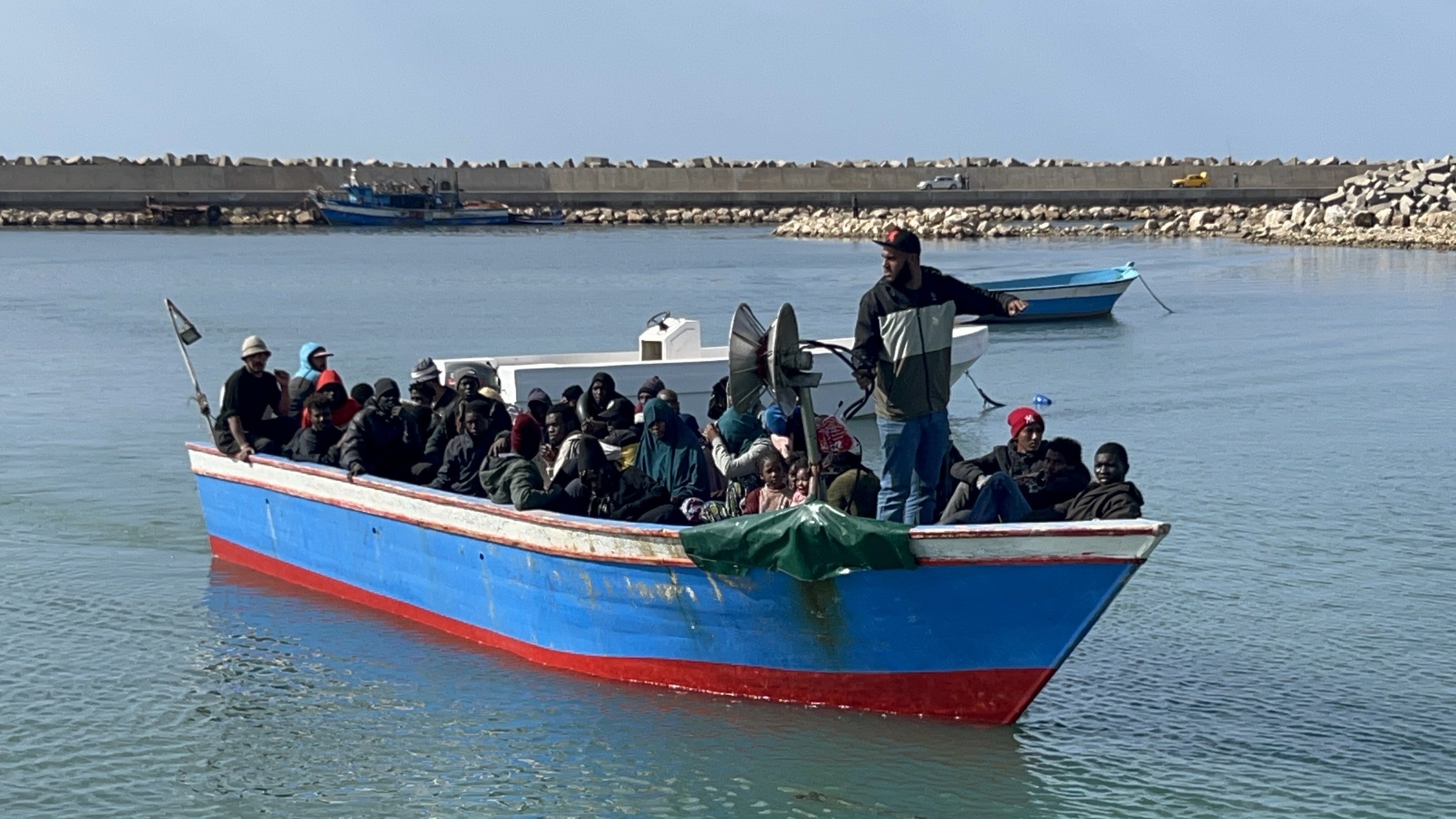
 Migrants on a boat in the port of Garaboli, east of Tripoli, Libya, 25 April 2023. EPA-EFE/STRINGER
A groundbreaking new digital archive launched yesterday in Valletta has laid bare what activists describe as Malta’s systematic abandonment of migrants in distress at sea, revealing that the island nation rescued only 2-3% of the nearly 80,000 people who found themselves in peril within Malta’s search and rescue zone between 2020 and 2024.
The Malta Migration Archive, unveiled on Monday at a launch event featuring testimonies from refugees, human rights defenders and civil society organisations, documents over 1,800 cases of maritime distress through an interactive online map that campaigners say exposes “border violence” and state-sanctioned “dehumanisation” of people seeking sanctuary.
The archive’s data reveals a dramatic shift in Malta’s approach to sea rescues since signing a secretive migration coordination deal with Libya in 2020. Armed Forces Malta rescues plummeted by 90% during this period, whilst interceptions by Libyan militia forces – criticised by human rights organisations for systematic abuses – surged by a staggering 230%.
“Alarmphone had its 10-year anniversary last year. It is a shame that we are still working because the fundamental rights of human beings are still being violated,” Hela Kanakane of AlarmPhone, the emergency hotline for migrants in distress at sea, said.
“We get calls for immediate rescue. But I have never witnessed a rescue within five or six hours in the Central Mediterranean. Whenever we call Malta we get either a recorded song or a curt ‘We are busy’.”
The stark statistics underscore what advocates describe as Malta’s deliberate policy of non-assistance. In 2020, migrant boats were roughly three times more likely to be rescued by Malta’s armed forces than intercepted by Libyan vessels. By 2024, however, boats in distress were approximately 10 times more likely to be seized by Libyan militias than rescued by Maltese authorities.
“1,700 people have died. The civil fleet rescued 12,000 but 21,000 people have been forcibly pushed back to Libya,” Kanakane added, highlighting the human cost of these policies.
The archive represents what organisers describe as a “counter-archive” designed to combat official secrecy and erasure surrounding Malta’s migration policies. It has been developed collaboratively by Maltese civil society groups including Aditus, the Association for Justice, Equality and Peace, the Coalition for the El Hiblu 3, Moviment Graffitti, and international organisations such as AlarmPhone and Sea-Watch.
Regine Nguini of the African Media Association Malta pulled no punches in her assessment of Malta’s approach, describing pushbacks as fundamentally racist. “The institution of pushbacks is racist. Racism is fed into the policies. It is a modern day exemplification of the colonial mindset. Pushbacks are illegal and racist,” she said at yesterday’s launch.
The archive’s interactive map draws on data from NGOs operating rescue hotlines and conducting surveillance in the Mediterranean. It reveals that Malta has increasingly allowed Libyan militias to operate within its search and rescue zone, despite widespread documentation of human rights abuses in Libyan detention centres.
Between 2020 and 2024, the database shows over 5,000 people were illegally returned to Libya from within Malta’s search and rescue zone. These returns violate international maritime law, which requires people rescued at sea to be taken to the nearest safe port—a designation the United Nations has explicitly denied Libya.
“We started this project wanting to do two things: one was to counter the lack of information about migration at sea, to counter the veil of secrecy that has surrounded our government’s actions when people are in distress in our waters,” the archive’s creators said.
“And the other was to connect what is happening at sea to all the work around migration that is being done in Malta.”
The testimonies collected reveal the human cost of these policies. Dursa Mama of Spark15, speaking from personal experience, said: “I often go down alone and talk to the sea—to the people we have lost in the sea. In Malta, I feel like I am home, safe. In my grassroots work, I meet all sorts of people but most of us are responsible and want to be accountable to society. Why is there not a safe way to travel for these people?”
The archive launch coincides with mounting criticism of Malta’s migration policies. Earlier this year, leaked EU military documents suggested Malta “refuses” to participate in migrant rescue missions, with Italian authorities frequently forced to take over operations despite incidents occurring primarily in Malta’s territorial waters.
Christine Cassar of Moviment Graffitti emphasised the need for broader Maltese solidarity: “While it’s vital that people from within the community keep speaking out and leading the way in highlighting the injustices they face, it’s just as important that Maltese people stand with them, so that we don’t allow politicians to weaponise that ‘us vs them’ narrative.”
The Libyan militias operating as coastguard forces have faced sustained criticism from human rights organisations. In November 2022, the European Centre for Constitutional and Human Rights called on the International Criminal Court to investigate their activities, citing evidence that migrants forcibly returned to Libyan detention centres “are subjected to grave human rights abuses.”
An Italian court ruled in June 2024 that interceptions by the Libyan coastguard cannot legally qualify as rescue operations due to the groups being armed and having used gunshots to intimidate migrants and civil society actors. Dramatic footage from 2021 showed a Libyan coastguard vessel opening fire on a migrant boat and ramming it repeatedly.
Despite these concerns, prime minister Robert Abela announced in July 2024 the extension of Malta’s controversial immigration agreement with Libya for another three years, praising its effectiveness in reducing arrivals. The agreement’s details remain largely secret, though Abela claimed it has “meant saving the lives of thousands of people including women and children.”
The human cost of current policies was powerfully articulated by Amara Kromah, a human rights defender and member of the El Hiblu 3—three young men currently facing terrorism charges in Malta for allegedly taking control of a merchant vessel to prevent their return to Libya.
David Yambio of Refugees in Libya captured the broader significance of the archive in stark poetry: “We live not as migrants, not as refugees, not as invaders. We live as humans. Here in Malta, here in Europe, here in this woeful state of neglect. For we live human.”
The archive’s creators acknowledge the limitations of data whilst emphasising its political importance. “In our work, we recognise the limits of ‘data’: the always incomplete nature of the information we hold, as well as the political exploitation of data that exists,” they stated. “We therefore supplement quantitative data with more in-depth case studies and testimonies from people on the move.”
Artist Sam Alekksandra of the PONKS art collective called for a fundamental shift in approach: “We need a universal right of passage in the Mediterranean. We are always looking North. That means we do not look sideways at each other.”
The Malta Migration Archive is designed as a collaborative resource, with organisers inviting continued contributions from researchers, activists, and affected communities. As the creators note: “This archive is thus conceived of as a counter-archive, countering erasure and forgetting.”
The launch comes amid broader European efforts to reduce migration from North Africa, with the EU providing financial support to countries like Libya and Tunisia to prevent departures. However, recent research indicates that net immigration to EU countries actually slowed significantly in 2024, dropping 37.5% from 2023 levels, challenging political narratives about an immigration “crisis.”
For Malta specifically, the contrast between rhetoric and reality remains stark. Whilst the government processed only around 600 asylum applications in 2023, it simultaneously issued over 33,000 residence permits to foreign workers in 2024, with foreign nationals now comprising 28.1% of Malta’s population.
The Malta Migration Archive represents an unprecedented attempt to document and expose what organisers describe as state-sanctioned violence against some of the world’s most vulnerable people. As visual artist Katel Delia observed at the launch, reflecting on her family’s own Mediterranean journey over the past century: “Checkpoint: they open your bags and rummage through everything.”
The archive is now publicly accessible at maltamigrationarchive.org.

