
Intelligence on natural gas market fundamentals presented by NGI’s data and price analysts
Expand
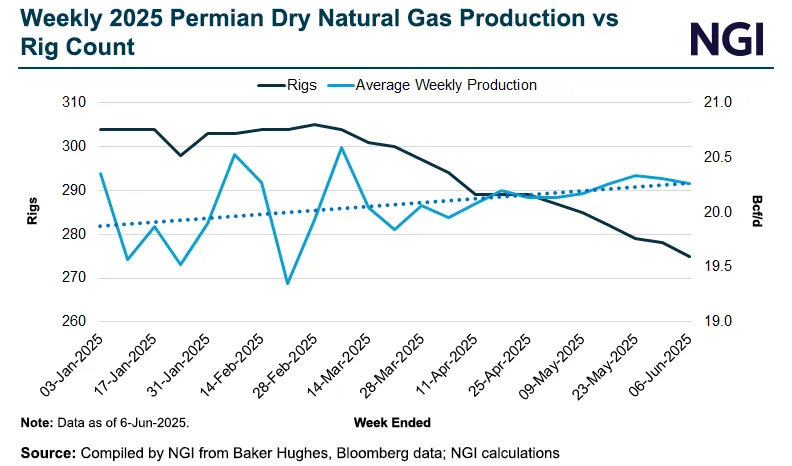
Barring a complete collapse in crude oil prices, natural gas production growth from the Permian Basin is likely to continue – albeit at a slower place – ensuring regional supply remains a powerhouse in U.S. energy output for the foreseeable future.Drilling rigs in the Permian Basin currently sit at 275, down nearly 30 since the start of 2025, thanks in no small part to the potential impacts that tariffs may have on the global economy and plans by OPEC-plus to add crude production over the next few months. Yet dry gas production in the Permian continues to grow at a 6% clip in 2025. Granted, that is down from the 13-19% annual growth range from 2020-2024, but it is growth nevertheless.Why the growth in a falling rig environment? Enterprise Products Partners LP (EPP) Executive Vice President Tony Chovanec during the recent earnings call said, “In general, we and others believe that $55-60/bbl puts the Permian more or less in a maintenance mode and closer to $50 takes the Permian probably below maintenance.”Despite falling from a high of $80 in mid-January, West Texas Intermediate (WTI) prices have still averaged roughly $62 since April 1, according to data from Bloomberg. Unless WTI prices absolutely crash and fall below $50, continued year/year gas supply growth out of the Permian for 2025 seems likely. Moreover, weaker oil prices could lead to a greater bump in ethane rejection in the Permian relative to other areas.Chovanec also noted that in “a theoretical flat case for Permian black oil between now and 2027 and to stay right where it is…rich natural gas grows between 1.3 and 1.5 Bcf/d.” Simply put, rising gas to oil ratios in the Permian support gas production growth even without a rise in crude oil production.
For now, the market expects Waha to average at around $1.900/MMBtu for the rest of 2025 and around $2.420 for 2026, as reflected in NGI’s Forward Look. But that is at today’s $65 oil. A move toward $50 would likely have a more measured impact on Permian gas production and possibly send Waha prices higher.