![[OC] Excess mortality in Europe during COVID-19 | Sweden recorded the lowest number despite (or because of) leveraging a heard-immunity strategy.](https://www.europesays.com/wp-content/uploads/2025/06/6dhghmup0b7f1-1920x1024.png)
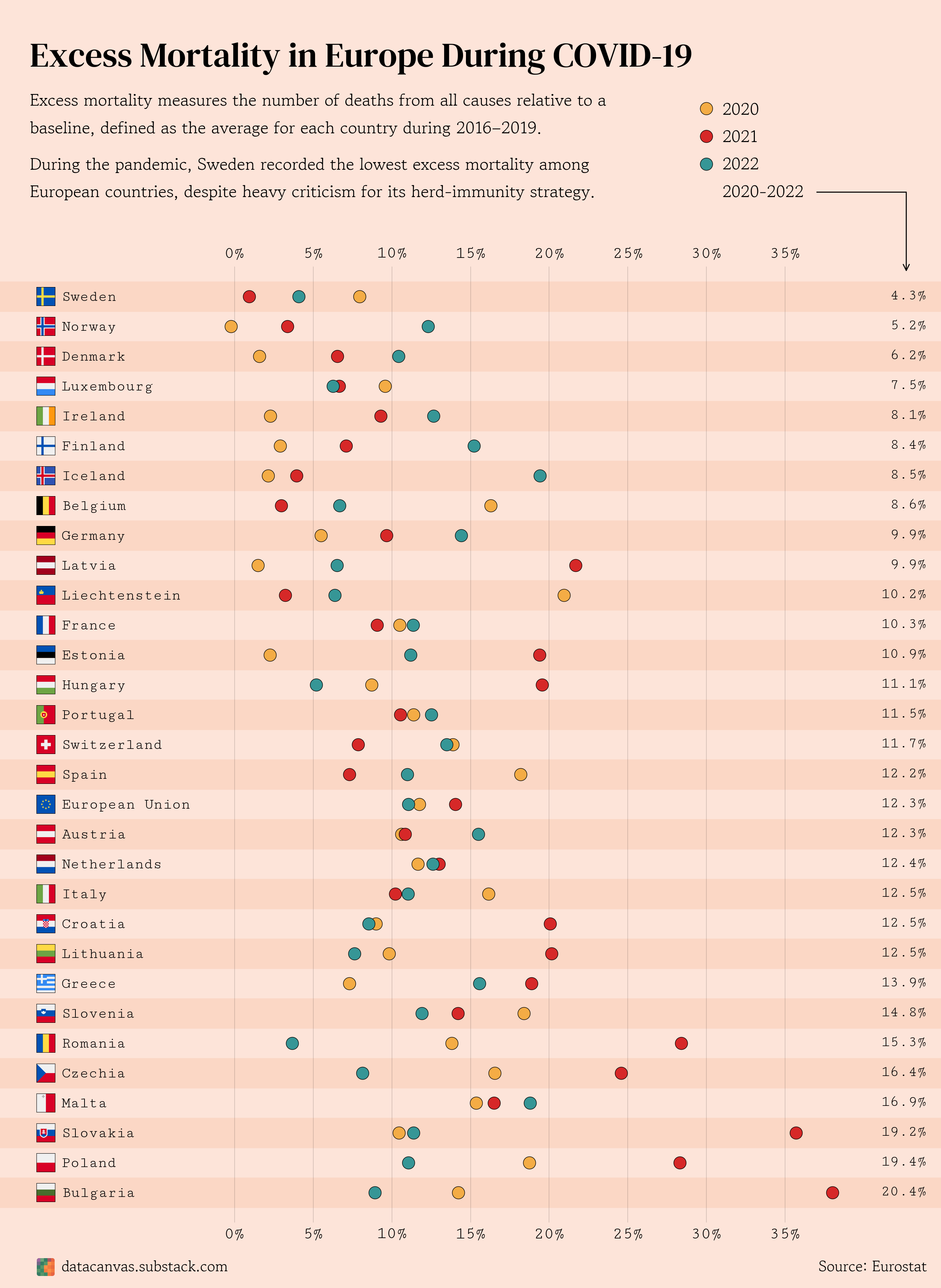
Data source: Eurostat – Excess mortality by month
Tools used: Matplotlib
Background
I live in Sweden, and it was clear right away that our handling of the COVID-19 pandemic stood out.
We had no laws regulating what we could and couldn’t do.
Instead, it was up to the individuals.
You could work from home if you wanted to, but many people still went to their offices as usual and traveled on subways and busses.
Perhaps 50% used face masks, but that was a recommendation and not mandatory.
You could leave your house as you liked, through out the pandemic.
Sweden never implemented a formal lockdown.
During all this time, we faced heavy criticism from all across the world for our dangerously relaxed approach to the pandemic.
Early on, it looked like Sweden was suffering from the pandemic more than most other countries.
However, the way countries attributed deaths to COVID-19 differed.
In Sweden, even the tiniest suspicion led to a death being classified as COVID while other countries were more conservative.
In response, the European Union introduced “Excess Mortality”, a way to measure the total number of deaths from any cause in relation to the years before the COVID-19 pandemic.
It allows us to see how different countries fared by stripping away any differences in deciding the cause of death.
And,
It turns out that Sweden recorded the lowest numbers of excess mortality of all European countries.
Posted by oscarleo0
10 comments
What did France, Netherlands and Portugal to similar to have such similar grouping?
The top three are Scandinavian countries. How to factors like climate, financial strength and education factor in? The top three has similar excess mortality, were their covid restrictions similar? Generally speaking I suspect that the richer countries did a better job, so how did the Netherlands and Austria ‘underperform’? What restrictions were applied in the countries that had the most excess mortality?
I am not really into this, but I do have a lot of questions. XD
Could it be because Sweden has the capacity to handle COVID without it overburdening the healthcare system?
Could just be a list of how good the overall healthcare system is. Less how well they handled COVID in particular, more how capable they are of handling any epidemic.
With that interpretation, Sweden could have done even better had they not adopted the heard immunity strategy.
You are reading this wrong. When talking about the lockdowns, look at 2020 only. Sweden’s numbers are much worse than Norway’s or Denmark’s. Your non lockdown strategy clearly lead to more death’s in 2020.
This is a good visual, thanks. You will probably be critiqued for some of the policy comments but I get it. As an American we get pretty defensive about these things. But the USA has a much older and less healthier population than Europe, lots of smokers and diabetics, so a herd immunity strategy probably wouldn’t have worked here. Interested to hear any dissenting opinions.
Two factors here:
-Quarantine didn’t avoid people getting sick, it avoided people getting all sick at the same time and saturating the health system. So as long as you could treat everyone it really doesn’t change anything.
-There probably are fewer people with untreated respiratory issues in the Nordic countries because you don’t want to live with that during the winters there.
Just one tiny nitpick, excess mortality predates covid, it wasnt something introduced at the time.
Why isn’t the UK on your list?
This is interesting data and I like the display of it. Fits in well to this sub.
However, the interpretation of this and much other data is challenging and requires nuance.
Applying post hoc rationalisation to observed data is fraught with biases and needs to be done with care in complex systems such as a pandemic with so many unmeasured and unknown factors.
For example, it might be fair to say that Sweden not having a lockdown in 2020 meant others that would become at risk in future years and with novel variants. Therefore that explains their lower 2021/2 excess mortality. However, there are other explanations that are potentially as good. Awareness and treatment of an emerging infection improves with time so the fall in excess mortality could be due to treatment (non invasive ventilation, oxygen, blood thinners or antivirals), increased health system resources (more staff, beds, increased capacity to triage infected individuals) and altered human behaviour (increased healthcare access, changing working patterns etc ).
Not trying to diminish what you’ve done here which I think is a great visualisation but the science is hard.
Herd immunity itself is also a very difficult concept, it is entirely dependent on viral dynamics and population mixing patterns which are obviously different across time. When you add on international travel and viral evolution it becomes even more of a headache.
Comments are closed.