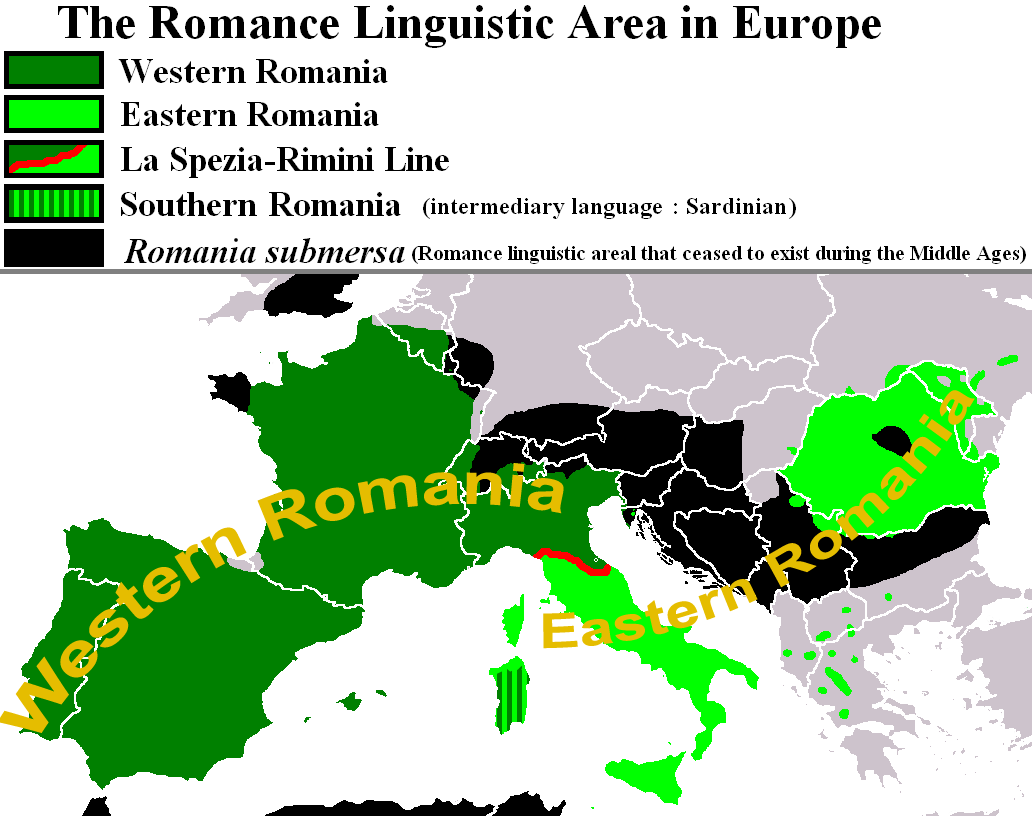
La Spezia-Rimini line divides Romance languages in two group, whereas western Romance languages show common innovations that the eastern Romance languages tend to lack.
La Spezia-Rimini line divides Romance languages in two group, whereas western Romance languages show common innovations that the eastern Romance languages tend to lack.
9 comments
Generally speaking, the western Romance languages show common innovations that the eastern Romance languages tend to lack. The three isoglosses considered traditionally are:
* formation of the plural form of nouns
* the voicing or not of some consonants
* pronunciation of Latin c before e/i as /(t)s/ or /tʃ/ (ch)
* preservation (below the line) or simplification (above the line) of Latin geminate consonants
More at [La Spezia-Rimini Line](https://en.wikipedia.org/wiki/La_Spezia%E2%80%93Rimini_Line)
This really shows why the concept of dialects and languages is so nebulous. The “dialects” of Northern Italy are considered part of the Italian language, despite being much more closely related to French.
Are still those green “oasis” existing in Albania, Greece, North Macedonia and Bulgaria? I thought Aromanian was extinct.
​
Edit: thank you all, nice to hear that that language is still alive.
What’s with the northwest tip of France?
*Roman linguistic areas that ceased to exist during the middle ages*
PAIN
r/2balkan4you
Idk what this means but you go Romania
Which one of these does standard Italian belong to? I assume people don’t just speak their local dialects when they’re e.g. in the national parliament.
At least in the case of Romanian, you can put it together with Southern Italian dialects/languages, but that’s a rather meaningless separation.
The features it shares with Southern Italian languages are mostly due to conservatism, not because they evolved together.
Romanian’s closest relative in Italy are in Northern Italy, particularly in Lombardy, with some similarities also with Veneto and some Romansch dialects.