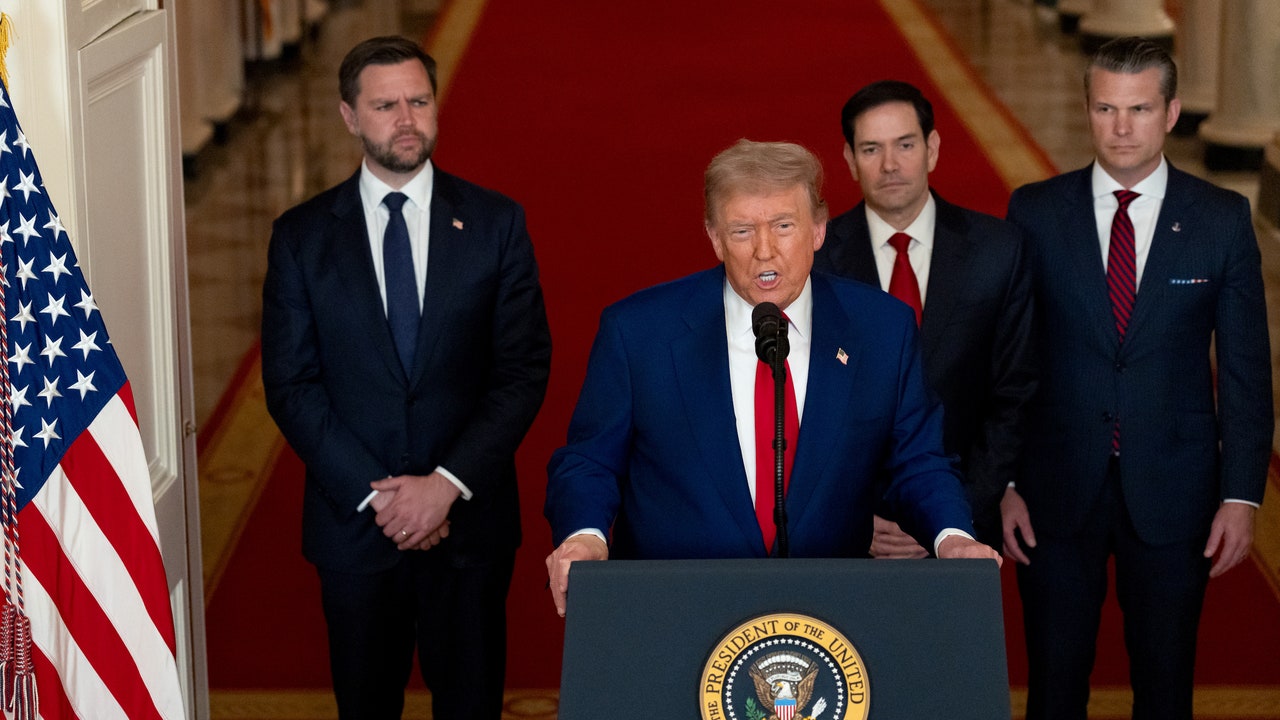
The United States joined Israel in its war against the Islamic Republic of Iran on Saturday night as President Donald Trump ordered American bombers to destroy three key nuclear sites. Just before 8 P.M., Trump went on Truth Social to deliver the news:
In a brief television address at 10 P.M., Trump declared the operation a “spectacular military success” and said the three sites had been “completely and totally obliterated.”
In recent days, polls have shown that a majority of the American people, including a majority of the President’s supporters, opposed going to war with Iran. By ordering these strikes, Trump acted without congressional approval and in contradiction to his campaign promise to avoid the kind of disasters experienced in Iraq, Libya, and Afghanistan. I recently wrote a piece reviewing many of the dangers and possibilities that could follow an American bombing in Iran. After hearing the news, I immediately called one of the country’s most knowledgeable experts on Iran, Karim Sadjadpour. He is a scholar at the Carnegie Endowment for International Peace and worked as an analyst with the International Crisis Group in Tehran, from 2003 to 2005.
“I’m in shock,” Sadjadpour told me, about ten minutes after Trump’s announcement. “I’m sitting here watching this on CNN and trying to see the reaction on Persian-language Twitter.”
“This is unprecedented, dropping a thirty-thousand-pound bomb,” he continued. “Anyone who has observed the last two decades of history in the Middle East would think hard about unleashing such an attack. You would want to think several steps ahead, and there is no evidence that the President has done that. His tweet and his public comments have given the impression that this is the end of war and the commencement of peace, but I suspect the Iranians think differently. They have a program on which they have spent hundreds of billions of dollars. The regime—perhaps not the people, but the regime—takes pride in that and now it is destroyed. No dictatorship wants to look emasculated and humiliated in the eyes of its own people.”
The question now is how Iran will respond. “If the Ayatollah [Ali Khamenei] responds weakly, he loses face,” Sadjadpour said. “If he responds too strongly, he could lose his head.”
“A lot of the options that they have for retaliation are the strategic equivalent of a suicide bombing,” he went on. “They can do enormous damage to our embassies. They might mine the Strait of Hormuz. They can continue missile barrages against Israel. They can attempt to do real damage to the world economy, though the regime might not survive the blowback.”
In the past couple of weeks, Israeli intelligence and bomber pilots have wiped out much of the upper echelons of the Iranian security establishment, along with the country’s top nuclear scientists. The Islamic Revolutionary Guard Corps is still in place, however, and, according to numerous analyses, they are likely to fill any power vacuum, at least in the short term. But the truth is, Sadjadpour said, the events of the coming days and months will be hard to predict.
Will the Israelis or Americans ever come forward with hard, convincing evidence about the Iranian nuclear threat and its timing? Not for the first time, Benjamin Netanyahu asserted that the threat was imminent and acted on it, and yet he did not provide the public with clear evidence of Iran being close to obtaining a nuclear weapon. Nor did Trump. Israel and the United States have now set back Iran’s nuclear program as never before. And yet, if this regime survives, it could well make a secret effort in the future to produce or obtain an atomic weapon as deterrence against a repeat of the strikes that have just taken place.
“Will we look back and say this prevented an Iranian bomb or insured one?” Sadjadpour said. “Similarly, have we hastened the demise of the regime, or have we entrenched it? The modern history of the Middle East does not give favorable answers to these questions. Iran is in a unique situation. It’s plausible that the Revolutionary Guard commanders will look at the Supreme Leader, Khamenei, and say, ‘You have led us to ruin. We have been the most sanctioned and isolated country in the world, and now your nuclear program is destroyed and we are humiliated. It is time to move aside.’ ”
Khamenei is eighty-six, and has been in power since 1989. “He’s one of the longest-serving dictators in the world—you don’t get to be that by being a gambler,” Sadjadpour said. “He has instincts for survival but also instincts of defiance. Right now, his survival instincts and his defiance instincts are in tension. Imagine it: You are eighty-six with the physical and, perhaps, cognitive limits that come with that. You have limited bandwidth, but now you are meant to lead a war against the U.S., the world’s biggest superpower, and Israel, the region’s biggest military power, and you are doing it from a bunker. It is hard to see how the outcome can be positive for him.
“But, as we have learned too often in history, military success doesn’t always translate to political success. In my opinion—and maybe history will view it differently—so much that we do now as a nation is not a reflection of national deliberation or national interest. It is the impulse of one man. Trump came to office believing his mere presence would resolve world conflicts in twenty-four hours: Russia-Ukraine, Israel-Palestine. When Trump saw that he wasn’t successful, he had a great sense of urgency to come to a resolution in Iran. The combination of Netanyahu’s persistence and Khamenei’s defiance transformed Trump from a self-proclaimed peacemaker to a warmonger.”
In Saudi Arabia last month, Trump delivered an extraordinary speech that was highly critical of military interventions and nation-building adventures in the Middle East. “In the end, the so-called nation builders wrecked far more nations than they built,” Trump said. “And the interventionalists were intervening in complex societies that they did not even understand.”