
 The proposed performance space for Damrosch Park. Images courtesy of Lincoln Center
By Scott Etkin
New York City’s Public Design Commission, the agency that reviews changes to the city’s public spaces, on Monday unanimously approved a preliminary redesign for Damrosch Park, the outdoor performance space on the west side of Lincoln Center’s campus.
The commission gave its approval to a series of landscape architecture changes intended to make audiences more comfortable inside the park, while also limiting the noise from performances that can be heard in streets surrounding the park.
For spectators at Summer for the City outdoor performances taking place at Damrosch Park in Lincoln Center this year, there’s no shady spot to take in the music; the new plan would add green areas in the park where music can be heard. And the current seating layout for performances means that spectators in the back row are 160 feet away from the stage; the redesign would put seating in a semicircle around the stage, so no seat is more than 88 feet from the stage.
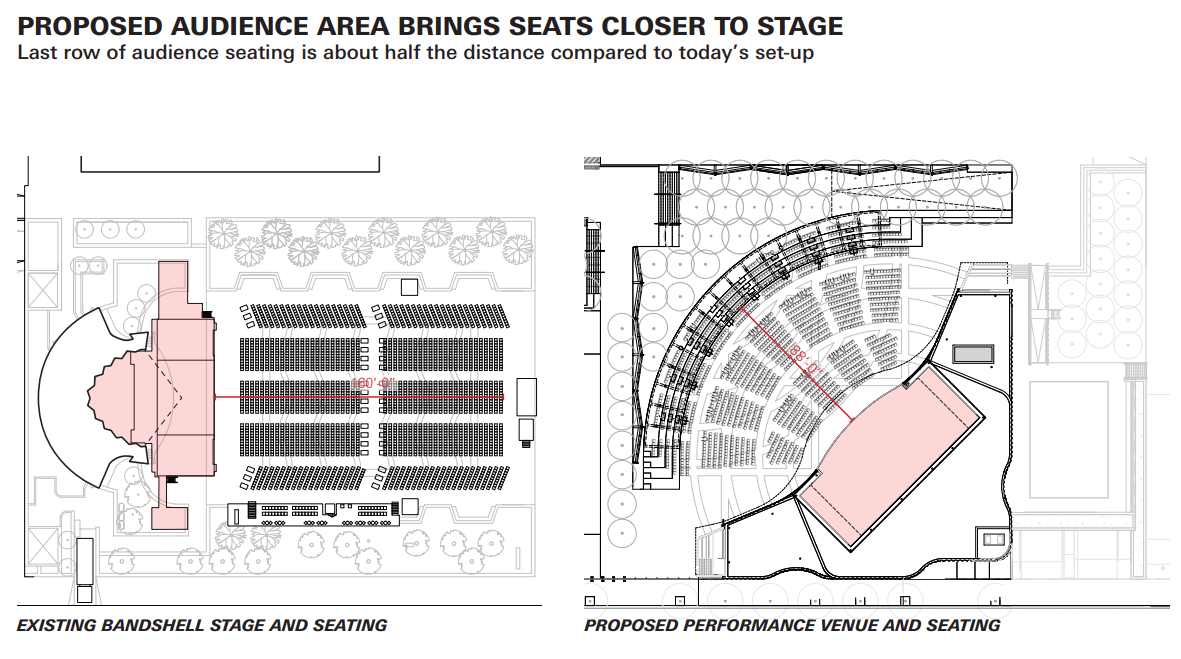 Current seating is shown on the left. The diagram on the right shows the semicircle seating proposed for the new venue.
This setup brings “everyone much closer to the stage, and there isn’t this sense of being in the back or in the front, which is currently the rectangular format,” said Michael Manfredi, cofounder of the design firm WEISS/MANFREDI, during a presentation to the commission. “It also allows us to reduce the acoustic levels it takes to project sound.”
A proposed 18-foot trellis and groves of trees to the west of the new stage are also planned as part of the overall park’s design to help reduce sound levels.
The new performance venue would be facing northwest (toward Amsterdam Avenue), unlike Damrosch Park’s current Guggenheim Bandshell, which faces east. A more detailed sound design study to model the impact of changing the orientation of the concert space is underway by Jaffe Holden, an acoustic consulting firm that has done work at Lincoln Center and many major outdoor venues around the world.
The proposed performance space is roughly 10,000 square feet smaller than the existing one. The difference will be allocated to a park that will be open to the public, even when concerts are going on. In the current setup, there’s no non-ticketed access to the park during performances.
A representative from Landmark West!, a preservation group on the Upper West Side, endorsed parts of the plan – such as its environmental benefits and ADA improvements – but lamented the loss of the Guggenheim Bandshell and the design’s move away from the park’s austere, modernist aesthetic. “Even when unpopulated, the park appears frenetic and busy,” said Megan Fitzpatrick, the group’s director of preservation and research.
The commission urged Lincoln Center to simplify some elements of the park’s design, such as the variety of materials used, to address this concern.
“We can see that the spatial and architectural legacy is represented here,” said Deborah Marton, president of the design commission. “I think it’s important for all constituents and stakeholders that you lead with that in some way.”
Lincoln Center will return to the commission to seek approval for architectural elements of the design, a representative confirmed to the Rag. The organization’s goal is to complete the renovation in the spring of 2028.
Subscribe to West Side Rag’s FREE email newsletter here. And you can Support the Rag here.