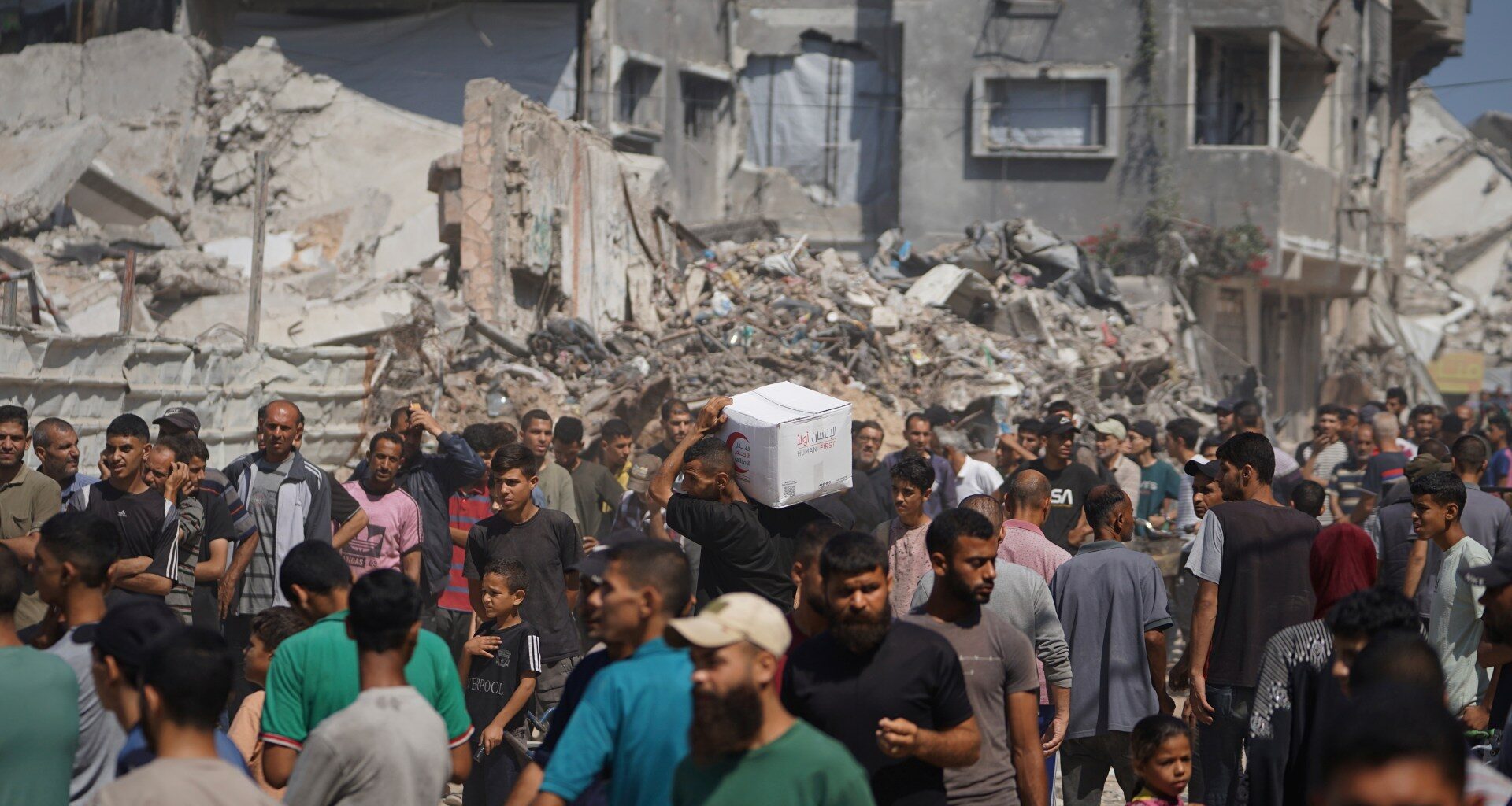
Since May 27, at least 583 Palestinians have been killed and 4,186 injured while waiting for food at aid distribution sites operated by the Israeli- and United States-backed Gaza Humanitarian Foundation (GHF), according to the Gaza Strip’s Ministry of Health.
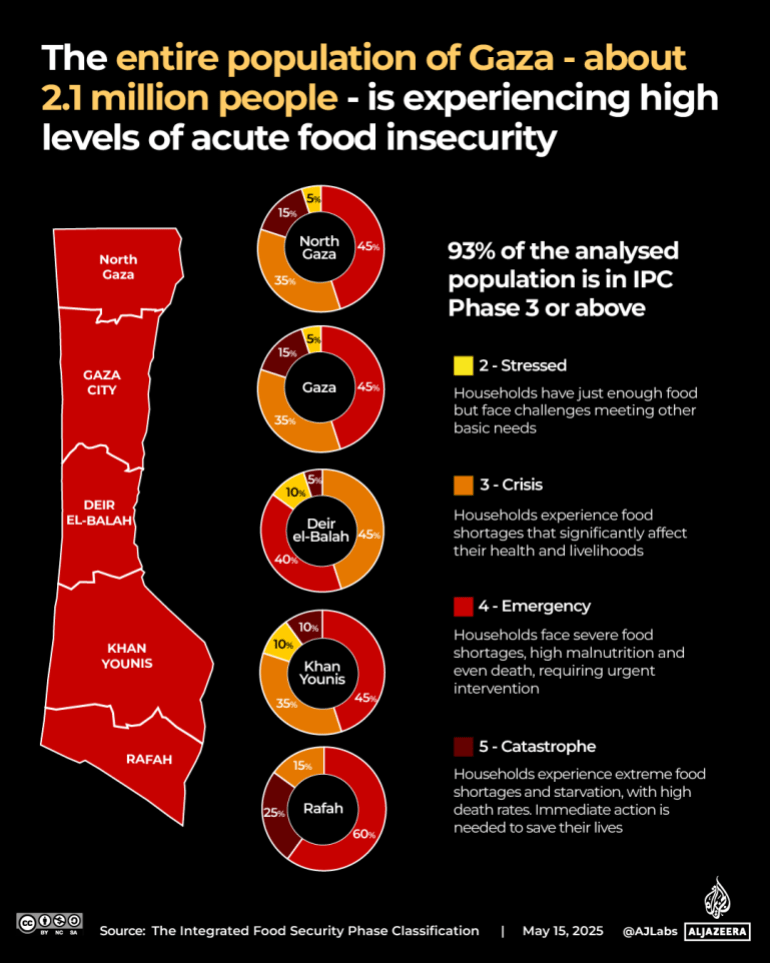
The killings have occurred daily as famine looms over the besieged enclave. International organisations have warned for weeks that Gaza’s 2.1 million residents face catastrophic food shortages with markets emptied, clean water scarce, and aid deliveries sporadic and dangerous.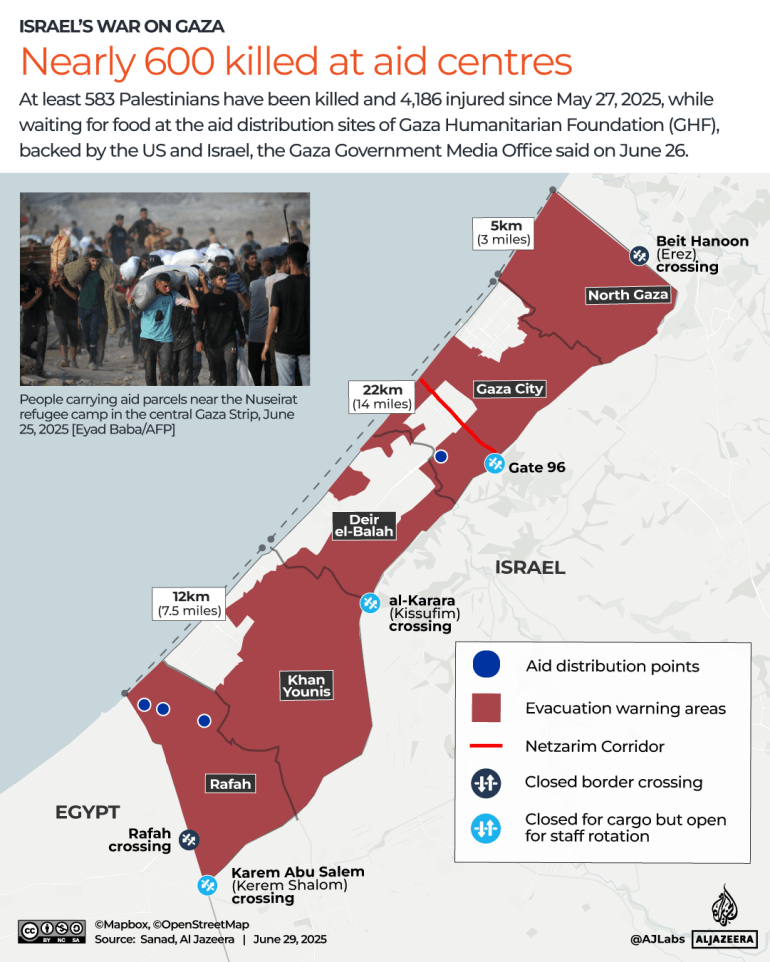
In the first eight days of the GHF’s operation, more than 100 people were killed by gunfire from Israeli forces.
Al Jazeera’s Hani Mahmoud, reporting from Gaza City, said the GHF remains the only source of food in the Strip as Israel continues to place severe restrictions on the entry of supplies by other groups.
“A lot of people here are trying to stay away from the GHF’s centres because of the danger involved in going to them because of the ongoing and deliberate shootings of aid seekers there,” Mahmoud said. “But again, staying away is not an answer because if there are no food parcels, it means that children are going to go to bed hungry.”
Where are the aid distribution sites?
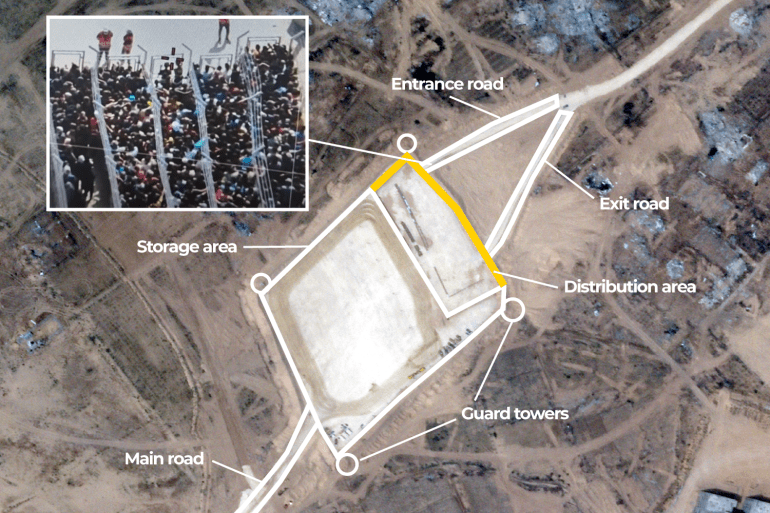
While the previous United Nations-led distribution network operated about 400 sites across the Strip, the GHF, guarded by armed private security contractors working for a US company, has set up only four “mega-sites”, three in the south and one in central Gaza – none in the north, where conditions are most severe.
 [Al Jazeera]
GHF centres operate irregularly, sometimes opening for just an hour. In one instance, a site announced its opening on Facebook, only to post eight minutes later that supplies had already run out.
The centres function on a first-come, first-served basis, often fostering chaos as desperate crowds fight over limited resources.
How do people access these aid distribution sites?
Accessing these centres is perilous. Palestinians must sometimes walk many kilometres through active combat zones, navigate biometric checkpoints and carry heavy provisions back to their families.
The system in effect excludes the most vulnerable – including the elderly, injured and disabled people – who are least able to make the journeys.
What’s in the boxes?
The aid boxes themselves barely meet subsistence needs. While the World Food Programme recommends 2,100 calories per person per day, Israel has capped aid at 1,600.
GHF parcels offer slightly more – about 1,750 calories – but fall far short of nutritional requirements and contain no clean water, medicine, blankets or fuel. For many, receiving a box is not relief but a rare stroke of luck.
Al Jazeera correspondent Hind al-Khoudary reported from Gaza that the rations offer little to sustain families for long.
She described a typical GHF box as containing 4kg (8.8lb) of flour, a couple of bags of pasta, two cans of fava beans, a pack of tea bags and a few biscuits. Some parcels include lentils and small portions of soup mix, but quantities are minimal.
Are aid seekers being deliberately shot?
According to Israel’s Haaretz newspaper, which quoted unnamed Israeli soldiers, troops were told to fire at the crowds of Palestinians and use unnecessary lethal force against people who appeared to pose no threat.
“We fired machineguns from tanks and threw grenades,” one soldier told Haaretz. “There was one incident where a group of civilians was hit while advancing under the cover of fog.”
In another instance, a soldier said between “one and five people were killed every day” in the area of Gaza where the soldier is stationed.
“It’s a killing field,” that soldier said.
What is the GHF?
Before the war began on October 7, 2023, about 500 trucks carrying humanitarian aid entered Gaza daily. That changed when Israel launched its war on the enclave. Aid deliveries plummeted to fewer than 80 trucks a day, and in March, Israel halted them altogether during a nearly three-month blockade on all supplies.
On May 27, the GHF took over aid operations as a private contractor, introducing a new delivery system outside the traditional UN framework.
The organisation, set up this year in the US, was described by The New York Times newspaper as “an Israeli brainchild” – part of a longer-term strategy conceived in 2023 as Israel began planning for Gaza’s future.
The GHF has not publicly disclosed its funding sources. It said it has secured $100m in commitments although details remain vague. The US Department of State recently pledged $30m in support.
How are Gaza’s children affected?
UNICEF has warned that child malnutrition in Gaza is rising at an “alarming rate”.
In May alone, at least 5,119 children between six months and five years old were admitted to hospitals for treatment for acute malnutrition – a nearly 50 percent increase from April and a 150 percent surge from February when a temporary ceasefire allowed for greater aid access.
“In just 150 days from the start of the year until the end of May, 16,736 children – an average of 112 each day – have been admitted for treatment,” said Edouard Beigbeder, UNICEF’s regional director for the Middle East and North Africa.
“Every one of these cases is preventable. The food, water and nutrition treatments they desperately need are being blocked from reaching them. These are man-made decisions that are costing lives,” he added.
Of 19 documented deadly incidents involving food aid distribution, children were among the casualties in more than half, underscoring the vulnerability of Gaza’s youngest residents.
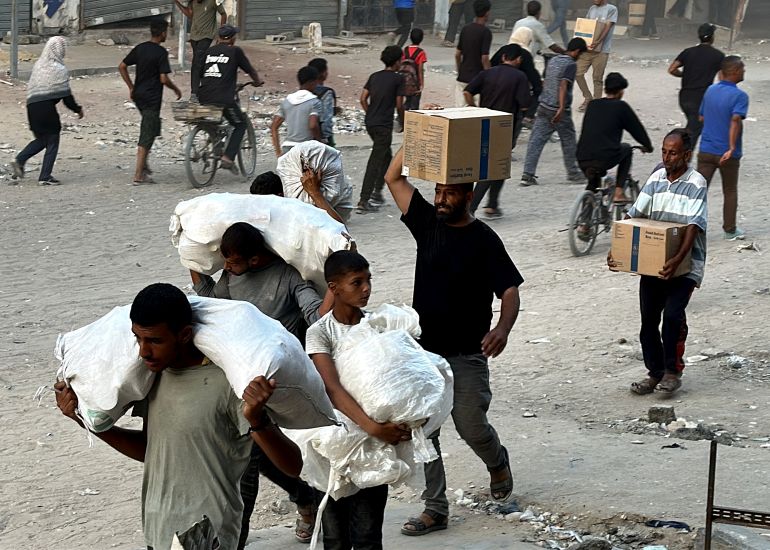 Palestinians travel on a route known as the ‘road of death’ to receive food parcels despite Israeli shelling and the threat of snipers in Khan Younis, Gaza, on June 28, 2025 [Doaa Albaz/Anadolu]
How is Israel threatening the people of Gaza with starvation?
One in five Palestinians in the Gaza Strip is facing starvation because of Israel’s aid blockade. The chaos at aid distribution points underscores the staggering level of hunger gripping Gaza.
According to the latest Integrated Food Security Phase Classification (IPC) report, 1.95 million people – 93 percent of the enclave’s population – are facing acute food shortages.
Certain governorates are experiencing more severe levels of hunger, namely in northern Gaza.
The IPC said Israel’s continued blockade “would likely result in further mass displacement within and across governorates” as items essential for people’s survival will be depleted.