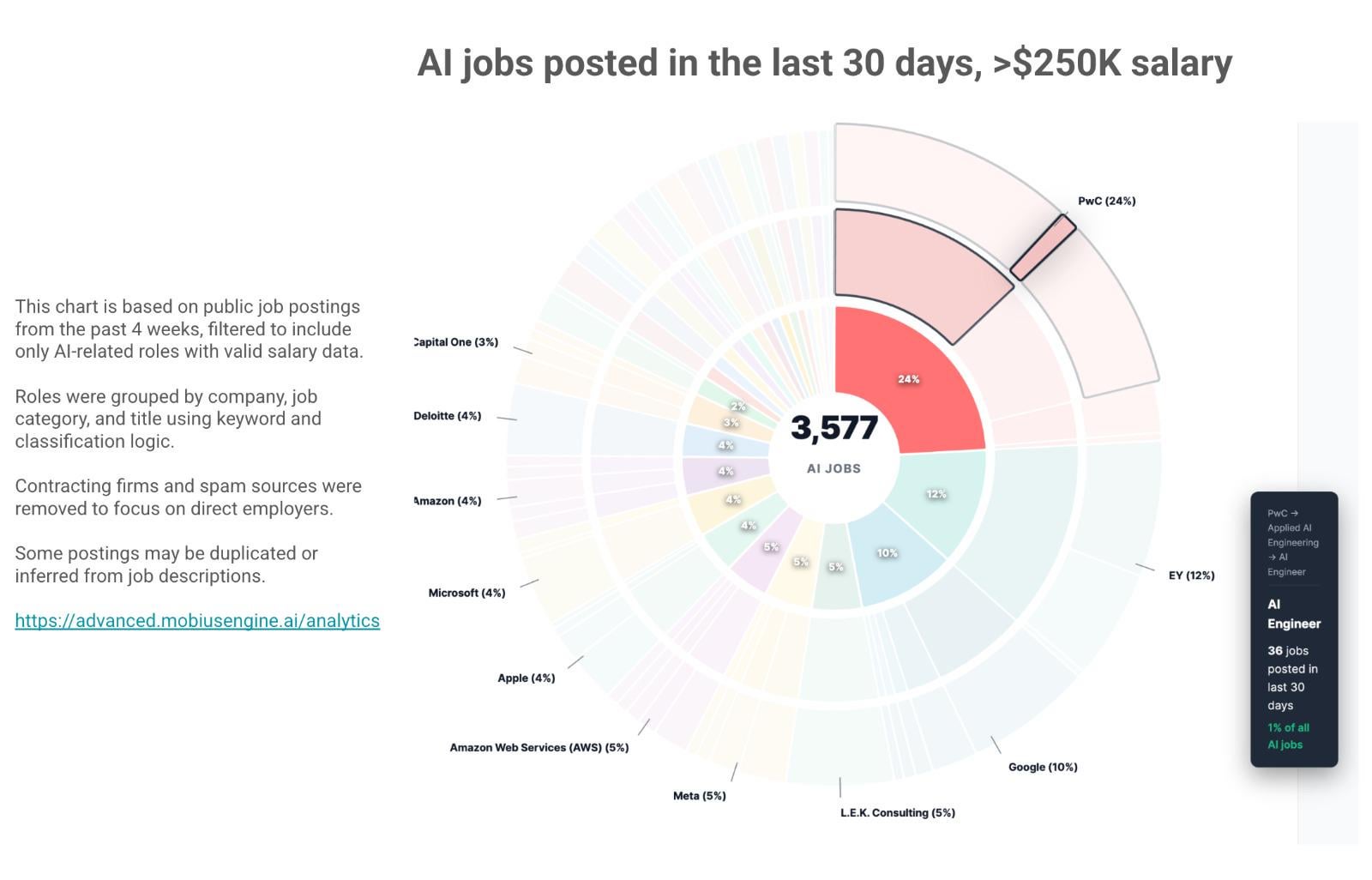
![[OC] I analyzed close to 1M jobs posted in last 30 days, cleaned up, extracted only the pure AI jobs >$250K of comp. Google, PwC and EY are hiring 50% of the pure AI jobs. Mostly tech, finance and some healthcare.](https://www.europesays.com/wp-content/uploads/2025/06/i922zipod0af1-1600x1024.jpeg)
Data Source
US-based AI-related job postings from May–June 2025, aggregated from LinkedIn and other major job board APIs. Data includes postings with listed compensation between $100,000 and $500,000/year, and only roles explicitly related to AI, machine learning, and related technologies.
Tools Used
- D3.js for interactive sunburst chart visualization
- React.js with TypeScript for rendering, layout, and component logic
- BigQuery for data processing, filtering, and role/company aggregation
- Custom categorical color system to visually distinguish companies and role types
- PostgreSQL/SQL logic for canonical title classification and salary range enforcement
Methodology
- Filtered to include only AI-specific job titles (e.g., "ML Engineer", "LLM Researcher", "AI Product Manager") using keyword-based inclusion/exclusion logic
- Salary range constrained to postings with max_salary between $100K and $500K
- Excluded contracting firms, staffing agencies, and job aggregators (e.g., Lensa, Jobot, CyberCoders)
- Each posting was classified into a canonical job title, then grouped into one of five AI job families:
- Applied AI Engineering
- Core Analytics
- AI Science & Research
- Product & Strategy
- Leadership
- Jobs aggregated by employer to highlight which companies are hiring most and for what types of AI talent
- Sunburst levels:
- Inner ring = Company
- Middle ring = Role group
- Outer ring = Specific job title
- Only branches with ≥10 postings shown for clarity
Key Insights
- Big Tech (Google, Amazon, Apple, Microsoft) dominates AI hiring volume and compensation
- Consulting firms (PwC, EY, Deloitte) lead in scale but skew slightly lower in per-role compensation
- Product and GenAI-related roles are increasingly common outside traditional R&D hubs
- Distribution illustrates both specialization (e.g., LLM-focused roles) and breadth across companies
Technical Notes
- Color-coded by company with radial segmentation for role hierarchy
- White inner dividers for visual separation between chart levels
- Radial label placement and path-tracing hover logic for full hierarchy visibility
- Responsive design with central job count label and accessible hover states
- Full interactive data is at https://advanced.mobiusengine.ai/analytics
- Click on the AI jobs analysis tab
Posted by aaghashm
1 comment
**Data Source:**
US-based AI-related job postings from May–June 2025, aggregated from LinkedIn and other major job board APIs. Data includes postings with listed compensation between $100,000 and $500,000/year, and only roles explicitly related to AI, machine learning, and related technologies.
**Tools Used:**
D3.js for interactive sunburst chart visualization
React.js with TypeScript for rendering, layout, and component logic
BigQuery for data processing, filtering, and role/company aggregation
Custom categorical color system to visually distinguish companies and role types
PostgreSQL/SQL logic for canonical title classification and salary range enforcement
**Methodology:**
Filtered to include only AI-specific job titles (e.g., “ML Engineer”, “LLM Researcher”, “AI Product Manager”) using keyword-based inclusion/exclusion logic
Salary range constrained to postings with max_salary between $100K and $500K
Excluded contracting firms, staffing agencies, and job aggregators (e.g., Lensa, Jobot, CyberCoders)
Jobs aggregated by employer to highlight which companies are hiring most and for what types of AI talent
**Sunburst levels:**
Inner ring = Company
Middle ring = Role group
Outer ring = Specific job title
Only branches with ≥10 postings shown for clarity
**Key Insights:**
Big Tech (Google, Amazon, Apple, Microsoft) dominates AI hiring volume and compensation
Consulting firms (PwC, EY, Deloitte) lead in scale but skew slightly lower in per-role compensation
Product and GenAI-related roles are increasingly common outside traditional R&D hubs
Distribution illustrates both specialization (e.g., LLM-focused roles) and breadth across companies
**Technical Notes:**
Color-coded by company with radial segmentation for role hierarchy
White inner dividers for visual separation between chart levels
Radial label placement and path-tracing hover logic for full hierarchy visibility
Responsive design with central job count label and accessible hover states
Full interactive data is at [https://advanced.mobiusengine.ai/analytics](https://advanced.mobiusengine.ai/analytics)
Click on the AI jobs analysis tab
Comments are closed.