I made a [post earlier this morning](https://www.reddit.com/r/dataisbeautiful/comments/1ls4i46/oc_nobel_prizes_in_stem_by_country/) highlighting the number of Nobel Prizes in STEM by country. One of the most striking features, especially when looking at rolling 20-year trends, is that war-torn Europe and authoritarian Germany never recovered their scientific glory over three generations later, while the United States was a clear beneficiary of this brain drain.
Unfortunately, there are problems trying to extrapolate too much out of Nobel Prize data. For instance, many scientists credit multiple countries to their development. Additionally, Nobel Prizes are generally awarded decades after the achievement for which they are granted, so it is an extremely lagging indicator.
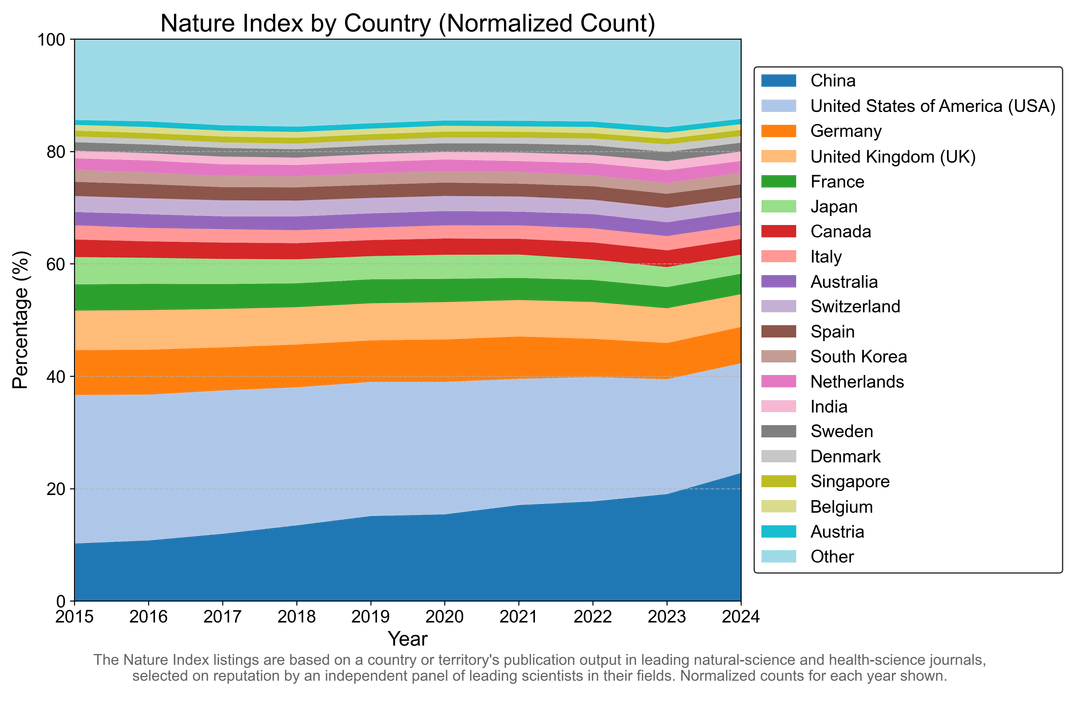
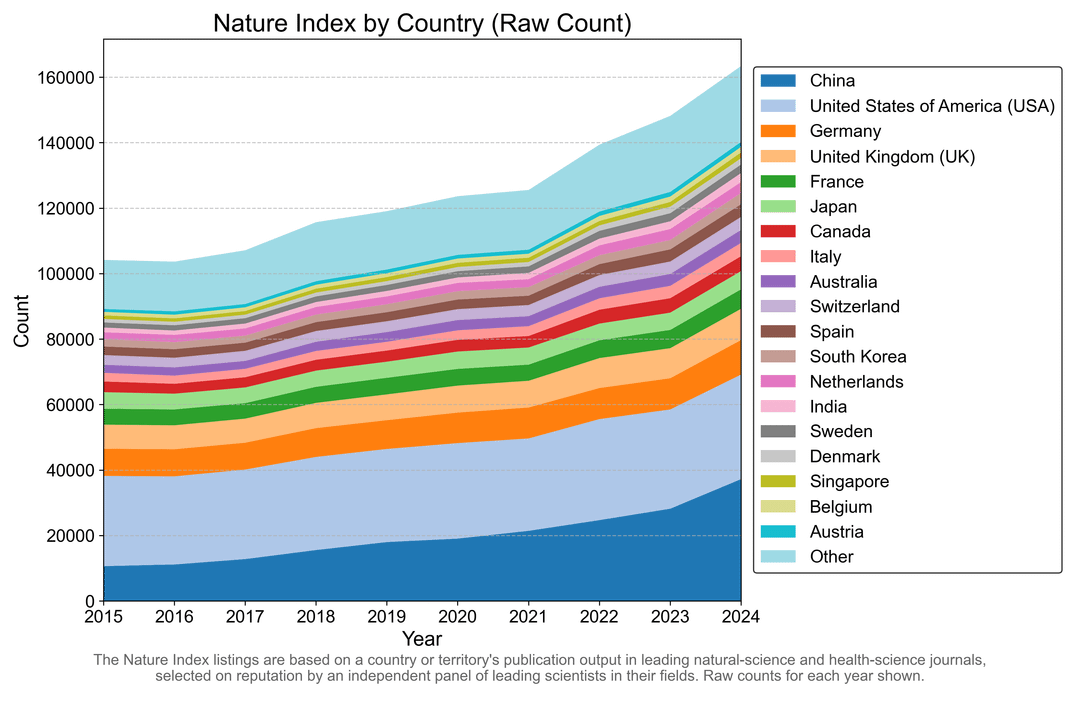
The Nature Index, established in late 2014, is a better metric of current productivity and better allocates “credit” to a specific country/territory or institution, usually only lagged by several years (most scientific projects take **at least** several years to complete and then **at least** another year to publish). Here are data since the Nature Index became available, both normalized and in terms of raw count.
3 comments
I made a [post earlier this morning](https://www.reddit.com/r/dataisbeautiful/comments/1ls4i46/oc_nobel_prizes_in_stem_by_country/) highlighting the number of Nobel Prizes in STEM by country. One of the most striking features, especially when looking at rolling 20-year trends, is that war-torn Europe and authoritarian Germany never recovered their scientific glory over three generations later, while the United States was a clear beneficiary of this brain drain.
Unfortunately, there are problems trying to extrapolate too much out of Nobel Prize data. For instance, many scientists credit multiple countries to their development. Additionally, Nobel Prizes are generally awarded decades after the achievement for which they are granted, so it is an extremely lagging indicator.
The Nature Index, established in late 2014, is a better metric of current productivity and better allocates “credit” to a specific country/territory or institution, usually only lagged by several years (most scientific projects take **at least** several years to complete and then **at least** another year to publish). Here are data since the Nature Index became available, both normalized and in terms of raw count.
Data obtained from [Springer Nature](https://www.nature.com/nature-index/research-leaders/2025/country/all/global). Graphs generated using Python Matplotlib.
I see the share of China increasing, but is the *quantity* of US *decreasing* (not share)?
Curious if modern decisions on US education outcomes has made an impact.
I find it interesting that the top 2 have never won a world soccer cup.
Less concussions=more scientific productivity? I’ll have to write a paper on that and help my country out a bit.
Comments are closed.