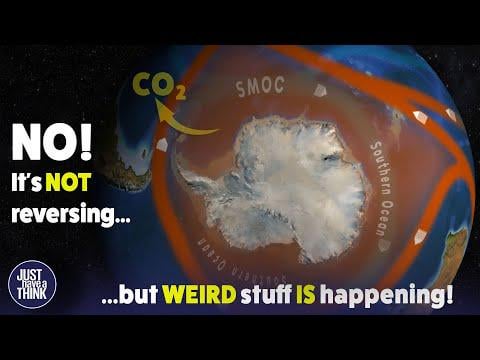
NO! The Antarctic Overturning Circulation is NOT REVERSING! The news is BAD enough without that!
by AlexFromOgish
NO! The Antarctic Overturning Circulation is NOT REVERSING! The news is BAD enough without that!
by AlexFromOgish
8 comments
From the video’s description (which I am copying from skeptical science)….
If you’ve seen dramatic headlines in recent days declaring that the Southern Ocean’s overturning current has ‘CATASTROPHICALLY’ reversed, well you can rest easy because that claim has turned out to be a completely spurious interpretation of an otherwise very good (and plenty worrying enough) scientific research paper. Today we look at the paper and investigate how and why it all got blown up on the socials.
– Dave Borlace, Just have a Think! on Youtube, July 13, 2025
This is why people don’t trust climate science. [Even the headline from one of the institutions involved used the term “reversal” originally](https://archive.is/https://www.icm.csic.es/en/news/major-reversal-ocean-circulation-detected-southern-ocean-key-climate-implications). Then advocates like us share the news and try to stress the importance of action — only to find out later what we were sharing wasn’t accurate. I’m tired.
Folks…. the PRESS RELEASE, after translation, use the word “reversed”
The PAPER (always check the original paper when you see a dramatic article in the press)…. the PAPER did not.
PEOPLE SHOULD TRUST SCIENCE but the same people should do critical thinking when reading other people’s representations of science in popular media
I saw your video last night and thank you for bringing some clarity to the issue. Much obliged.
“Read the paper” is NOT a solution to poor climate science reporting. Most studies are not worded in a way for a layman to fully understand. Furthermore, this specific study does literally say multiple times that conditions related to SMOC have reversed. So, if we send laymen to “check” the original study, they will find information that seemingly confirms the headline.
It’s a really unfortunate situation. And honestly, most folks won’t give this a second thought after the original reporting. And sadly, the net-effect for many is increasing mistrust in climate science. At the very worst, it confirms the false bias that climate scientists are always saying the sky is falling.
Frankly, it makes me feel like a tool. I shared this study when it came out because it was alarming and it highlighted the need to take urgent climate action, especially in the midst of all of these extreme weather events.
What do you call the change in trajectory in the case it might not be reversal of SMOC but it is doing the opposite of what was happening before?
I asked ChatGPT about this paper.
The response was:
Silvano’s team used satellite SMOS data and Argo buoys to show that, south of ~50° S, surface salinity increased sharply starting in 2015 — exactly as Antarctic sea ice stalled its growth and retreated dramatically in both winter and summer.
I then asked ChatGPT:
*Silvano et al. (2025) and other researchers explain the unexpected salinification of the Southern Ocean since around 2015. There was also the loss of Antarctic sea ice. How much is the Albedo change impacting the earth energy imbalance? Is it 1% or more?*
ChatGPT response:
Thought for 20 seconds
The direct radiative forcing from Antarctic sea‑ice loss isn’t tiny—it’s on the order of 0.08–0.12 W/m² of positive forcing attributable just to the change in surface albedo south of ~50° S. To put that in context:
* Earth’s current energy imbalance (EEI)—the net downward flux at the top of atmosphere—is roughly 0.65–0.90 W/m² (CERES satellite record, 2006–2018 average ~0.79 W/m², 2011–2023 average ~0.96 W/m²) WikipediaScienceAlert.
* If Antarctic sea‑ice retreat contributes ~0.08–0.12 W/m², that alone is ≈10–15 % of today’s total EEI—an order of magnitude larger than 1 %.
RFK Jr. told us not to trust the experts, and he would know because he’s an expert. Therefore, I don’t trust him, but I do trust the experts.
Lol thanks for the clarification. We need to find a better way to bridge the gap in communication between scientists and laypeople. The current “reversing” might just be the best concept for people to quickly and easily pick up on the severity of the situation, despite not being the technically correct term.
Comments are closed.